
Développer ou acheter : surmonter la complexité de la vérification par OTP
Un guide pratique des systèmes de vérification par OTP. Comparez les approches de développement interne et d'achat, explorez la complexité des infrastructures, les coûts, les risques de fraude et ce dont les équipes ont besoin pour faire évoluer l'authentification de manière fiable.

Rowan Haddad
Responsable Contenu et SEO
Résumé
La mise en place de la vérification par OTP semble simple — il suffit d'envoyer un code à 6 chiffres — mais elle se transforme rapidement en un problème de systèmes distribués impliquant l'optimisation de la délivrabilité, la logique de tentative, la prévention de la fraude et la gestion des relations avec les opérateurs télécoms mondiaux. Si les outils d'IA facilitent l'écriture du code, ils n'éliminent pas pour autant la complexité de la mise en production, faisant du choix entre l'achat et le développement interne une décision bien plus subtile que ce que la plupart des équipes imaginent.
Créer ou acheter un logiciel est une décision à laquelle chaque équipe produit et ingénierie est confrontée, indépendamment de la taille ou du stade de développement de l'entreprise. Lorsqu'il s'agit d'authentification, et plus particulièrement de la vérification par OTP, ce choix devient encore plus critique.
Avec les outils d'IA qui accélèrent le développement, la barrière à la création de logiciels n'a jamais été aussi basse, les équipes assemblant des systèmes plus rapidement que jamais. Cependant, bien que l'IA facilite l'écriture de code, elle n'élimine pas la complexité liée à l'exploitation de systèmes en production, en particulier pour ceux qui exigent une haute fiabilité, une sécurité renforcée et des performances mondiales.
À première vue, concevoir un système OTP semble assez simple. Pourtant, le choix que vous ferez concernant votre processus d'authentification aura non seulement des implications majeures en matière de sécurité, mais affectera également l'expérience utilisateur, la bande passante de vos ingénieurs et le coût à long terme de la maintenance du système.
Vous pourriez envisager de développer vos propres flux OTP, mais les équipes sous-estiment souvent la complexité que cela implique. Après tout, qu'y a-t-il de si complexe à envoyer un code à 6 chiffres ? En pratique, ce qui paraît simple se transforme rapidement en un problème de systèmes distribués, impliquant l'optimisation de la livraison des messages, la logique de tentative de renvoi, la prévention de la fraude et des contraintes d'infrastructure mondiale.
Les enjeux sont également exceptionnellement élevés, car les systèmes d'authentification gèrent de gros volumes de données personnelles et sensibles, ce qui en fait des cibles privilégiées pour les abus et les attaques. Cela peut entraîner des failles de sécurité, une perte de confiance des utilisateurs et des dommages durables sur la réputation de l'entreprise. Selon un rapport de CrowdStrike, les attaques basées sur l'IA ont bondi de 89 % au cours de la seule année écoulée, avec des temps d'intrusion moyens d'à peine 29 minutes, permettant aux attaquants de passer d'un accès initial à un impact réel plus rapidement que jamais.
Ce niveau de risque est aussi la raison pour laquelle la décision d'acheter ou de développer en interne est plus cruciale que jamais.
En règle générale, si cela ne fait pas partie de votre cœur de produit, il est préférable de reconsidérer l'option de le développer vous-même. En effet, pour la plupart des équipes, le véritable défi n'est pas d'implémenter l'OTP, mais de l'exploiter de manière fiable et à grande échelle.
Ce qu'un système de vérification OTP comprend réellement
À première vue, les flux SMS OTP semblent simples : un utilisateur demande l'accès à un système, reçoit un code OTP sur son appareil, le saisit et le voilà connecté. Le concept en lui-même est simple, mais son implémentation est bien plus complexe que ce que les équipes anticipent.
En réalité, cette interaction simple repose sur un système qui doit générer, acheminer de manière sécurisée et valider ces codes, souvent à travers différentes régions et réseaux.
La vérification OTP ne se limite pas à l'envoi d'un message. Ce qui se passe en coulisses, y compris la création, la livraison et la validation du code, est bien plus complexe. Le véritable défi est de réaliser cela de manière sécurisée et à grande échelle.
Composants clés d'un système de vérification OTP
Génération de l'OTP
Un système OTP commence par la génération de code, mais même cette étape est plus nuancée qu'il n'y paraît.
L'objectif ultime de tout système SMS OTP est de garantir que seul le bon utilisateur reçoive le code et que ce code :
Ne fonctionne qu'une seule fois
Expire dans un délai très court
Soit délivré correctement et rapidement, même lors des pics de trafic
Résiste aux attaques
Le système doit ensuite gérer l'intégralité de son cycle de vie, de sa génération à son expiration, en passant par sa période de validité.
Sans une gestion rigoureuse du cycle de vie, les systèmes peuvent devenir vulnérables aux attaques par rejeu ou offrir une mauvaise expérience utilisateur.
Stockage sécurisé
Une fois généré, le code doit être stocké de manière sécurisée pour éviter toute exposition, généralement par hachage ou chiffrement.
C'est d'autant plus critique que les systèmes d'authentification sont des cibles de choix pour les attaquants. Il est donc essentiel d'appliquer des règles de validation strictes lors de la vérification, car la moindre faiblesse dans la validation ou le stockage des codes peut être exploitée.
Routage SMS et optimisation de la livraison
La livraison introduit un autre niveau de complexité. Les performances varient considérablement selon les régions, les opérateurs et les choix de routage.
Garantir qu'un message atteigne un utilisateur rapidement et de manière fiable nécessite souvent une logique de routage dynamique, une connaissance des contraintes régionales et la capacité de s'adapter au comportement fluctuant des opérateurs.
Ce qui fonctionne bien dans un pays ou une région peut échouer de manière invisible dans un autre.
Logique de tentative de renvoi et de secours
Même avec un routage optimisé, une livraison réussie n'est jamais garantie. Les messages peuvent être retardés ou ne jamais arriver à destination, ce qui rend la logique de tentative de renvoi et de secours indispensable.
Un système bien conçu doit être capable de déterminer quand renvoyer un code sans submerger l'utilisateur, et comment gérer les cas intermédiaires, à savoir un OTP retardé qui arrive après l'envoi d'un nouveau code. Le système doit gérer efficacement les retards et les renvois, notamment en limitant le nombre de tentatives et en invalidant systématiquement les anciens OTP si un nouveau est renvoyé, afin de préserver la sécurité du processus d'authentification.
De plus, un système OTP robuste ne doit pas dépendre d'un seul chemin de livraison. Il doit disposer de mécanismes de secours automatisés capables de basculer vers un autre fournisseur ou un canal alternatif. Cela signifie que si une route principale est dégradée ou indisponible, le système doit rediriger les messages de manière fluide via un autre fournisseur ou basculer vers un autre canal.
Dans le cas contraire, les échecs de livraison deviennent des points de défaillance uniques, ce qui affecte directement les taux de réussite de connexion, la confiance des utilisateurs et, par conséquent, les taux de conversion.
Limitation du débit et prévention des abus
Parallèlement, les systèmes SMS OTP doivent continuellement se défendre contre un large éventail d'attaques. L'une des menaces courantes est le SMS pumping (ou pompage de SMS), où des attaquants génèrent de gros volumes de requêtes OTP vers des numéros surtaxés ou des régions spécifiques, faisant grimper les coûts de messagerie. En parallèle, on trouve les attaques par force brute où les attaquants testent à répétition différentes combinaisons de codes pour obtenir un accès non autorisé. Ce ne sont là que quelques-unes des nombreuses façons d'exploiter les points de terminaison OTP.
Comme ces attaques imitent souvent le trafic légitime, elles peuvent passer inaperçues jusqu'à ce que les coûts explosent, transformant ces systèmes en un véritable gouffre financier.
Contrer de tels risques nécessite des approches avancées, telles que la reconnaissance de formes, la détection d'anomalies et l'analyse comportementale pour distinguer l'activité légitime de l'activité malveillante.
À mesure que les méthodes d'attaque évoluent, ces protections nécessitent des ajustements continus, faisant de la lutte contre la fraude et les abus un effort constant de veille et d'adaptation.
Suivi et analyses
Il est important d'avoir une visibilité globale pour s'assurer que les messages sont livrés, déterminer s'il y a des retards et identifier où se produisent les échecs.
Un système OTP robuste doit vous permettre de suivre des indicateurs clés tels que les taux de livraison, la latence et les types d'échecs. Des tableaux de bord centralisés, associés à des alertes en temps réel, permettent aux équipes de détecter et de résoudre les problèmes avant qu'ils n'impactent les utilisateurs à grande échelle. Sans ce niveau de visibilité, les pannes passent inaperçues jusqu'à ce qu'elles affectent la confiance des utilisateurs ou la conversion.
Disposer d'une observabilité continue et en temps réel est le meilleur moyen d'optimiser les performances d'un système OTP.
Vérification rapide : ce qu'exige réellement un système OTP fiable
✔ Pouvons-nous générer, stocker et faire expirer les OTP de manière sécurisée et correcte ?
✔ Gérons-nous le cycle de vie des OTP (validation, invalidation, cas particuliers) ?
✔ Les messages sont-ils routés et optimisés pour une livraison internationale ?
✔ Disposons-nous d'une logique de tentative de renvoi et de secours en cas d'échec de livraison ?
✔ Avons-nous mis en place une limitation du débit et une prévention des abus ?
✔ Avons-nous une visibilité sur la livraison, la latence et les échecs ?
Quand il est judicieux de développer un système SMS OTP en interne
Après avoir examiné en détail ce à quoi ressemble réellement un système OTP, de nombreuses équipes peuvent décider que cela n'en vaut pas la peine. Cependant, il existe des scénarios spécifiques où le développement de votre propre système OTP peut être un choix justifié.
Vérification rapide : devez-vous développer votre solution OTP en interne ?
Disposons-nous d'une équipe d'infrastructure et de sécurité mature ?
Avons-nous besoin d'un contrôle total sur les données et la conformité ?
Opérons-nous à une échelle où l'optimisation est cruciale ?
L'OTP est-il au cœur de notre expérience produit ou de notre conversion ?
Sommes-nous prêts à maintenir et à faire évoluer ce système à long terme ?
Si vous avez répondu oui à la majorité de ces questions, vous êtes sur la bonne voie pour développer votre propre système. Voyons plus en détail ce que cela implique.
Vous disposez d'une équipe d'infrastructure et de sécurité mature
Comme nous l'avons vu, les systèmes OTP ne sont pas des fonctionnalités isolées. La vérification OTP peut sembler simple en surface, mais en pratique, elle repose sur une infrastructure qui doit être hautement disponible, distribuée mondialement et résiliente aux pannes.
Construire et exploiter ce type d'infrastructure mature nécessite des équipes expérimentées en systèmes distribués, en ingénierie de la fiabilité, en sécurité et en systèmes backend à grande échelle, ainsi que des équipes dédiées capables de surveiller la santé du système, de répondre aux incidents et d'optimiser continuellement les performances. Même de légères perturbations dans la livraison ou la latence peuvent impacter directement l'expérience utilisateur, faisant de la fiabilité une exigence fondamentale et non une option secondaire.
De plus, les systèmes OTP sont des cibles fréquentes de fraude et d'abus. Si vous choisissez de les développer en interne, cela signifie assumer l'entière responsabilité de la sécurité de tout le flux. Cela nécessite non seulement de mettre en place des protections, mais aussi de les faire évoluer en permanence à mesure que les techniques d'attaque changent.
Enfin, le travail sur les systèmes OTP ne s'arrête pas une fois le système construit. Il nécessite une maintenance, une surveillance et des itérations continues. Les organisations qui exploitent déjà des systèmes similaires, comme des plateformes de messagerie ou des services d'authentification, sont les mieux armées pour gérer cette complexité.
Vous avez besoin d'un contrôle total sur les données et la conformité
Le développement en interne est logique lorsque vous avez besoin d'un contrôle total sur les données et la conformité. C'est particulièrement vrai pour les organisations des secteurs financier, de la santé ou public, qui opèrent souvent sous des réglementations strictes concernant le stockage et l'utilisation des données.
Dans ces cas, s'appuyer sur des fournisseurs tiers peut introduire des risques ou des contraintes, surtout si ces fournisseurs ne peuvent garantir la manière et le lieu de traitement des données.
D'un côté, conserver la pleine propriété du flux d'authentification permet à ces organisations de respecter plus facilement leurs normes de sécurité internes, de réussir leurs audits de conformité et de s'aligner sur les cadres réglementaires.
D'un autre côté, ce niveau de contrôle s'accompagne d'une responsabilité accrue. Les équipes doivent s'assurer que leur implémentation respecte toutes les normes de sécurité et réglementations en vigueur, et que les systèmes sont continuellement mis à jour au fil de l'évolution des exigences. Cela demande un investissement continu, tant dans l'infrastructure que dans les processus.
Vous opérez à très grande échelle
L'échelle est un autre facteur important à prendre en compte lors du choix de développer votre propre système. Lorsqu'elles opèrent à grande échelle, en envoyant de gros volumes de requêtes OTP par jour, les organisations peuvent choisir de développer leur système en interne pour obtenir un meilleur contrôle sur l'acheminement des messages, en sélectionnant dynamiquement les fournisseurs en fonction des coûts, des performances ou de la fiabilité régionale.
Dans ce cas, les organisations peuvent tirer parti de négociations directes avec les opérateurs, de l'optimisation des stratégies de routage et de l'ajustement des performances d'une manière difficile à réaliser via des API standards.
Cependant, ces optimisations introduisent un nouveau niveau de complexité. Le routage dynamique nécessite une logique personnalisée et un ajustement constant. La gestion de plusieurs fournisseurs entraîne une surcharge administrative, des négociations de contrats et un suivi continu des prestataires. Ce qui commence par un effort de réduction des coûts peut rapidement se transformer en une charge opérationnelle, les équipes devant maintenir les systèmes de routage, surveiller les performances et résoudre les problèmes de livraison dans différentes régions.
De plus, les systèmes à grande échelle nécessitent une infrastructure plus sophistiquée, exigeant des systèmes de file d'attente robustes, des mécanismes de tentative de renvoi efficaces et la capacité de gérer des pics soudains de trafic sans dégradation des performances. Sans oublier que les produits opérant à l'échelle mondiale doivent tenir compte des différences régionales concernant les opérateurs, les réglementations et la fiabilité des réseaux, ce qui ajoute un niveau de complexité supplémentaire.
Opérer à ce niveau introduit de nouveaux défis car plus vous grandissez, plus vous intégrez d'éléments mobiles : fournisseurs multiples, logique de routage, surveillance des performances et gestion des coûts. Finalement, vous vous retrouvez avec un système complexe qui nécessite sa propre ingénierie et des ressources dédiées pour être maintenu à long terme, d'où l'importance de déterminer si les avantages de l'optimisation l'emportent sur les coûts à long terme de la possession et de la maintenance du système.
Pour les plus petites entreprises, le défi est légèrement différent. Il ne s'agit pas seulement de l'échelle actuelle, mais de l'anticiper. Ces entreprises doivent souvent concevoir des systèmes capables de grandir avec elles, mais sans disposer des mêmes ressources ou de la même expertise que les grandes structures pour concevoir à grande échelle. Par conséquent, les équipes sont contraintes de faire des compromis, soit en investissant tôt dans une infrastructure plus complexe que nécessaire à l'instant T, soit en commençant simplement au risque de rencontrer des limites lors de leur croissance.
L'OTP est un élément central de l'expérience de votre produit
Pour certains, l'OTP est le cœur même du produit plutôt qu'une fonctionnalité secondaire. Pour des applications telles que les places de marché ou les plateformes fintech, où l'authentification est fréquente et liée à des actions clés de l'utilisateur, l'OTP joue un rôle central, impactant directement l'expérience utilisateur et influençant ainsi les taux de conversion.
Dans ces cas, les équipes ont souvent besoin d'un niveau de contrôle plus élevé, allant de l'optimisation de la vitesse de livraison dans des régions spécifiques à la personnalisation des flux de vérification en fonction du comportement des utilisateurs et des signaux de risque, en passant par de petites améliorations comme l'augmentation des taux de réussite de livraison, qui ont toutes un impact direct sur l'engagement des utilisateurs et le chiffre d'affaires.
Par conséquent, le développement en interne est logique lorsque les équipes ont besoin de flexibilité pour optimiser et intégrer en profondeur la vérification dans leurs flux d'utilisateurs principaux.
En fin de compte, concevoir en interne se justifie si vous êtes prêt à traiter l'OTP comme une infrastructure plutôt que comme une fonctionnalité ponctuelle. Cela implique de s'engager pleinement dans une maintenance, un suivi et des itérations continues. Les équipes doivent être sur le pont, prêtes à répondre au moindre incident, à optimiser les performances et à investir dans la fiabilité à long terme.
Pour les organisations qui recherchent un contrôle total et de la flexibilité, le développement interne est généralement l'option privilégiée. Pour les autres, le défi ne réside pas seulement dans la mise en œuvre de l'OTP, mais aussi dans la viabilité et l'évolution du système au fil du temps.
Ce qui commence comme un simple système OTP se transforme souvent en un ensemble de composants interconnectés : plusieurs fournisseurs de SMS pour la couverture et la redondance, une logique de routage personnalisée pour optimiser la livraison, des outils distincts pour la prévention de la fraude et des tableaux de bord internes pour suivre les performances. Avec le temps, les équipes se retrouvent à gérer non pas un simple système, mais une pile fragmentée composée de multiples éléments mobiles.
Comprendre la nature d'un système fragmenté et la surcharge opérationnelle qui l'accompagne est essentiel pour évaluer le coût réel de la construction de votre propre infrastructure OTP.
La réalité de la construction de votre propre système OTP
Même lorsque la décision de développer en interne est justifiée, la réalité opérationnelle est plus complexe qu'il n'y paraît. Ce qui ressemble à une simple fonctionnalité d'authentification se transforme rapidement en un système fragmenté qui doit fonctionner de manière fiable dans le temps et sous pression.
Le fait est que les équipes sous-estiment souvent grandement la complexité d'un système OTP sous la surface, faisant du processus de conception et d'implémentation un défi plus important que prévu.
Voyons ce qu'il faut réellement pour construire votre propre système OTP à travers quelques questions que vous et votre équipe devriez vous poser :
Sommes-nous prêts à gérer la complexité des systèmes distribués ?
Pouvons-nous gérer la livraison mondiale de SMS à travers les régions et les opérateurs ?
Disposons-nous de systèmes pour détecter et prévenir la fraude ?
Pouvons-nous détecter et résoudre de manière fiable les échecs de livraison silencieux ?
Avons-nous les ressources pour la maintenance continue et la gestion des incidents ?
Complexité de l'infrastructure
Un système OTP est un problème de système distribué et fragmenté. Chaque demande de vérification doit être traitée en temps réel sous des contraintes de latence strictes tout en interagissant avec de multiples dépendances externes telles que les passerelles SMS, les bases de données et les services de secours.
Cela signifie que le système doit être conçu pour gérer les tentatives de renvoi, les expirations et les pannes partielles sans dupliquer les messages ni interrompre le parcours de l'utilisateur. Les systèmes OTP doivent également être capables de fonctionner de manière fiable dans des conditions imprévisibles, comme des pics de trafic soudains, sans dégradation de service.
La gestion des pannes est l'un des aspects les plus critiques de cette architecture. Les fournisseurs de SMS externes peuvent connaître des latences, des limitations de débit ou des pannes, et les services internes peuvent également faillir sous la charge. Le système doit être conçu pour gérer efficacement ces scénarios via des tentatives de renvoi, des délais d'attente et une logique de secours.
Un autre défi consiste à assurer la cohérence entre les processus asynchrones. Un OTP peut être généré, mis en file d'attente, partiellement livré, renvoyé ou retardé, arrivant parfois même dans le désordre par rapport à des codes plus récents. Le système doit garantir que seul le code valide le plus récent est accepté, tandis que les codes plus anciens sont correctement invalidés dans tous les états.
L'observabilité devient également essentielle à ce niveau. Le débogage des problèmes nécessite souvent de tracer une seule requête OTP à travers plusieurs services et fournisseurs externes, ce qui peut s'avérer difficile sans une journalisation et une surveillance unifiées.
Par conséquent, ces systèmes exigent une planification architecturale minutieuse, une compréhension approfondie des modes de défaillance et une supervision opérationnelle continue pour garantir des performances constantes à grande échelle.
Livraison internationale de SMS
La livraison de SMS à l'échelle mondiale est loin d'être uniforme. Elle dépend d'un écosystème fragmenté d'opérateurs, d'agrégateurs et de réglementations régionales, chacun ayant ses propres contraintes et caractéristiques de performance. Chaque pays a ses propres exigences en matière d'opérateurs, ses contraintes réglementaires et ses comportements de livraison qui ont un impact direct sur les taux de réussite de livraison.
Par exemple, le comportement des opérateurs varie considérablement d'une région à l'autre. La vitesse de livraison, la fiabilité et le débit peuvent différer selon le réseau local, les chemins de routage et même l'heure de la journée. Cela signifie que pour obtenir une livraison constante, il faut souvent sélectionner dynamiquement les fournisseurs ou les routes en fonction des performances régionales.
Par conséquent, les équipes doivent maintenir une logique de routage complexe qui détermine comment les messages sont livrés en fonction d'une combinaison de facteurs tels que la géographie, le coût et la performance. Dans de nombreux cas, cela implique d'établir des relations solides avec les opérateurs et de comprendre les spécificités régionales.
De plus, ces conditions ne sont pas statiques. Les performances des opérateurs fluctuent, les réglementations évoluent et l'efficacité du routage peut changer avec le temps. Assurer une livraison OTP fiable à travers les régions nécessite une optimisation, une surveillance et une adaptation continues aux contraintes locales.
Fraude et abus
Les systèmes OTP sont fréquemment la cible d'attaques, dont beaucoup imitent le trafic réel et les comportements d'utilisation légitimes. Parmi les exemples courants, citons le SMS pumping, où les attaquants génèrent de gros volumes de messages pour faire grimper les coûts, les attaques par robots qui saturent les points de terminaison de vérification, et les attaques par recyclage de numéros, où des numéros de téléphone précédemment utilisés sont exploités pour obtenir un accès non autorisé.
Détecter ces attaques n'est pas simple, ce qui fait de la fraude un défi permanent nécessitant des défenses multicouches, une surveillance continue et une adaptation à mesure que les techniques d'attaque évoluent.
Fiabilité : le problème des pannes silencieuses
On attend des systèmes OTP qu'ils soient hautement fiables, et pourtant, garantir une livraison constante à grande échelle s'avère difficile en pratique.
Comme nous l'avons vu, les taux de réussite de livraison varient en fonction de la région, du comportement de l'opérateur et de l'état du réseau. Il y a aussi le problème des messages envoyés avec succès mais qui arrivent en retard, dans le désordre ou pas du tout, créant d'importantes incohérences dans l'expérience utilisateur.
Cela signifie que les systèmes OTP ne doivent pas comporter de point de défaillance unique. Pour atténuer ce risque, les systèmes nécessitent souvent de la redondance, c'est-à-dire l'utilisation de plusieurs fournisseurs ou chemins de livraison pour s'assurer que les messages sont bien livrés si l'un d'eux échoue ou s'avère moins performant. Cependant, cela oblige les équipes à concevoir une logique non seulement pour détecter ces échecs, mais aussi pour changer de fournisseur en temps réel et s'assurer que les mécanismes de secours fonctionnent de manière fluide, sans risque de duplication des messages ni d'impact sur l'expérience utilisateur.
Ces défaillances sont le plus souvent silencieuses, les messages étant retardés ou abandonnés sans signaux d'erreur clairs. Sans une visibilité unifiée sur l'ensemble des fournisseurs et des régions, les équipes ont souvent du mal à diagnostiquer rapidement les problèmes, ce qui entraîne une dégradation de l'expérience utilisateur et une baisse des taux de conversion sans causes racines clairement identifiées.
Les pannes d'OTP les plus préjudiciables ne sont pas celles qui bloquent tout, mais celles que vous ne remarquez pas.
La maintenance ne s'arrête jamais
Avec des fournisseurs qui modifient leurs API, des comportements d'opérateurs qui varient selon les régions, des techniques de fraude qui évoluent et des exigences d'infrastructure qui augmentent avec le temps, les systèmes OTP doivent être surveillés et mis à jour en permanence pour s'adapter à ces changements et maintenir leurs performances et leur fiabilité.
De plus, face aux incidents qui surviennent constamment, la gestion des anomalies devient une responsabilité récurrente. Cela signifie que les équipes doivent être parfaitement préparées à répondre aux pannes de livraison, à enquêter sur les anomalies et à appliquer des correctifs dans des délais très serrés.
Au fil du temps, ce qui n'était qu'une simple fonctionnalité d'authentification se transforme rapidement en un système qui exige une attention dédiée et des ressources d'ingénierie à long terme.
Le coût réel de la construction d'une infrastructure OTP
Bien que l'approche du développement en interne puisse apporter de nombreux avantages, notamment un contrôle et une propriété totale de la solution, ainsi que des économies potentielles par rapport aux solutions tierces, les contreparties peuvent être significatives.
Les équipes doivent désormais consacrer beaucoup de temps et d'efforts non seulement à concevoir la solution, mais aussi à la maintenir à long terme, ce qui peut détourner leur attention de leur cœur de métier.
De plus, le fossé entre la mise en œuvre de l'OTP et son exploitation fiable à grande échelle est immense, et la nature complexe de ces systèmes n'affecte pas seulement l'ingénierie, mais génère également des coûts directs à long terme.
L'une des idées reçues les plus courantes concernant la création de systèmes OTP en interne est que le coût principal est technique, centré sur le prix des SMS et de l'infrastructure. Bien que ces considérations financières soient réelles et importantes, les coûts totaux dépassent largement la partie visible de l'iceberg.
Alors que les coûts directs sont relativement faciles à estimer, les coûts opérationnels cachés et récurrents sont souvent ceux qui rendent le développement interne nettement plus onéreux au fil du temps.
Coûts directs
À la base, les systèmes OTP entraînent des coûts directs et mesurables.
Le plus évident est le coût des SMS. Chaque OTP envoyé engendre un coût par message, qui varie selon la destination, l'opérateur et le canal de routage. À mesure que le volume d'OTP augmente, ces coûts peuvent rapidement devenir substantiels, en particulier dans les régions où les frais de messagerie sont élevés.
Il y a également les coûts liés au fonctionnement du système lui-même. Cela comprend les ressources de calcul, les bases de données pour stocker les OTP et les données de session, les systèmes de file d'attente pour gérer le trafic, et les outils de surveillance pour suivre les performances du système.
Cependant, ces frais ne représentent qu'une partie de l'investissement requis pour exploiter ces systèmes.
Coûts cachés
Temps d'ingénierie
Un système OTP nécessite une maintenance, une optimisation et un dépannage continus bien au-delà de sa mise en œuvre initiale. Cela inclut la définition de la logique de routage, l'amélioration des taux de livraison, la mise à jour des intégrations avec les fournisseurs et la résolution des problèmes de performance.
En raison de sa complexité, une infrastructure OTP devient un engagement d'ingénierie récurrent plutôt qu'un effort ponctuel.
Coût d'opportunité
Tout temps passé à concevoir et à maintenir des systèmes OTP est du temps qui n'est pas consacré au développement de votre cœur de produit.
Comme mentionné précédemment, les équipes doivent désormais consacrer un temps considérable à la maintenance du système et à la résolution d'incidents à tout moment. Pour les équipes pour lesquelles l'authentification n'est pas une fonctionnalité centrale et différenciante, le développement en interne prive les ressources d'ingénierie d'initiatives à plus fort impact, telles que l'innovation produit, les fonctionnalités de croissance ou l'amélioration de l'expérience utilisateur.
Ce compromis est souvent sous-estimé, alors que son impact est significatif, en particulier dans les organisations agiles où la vitesse de mise sur le marché est cruciale.
Résolution des incidents
Les systèmes OTP affectent directement l'accès des utilisateurs, ce qui signifie que toute défaillance peut avoir un impact immédiat (et négatif). Lorsque des problèmes surviennent, comme des pannes de livraison ou de fournisseur, les équipes doivent réagir rapidement pour minimiser l'interruption de service.
La réponse aux incidents nécessite généralement des efforts transversaux, incluant le débogage sur plusieurs systèmes et fournisseurs externes.
Par conséquent, ces situations sont urgentes, imprévisibles et nécessitent d'importantes ressources, ce qui alourdit encore la charge opérationnelle au fil du temps.
Achats et gestion des fournisseurs
Au-delà de la mise en œuvre technique, les équipes doivent également prendre en compte la responsabilité de la gestion des prestataires externes.
Cela comprend la recherche de fournisseurs de SMS, la négociation de contrats, le suivi des changements de tarifs et le maintien des relations dans différentes régions. Pour les équipes qui utilisent plusieurs fournisseurs afin de garantir couverture et redondance, cette charge de travail augmente considérablement.
Ces efforts d'achats et de gestion des prestataires sont rarement anticipés au départ, pourtant ils introduisent une complexité et des coûts continus qui évoluent proportionnellement au système.
Le coût réel d'un système OTP va bien au-delà du simple envoi de ce message. Il englobe tous les coûts liés à l'exploitation, à la maintenance et à la mise à jour du système dans le temps.
Développer vs Acheter : Tableau comparatif des coûts
Catégorie de coût | Développer en interne | Acheter (Fournisseur OTP) |
Coûts des SMS / d'usage | Tarification directe de l'opérateur ou de l'agrégateur (optimisable à grande échelle, mais exige des efforts) | Tarification à l'usage, généralement associée à l'optimisation de la livraison |
Infrastructure | Hébergement, bases de données, files d'attente, systèmes de surveillance | Inclus dans les tarifs du fournisseur |
Ingénierie initiale | Coût initial élevé pour concevoir, construire et intégrer le système | Faible — l'intégration de l'API prend généralement de quelques jours à quelques semaines |
Ingénierie continue | Maintenance, optimisation et mises à jour continues | Minimal — géré par le fournisseur |
Coût d'opportunité | Élevé — le temps des ingénieurs est détourné du cœur de produit | Faible — les équipes se concentrent sur le développement du produit |
Prévention de la fraude et des abus | Nécessite de concevoir et de maintenir des systèmes de détection | Souvent intégré ou partiellement pris en charge |
Ingénierie de la fiabilité | Responsabilité interne (basculement, tentatives de renvoi, surveillance) | Géré par le fournisseur (SLA, redondance) |
Gestion multi-fournisseur | Nécessaire pour la redondance et l'optimisation | Non requis (ou géré de manière transparente) |
Achats et négociation | Élevé — recherche de prestataires, contrats, négociations tarifaires | Aucun — relation avec un fournisseur unique |
Gestion des fournisseurs | Coordination continue avec de multiples fournisseurs | Minimale |
Conformité mondiale | Responsabilité interne (réglementations, IDs d'expéditeur, enregistrement) | Généralement géré ou guidé par le fournisseur |
Observabilité et analyses | Nécessite de créer des tableaux de bord, des alertes et des rapports | Souvent inclus d'office |
Gestion des incidents | Entièrement gérée en interne | Partagée ou gérée par le fournisseur |
Délai de mise sur le marché | Lent — plusieurs semaines à plusieurs mois | Rapide — quelques jours à quelques semaines |
Coûts d'évolutivité (Scalability) | Nécessite un investissement continu dans l'infrastructure et l'architecture | S'adapte automatiquement à l'usage |
Comment fonctionnent les API de vérification (et en quoi elles aident)
Compte tenu de la nature complexe des systèmes OTP, de nombreuses entreprises optent pour des API de vérification afin de simplifier l'implémentation et de se délester de la charge opérationnelle.
Les API de vérification permettent aux entreprises de valider les numéros de téléphone et/ou les adresses e-mail. Elles prennent en charge la gestion complète du cycle de vie de la vérification, de l'initialisation de la vérification à l'envoi des messages OTP et aux tentatives de renvoi, jusqu'à la vérification de la validité du code OTP et au retour du résultat.
En ce sens, plutôt que de concevoir et de maintenir l'intégralité du système, les équipes peuvent simplement s'intégrer à une API qui gère l'ensemble du travail difficile, y compris la génération, la livraison et la vérification des codes, sous forme de service managé.
De cette façon, les équipes n'ont pas à gérer d'infrastructure en effectuant des appels d'API, ce qui leur permet de réduire le temps et les efforts qui seraient autrement nécessaires pour lancer et exploiter des flux OTP.
Voici quelques-unes des façons dont les API peuvent aider à alléger cette charge :
Une implémentation plus rapide
La rapidité est sans doute l'un des plus grands avantages des API de vérification.
Avec les API de vérification, les équipes n'ont plus besoin de passer un temps considérable à concevoir un système OTP à partir de zéro. Elles peuvent s'intégrer à un fournisseur en quelques jours seulement. La plupart des API proposent des points de terminaison simples pour envoyer et vérifier les codes, ainsi que des SDK et une documentation claire qui simplifient le processus d'intégration et permettent de démarrer rapidement.
Cela permet aux équipes de se concentrer sur leurs fonctions clés et d'offrir une meilleure expérience utilisateur plutôt que de se soucier de l'infrastructure backend, accélérant ainsi le délai de mise sur le marché.
Routage SMS mondial
De nombreuses API de vérification prennent en charge la complexité de la livraison mondiale de SMS.
Les fournisseurs d'OTP entretiennent généralement des relations solides avec de multiples opérateurs et agrégateurs à travers les régions afin d'acheminer les messages efficacement selon leur destination, ce qui évite aux équipes de devoir naviguer dans le réseau complexe des réglementations télécoms internationales.
Cela permet de s'affranchir de la nature fragmentée de l'écosystème SMS, offrant une livraison plus constante et fiable sans nécessiter d'expertise interne.
Détection de la fraude intégrée
Les API de vérification avancées analysent les comportements et détectent les anomalies dans les processus de vérification, intégrant des mécanismes natifs pour se protéger contre la fraude et les abus.
Par exemple, l'API peut automatiquement signaler ou bloquer des numéros de téléphone suspects, des tentatives d'échec répétées ou des modèles de requêtes inhabituels.
En intégrant ces protections directement dans la plateforme, les fournisseurs d'OTP réduisent le risque d'abus sans que les équipes internes n'aient à concevoir leurs propres outils de détection de fraude.
Dans des cas plus avancés, ces systèmes peuvent distinguer les utilisateurs légitimes des comportements frauduleux en utilisant une combinaison de signaux tels que les modèles de requêtes, les caractéristiques des appareils et l'historique d'activité.
Étant donné la vitesse à laquelle les coûts liés à la fraude peuvent s'accumuler, disposer de mécanismes anti-fraude intégrés réduit considérablement les risques en permettant d'identifier et, souvent, de stopper les menaces potentielles avant même qu'elles ne surviennent.
Fiabilité et redondance
La fiabilité est généralement une caractéristique essentielle des systèmes conçus par les fournisseurs d'OTP.
Pour optimiser les taux de livraison, de nombreuses API utilisent plusieurs fournisseurs ou une stratégie de routage multiple, gérant automatiquement le basculement si un chemin de livraison s'avère moins performant. Cela permet de s'assurer que les messages sont toujours livrés avec succès, même si certains fournisseurs ou certaines routes rencontrent des difficultés.
Certaines API intègrent également une fonction de secours multicanal : si un canal échoue, comme le SMS, l'OTP peut toujours être envoyé par e-mail ou via WhatsApp.
Grâce à cela, les équipes bénéficient d'une plus grande fiabilité sans avoir à concevoir ou maintenir leur propre logique de secours.
Le problème de la pile de vérification fragmentée : les limites des API de vérification
Bien que les API de vérification réduisent la complexité, elles comportent tout de même leurs propres limites, en particulier lorsque les produits évoluent et que les exigences deviennent plus complexes.
Les API peuvent résoudre le problème initial, mais elles ne répondent pas pleinement aux besoins de contrôle, de visibilité et d'optimisation. Par conséquent, les équipes commencent à rencontrer des problèmes qui nécessitent des solutions de contournement supplémentaires ou des outils internes, ce qui complique d'autant plus les choses.
Dépendance vis-à-vis d'un fournisseur unique
La plupart des API de vérification fonctionnent comme une abstraction à fournisseur unique, ce qui signifie que les équipes dépendent des choix de routage, de la tarification et des performances régionales d'un seul prestataire. Cela limite la possibilité d'optimiser les chemins de livraison ou de basculer dynamiquement en fonction du coût.
Ce manque de contrôle devient d'autant plus flagrant lorsque le trafic augmente ou s'étend à l'international.
Visibilité limitée sur les performances de livraison
Les équipes disposent souvent d'une vue limitée sur l'état de livraison, avec peu de visibilité sur ce qui se passe après l'envoi du message.
Il est donc difficile d'identifier les problèmes liés aux retards, au filtrage des opérateurs ou à la dégradation des performances régionales. Sans ces informations détaillées, les équipes avancent à l'aveugle et s'appuient sur des données incomplètes pour tenter de résoudre efficacement les problèmes rencontrés par les utilisateurs.
Protection générique contre la fraude
Bien que de nombreuses API intègrent des fonctionnalités de détection de la fraude, ces systèmes sont généralement conçus pour des cas d'utilisation généraux ou courants.
En d'autres termes, ils peuvent ne pas détecter pleinement des attaques spécifiques à un produit ou à une région, ou des attaques plus sophistiquées, laissant ainsi des failles de sécurité. À mesure que les tactiques de fraude évoluent, en particulier à l'ère de l'IA, les équipes ont besoin de solutions plus avancées que ce que proposent les API standards.
Faible optimisation multirégionale
Bien que les API offrent une couverture mondiale, les performances de livraison ne sont pas réellement uniformes d'une région à l'autre.
Sans la possibilité d'ajuster précisément le routage ou de s'appuyer sur plusieurs fournisseurs, les équipes peuvent avoir du mal à obtenir des taux de livraison, une latence ou une rentabilité optimale sur certains marchés. Cela peut impacter les taux de réussite de livraison, la latence et les coûts, qui varient selon la géographie, le comportement de l'opérateur et les canaux de routage.
Il en résulte des performances irrégulières, où la vérification fonctionne parfaitement dans certaines régions mais échoue dans d'autres.
La pile de vérification fragmentée
Pour pallier ces lacunes, les équipes commencent à superposer des composants supplémentaires à leur intégration API initiale.
Ce qui commence par une configuration simple évolue progressivement vers une pile fragmentée comprenant :
plusieurs fournisseurs de SMS pour assurer couverture et redondance
une logique de routage interne pour optimiser la livraison et les coûts
des outils de prévention de la fraude distincts pour combler les failles de protection
des tableaux de bord personnalisés pour suivre les performances et les KPI
Ce qui visait initialement à économiser du coût, du temps et des ressources en s'appuyant sur un fournisseur externe finit par recréer bon nombre des défis liés au développement en interne.
Avec le temps, les équipes se retrouvent confrontées à l'exploitation d'un système tout aussi complexe à gérer que leur propre infrastructure interne, mais beaucoup plus fragmenté.
La simplicité initiale est finalement remplacée par une pile croissante d'outils interconnectés, résolvant chacun un problème spécifique mais ajoutant, au final, une nouvelle couche de complexité.
Ce dont les équipes ont réellement besoin (mais qu'elles obtiennent rarement)
À mesure que les exigences des entreprises évoluent et grandissent, leurs besoins concernant les systèmes OTP se précisent. En fin de compte, les équipes recherchent la fiabilité, le contrôle, la visibilité et la protection contre la fraude.
Bien que ces besoins soient légitimes, les satisfaire tous en même temps est un tout autre défi.
Ce dont les équipes ont réellement besoin
Pour exploiter les systèmes OTP de manière fiable et à grande échelle, les équipes ont besoin de :
Un support multi-fournisseur pour éviter les points de défaillance uniques
Un routage intelligent pour optimiser la livraison en fonction des coûts, de la région et des performances
Une protection anti-fraude intégrée qui s'adapte continuellement aux nouvelles vagues d'attaques
Une observabilité unifiée offrant une visibilité sur les taux de livraison et les échecs
Une couverture mondiale sans la contrainte de négocier et de gérer de multiples prestataires
Pourquoi est-ce si difficile à réaliser ? La réalité des compromis
La réalité est que ces fonctionnalités coexistent rarement au sein d'une seule et même solution. Les équipes doivent donc les assembler elles-mêmes : combiner les fournisseurs, concevoir la logique de routage, intégrer des outils anti-fraude et créer leurs propres tableaux de bord pour surveiller les incidents en temps réel.
Par conséquent, les équipes se retrouvent à gérer un système distribué de fournisseurs, d'outils et de logique interne.
À ce stade, elles sont contraintes de faire des choix difficiles et des compromis :
Privilégier la simplicité au détriment du contrôle
Privilégier le coût au détriment de la complexité
Privilégier la fiabilité au détriment d'une surcharge opérationnelle
La plupart des équipes finissent par trouver un juste milieu inconfortable : gérer un système partiellement optimisé mais de plus en plus fragmenté. Ce qui semblait être une décision simple (choisir un fournisseur de vérification) se transforme finalement en une tâche bien plus colossale.
Le défi n'est donc pas seulement d'implémenter la vérification OTP. Il s'agit de trouver un moyen de répondre à ces exigences sans introduire de fragmentation, de surcharge opérationnelle et de complexité à long terme.
Comparaison : Développer vs Acheter
Développer ou acheter, les deux approches partagent le même objectif final : identifier les utilisateurs de manière rapide et fiable. Cependant, elles diffèrent considérablement dans la manière dont ce résultat est obtenu et maintenu dans le temps.
Critère | Développer en interne | Acheter (API de vérification) |
Délai de lancement | Lent — nécessite de concevoir et de construire toute l'infrastructure du système | Rapide — intégration basée sur l'API en quelques jours ou semaines |
Complexité initiale | Élevée — génération d'OTP, routage, livraison, tentatives de renvoi et détection de fraude sont développés en interne | Faible — géré par le fournisseur |
Maintenance continue | Effort d'ingénierie continu requis | Maintenance minimale |
Contrôle sur le système | Contrôle total sur le routage, la logique et les données | Limité à l'abstraction proposée par le fournisseur |
Livraison internationale de SMS | Nécessite de gérer les opérateurs, la logique de routage et les contraintes régionales | Géré par le fournisseur |
Ingénierie de la fiabilité | Entièrement gérée en interne (basculements, redondance, réponse aux incidents) | Géré via les SLA et l'infrastructure du fournisseur |
Prévention de la fraude et des abus | Doit être conçu et continuellement mis à jour | Protections de base intégrées |
Observabilité | Nécessite de créer des tableaux de bord et des systèmes de surveillance | Généralement inclus d'office |
Évolutivité (Scalability) | Nécessite un investissement continu dans l'infrastructure | S'adapte automatiquement à l'usage |
Structure des coûts | Coûts d'infrastructure + ingénierie fixes et variables élevés | Tarification basée sur l'usage |
Dépendance fournisseur | Aucune, mais remplacée par la charge d'exploitation interne | Dépendance vis-à-vis d'un fournisseur unique |
Flexibilité | Très élevée — entièrement personnalisable | Modérée — limitée par les capacités de l'API |
Surcharge opérationnelle | Élevée — plusieurs systèmes et composants à gérer | Faible — centralisé via le fournisseur |
Questions à se poser avant de décider
Plutôt que de penser cela comme une décision binaire « développer vs acheter », il est utile d'évaluer votre niveau de préparation selon plusieurs dimensions clés.
Répondre à ces questions peut vous aider à déterminer si votre équipe doit développer sa solution en interne ou faire appel à un fournisseur de vérification.
Quiz de préparation : OTP Développer vs Acheter
Pour chaque question, choisissez l'option qui reflète le mieux votre situation actuelle.
1. À quel point l'OTP est-il critique pour l'expérience de votre produit principal ?
A. Il est au cœur des parcours utilisateurs et impacte directement la conversion ou le chiffre d'affaires
B. Il est important, mais principalement fonctionnel (ex. connexion, accès au compte)
C. C'est une fonctionnalité secondaire avec un faible impact sur la différenciation du produit
2. Comment décririez-vous vos capacités d'infrastructure actuelles ?
A. Nous exploitons déjà des systèmes distribués hautement disponibles et à grande échelle
B. Nous disposons de solides systèmes backend, mais d'une expérience limitée en infrastructures de livraison mondiales
C. Nous ne gérons pas d'infrastructure de ce niveau de complexité actuellement
3. Quelle est l'importance d'un contrôle total sur le routage, la livraison et la logique ?
A. Nous avons besoin d'un contrôle total et d'une personnalisation sur l'ensemble de la pile
B. Nous avons besoin d'un peu de flexibilité mais pouvons accepter des abstractions
C. Nous préférons ne pas gérer les décisions liées à l'infrastructure
4. Quelle est l'importance de la régularité de la livraison mondiale dans toutes les régions ?
A. Critique — nous opérons à l'international et avons besoin de performances optimisées par région
B. Important, mais des variations occasionnelles sont acceptables
C. Ce n'est pas une préoccupation majeure pour notre cas d'utilisation
5. Avez-vous la capacité d'assumer une complexité opérationnelle continue ?
A. Oui — nous pouvons assurer une surveillance, une maintenance et une optimisation continues
B. Partiellement — mais nous préférerions minimiser la charge opérationnelle
C. Non — nous avons besoin d'une solution clé en main
6. À quel point êtes-vous à l'aise avec la gestion de multiples fournisseurs et systèmes ?
A. Nous gérons déjà plusieurs prestataires et pouvons tout à fait en ajouter d'autres
B. Nous préférons limiter au maximum la complexité liée aux fournisseurs
C. Nous voulons une solution unique et intégrée
Comment interpréter vos réponses
Majorité de A → Vous tirerez probablement profit de la construction en interne ou d'une personnalisation poussée de votre infrastructure
Majorité de B → Vous vous situez dans une zone hybride, où les API vous aident mais peuvent ne pas répondre pleinement à l'ensemble de vos besoins
Majorité de C → Une API de vérification ou une solution managée est sans doute la solution la plus adaptée
Quelle que soit votre situation actuelle, une chose devient évidente avec le temps : la vérification ne reste pas simple très longtemps, ce qui aboutit à un système fragmenté qui doit être activement supervisé et entretenu.
De la fragmentation à la fiabilité : la vérification de bout en bout sur une seule plateforme
À ce stade, une chose est sûre : la vérification OTP n'est pas une simple fonctionnalité, c'est un système qui exige une coordination entre plusieurs fournisseurs, une logique de routage, une protection contre la fraude et une observabilité fine.
Le véritable défi n'est donc pas d'envoyer des OTP, mais de faire fonctionner le système qui se trouve derrière.
Résoudre le problème de la fragmentation
La plupart des systèmes de vérification modernes adoptent une approche fondamentalement différente en évitant d'obliger les équipes à assembler et gérer de multiples composants fragmentés.
Au lieu de cela, ils proposent la vérification comme une couche unifiée, où le routage, la redondance, la protection contre la fraude et l'observabilité sont intégrés au sein d'un seul et même système.
L'objectif est non seulement de simplifier la mise en œuvre, mais aussi d'éliminer la charge opérationnelle inhérente à ces architectures.
La vérification de bout en bout, conçue pour les équipes sur une seule plateforme
À mesure que les équipes grandissent, des pannes auparavant silencieuses et des inefficacités cachées commencent à faire surface.
Les équipes se retrouvent à jongler entre plusieurs fournisseurs, à gérer la logique de routage, à mettre en œuvre la prévention de la fraude et à concevoir des tableaux de bord personnalisés pour la surveillance.
Ce qui devrait être simple se transforme en un système qui réclame une attention constante.
Prelude a été conçu précisément pour éliminer cette complexité.
Prelude remplace cette approche fragmentée par un système unique, qui prend en charge le routage, la fiabilité, la protection contre la fraude et l'observabilité.
Plutôt que d'assembler et de gérer tous ces composants séparément, les équipes peuvent désormais s'appuyer sur un système où tout fonctionne harmonieusement et de manière intégrée dès le départ.
Une infrastructure multi-fournisseur, sans la surcharge de travail
Prelude vous donne accès à de multiples fournisseurs de SMS dans le monde entier en s'associant à de nombreux acteurs pour garantir le taux de livraison le plus élevé possible au coût le plus bas, sans que vous ayez à les rechercher, les intégrer ou les gérer individuellement.
Cela signifie :
Pas de recherche de fournisseurs ni de gestion des achats
Pas de logique de routage personnalisée à concevoir ou à maintenir
Une redondance intégrée entre les fournisseurs
Ce qui prend habituellement des mois à construire est disponible immédiatement dès la mise en service.
Routage en temps réel et fiabilité
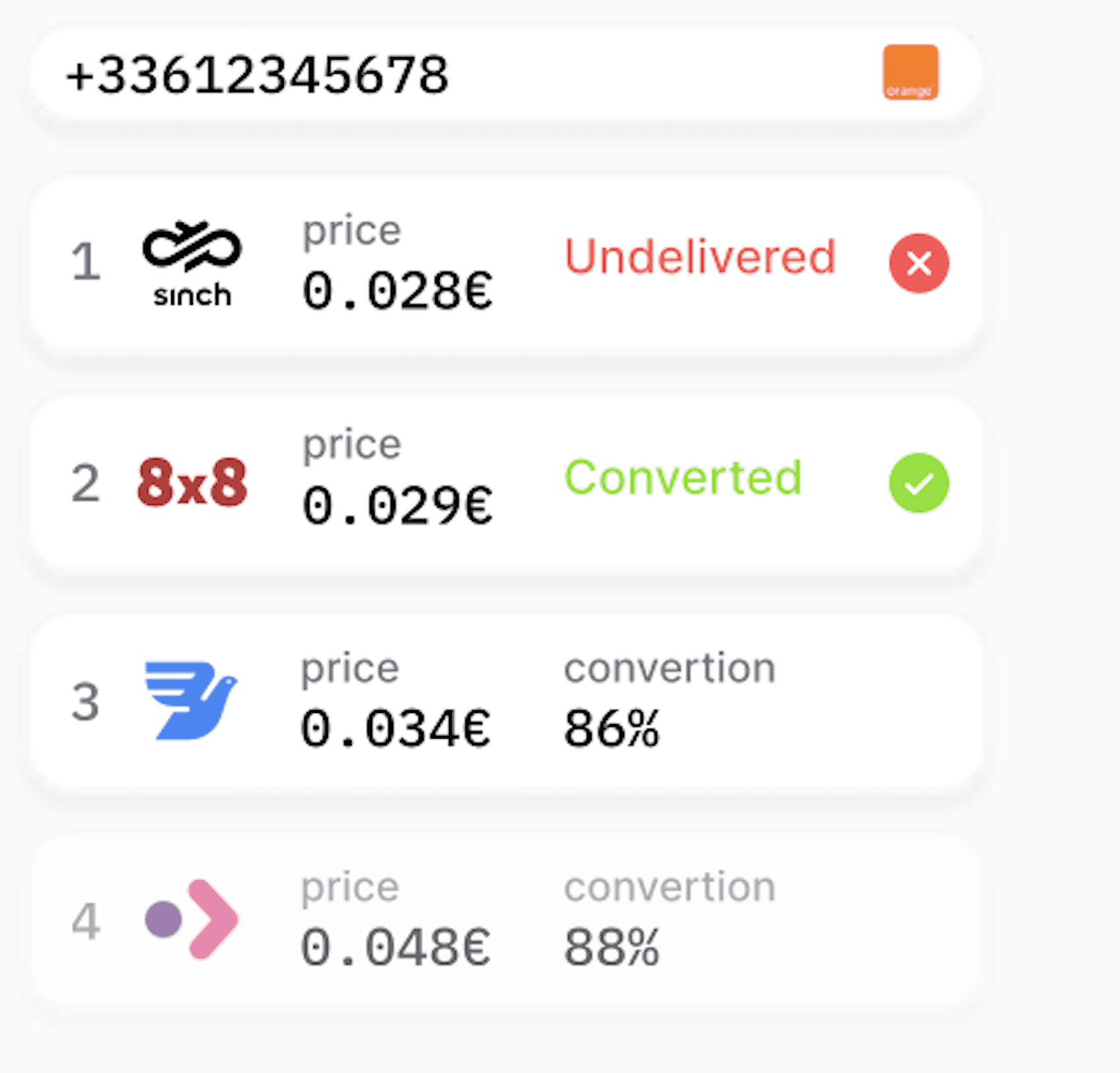
Prelude surveille en permanence les performances de livraison pour vous et achemine dynamiquement le trafic pour garantir des taux de réussite élevés.
Le routage est géré automatiquement grâce à notre moteur de routage qui compare toutes les voies disponibles et sélectionne la meilleure pour chaque utilisateur individuel.
Si un fournisseur s'avère moins performant ou subit une panne, le trafic est automatiquement redirigé sans aucun impact sur l'expérience utilisateur.
La mesure suprême : au-delà des taux de livraison
Bien que le suivi des taux de livraison des SMS soit une priorité, ce n'est pas le seul indicateur sur lequel vous devez vous concentrer.
La plupart des systèmes OTP se concentrent sur la première étape du processus d'authentification, mais négligent l'étape suivante, qui est tout aussi importante, voire plus.
Le véritable objectif doit être de mesurer la conversion. En d'autres termes, combien d'utilisateurs ayant reçu un OTP ont réellement effectué l'action souhaitée suite à la réception de ce SMS ?
La solution Verify API de Prelude donne la priorité au temps et à la conversion en dirigeant dynamiquement les utilisateurs vers le canal le moins cher et le plus susceptible de convertir.
Protection anti-fraude intégrée
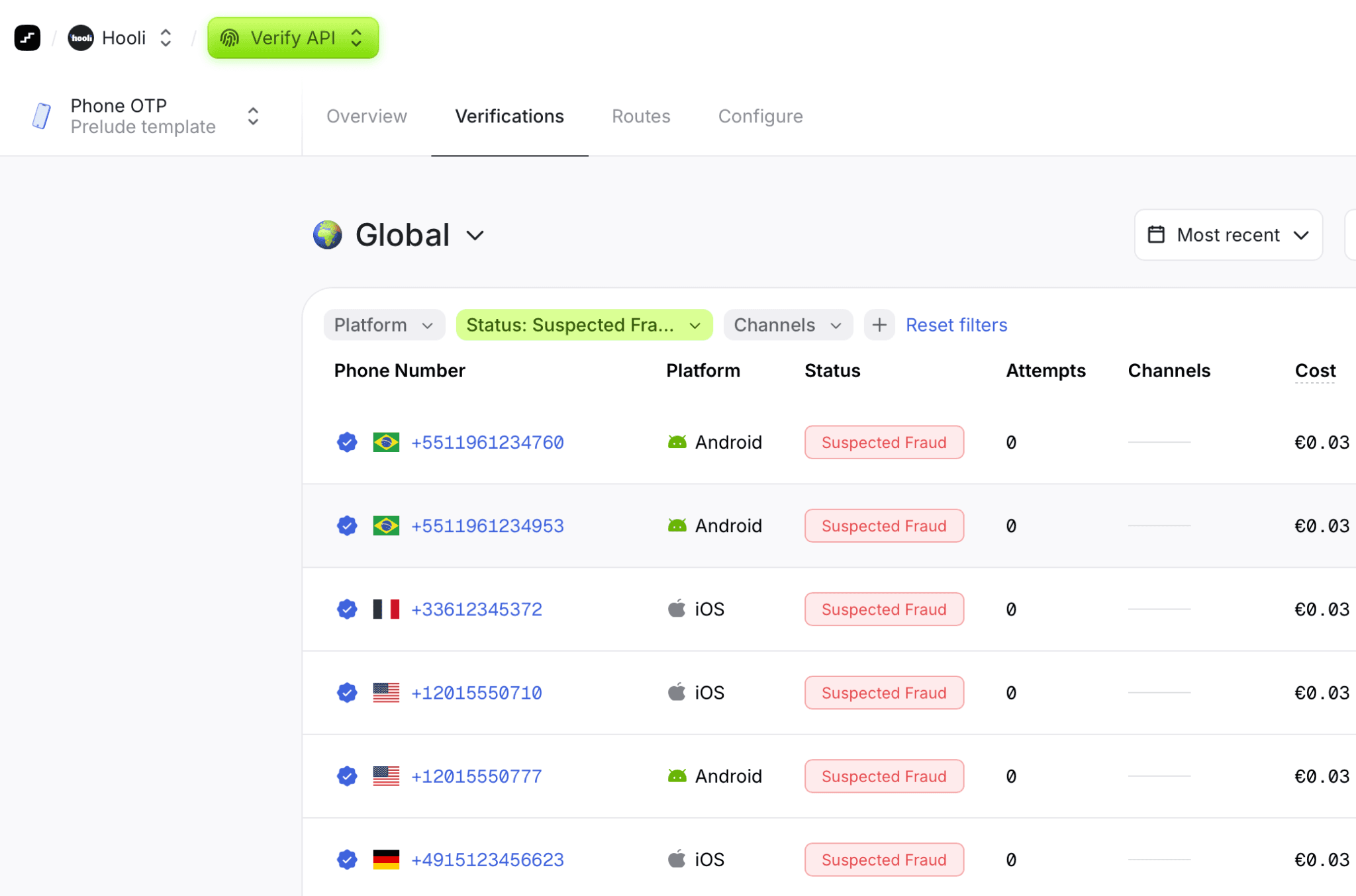
Alors que de nombreuses solutions proposent des fonctionnalités anti-fraude en option, la détection de la fraude est intégrée directement dans le flux de vérification de Prelude.
Notre solution détecte les comportements suspects en temps réel en s'appuyant sur des dizaines de signaux liés à chaque vérification et utilise les données de notre vaste base de données pour prédire si une requête est susceptible d'être frauduleuse.
Le système de Prelude apprend continuellement des nouveaux schémas de fraude afin de s'adapter aux nouveaux vecteurs d'attaque, tout en filtrant de manière granulaire les attaquants des utilisateurs réels sans avoir à bloquer tout un pays ou toute une plage réseau.
Aucune équipe ni intégration supplémentaire n'est requise.
Une visibilité unifiée sur l'ensemble de votre système
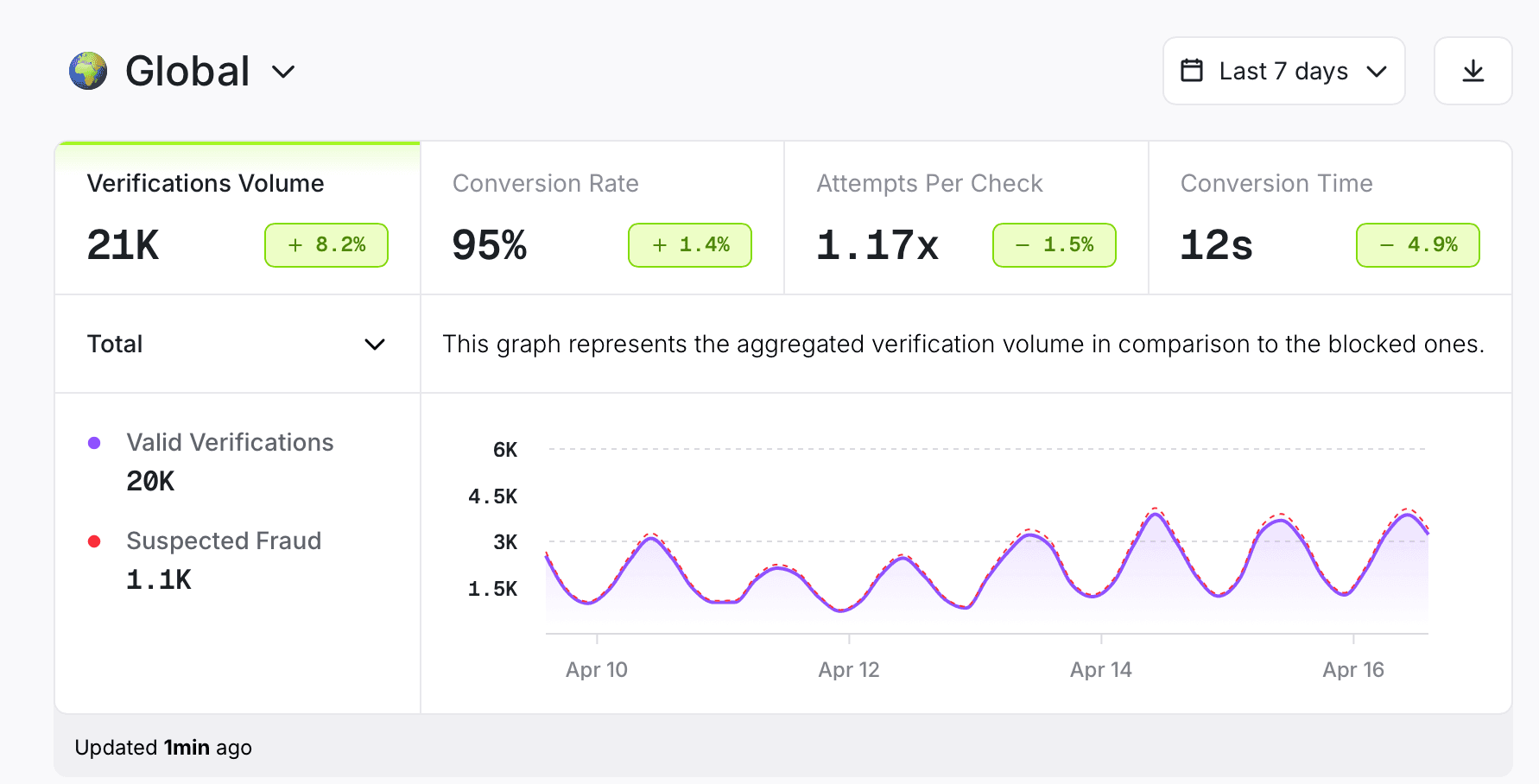
Prelude offre une visibilité totale, incluant des analyses et des alertes en temps réel sur votre système de vérification, le tout réuni en un seul endroit. Cela permet aux équipes de suivre les performances par région et par fournisseur, ainsi que de surveiller les taux de livraison afin de détecter rapidement les anomalies et d'optimiser les performances sans avoir à concevoir elles-mêmes un tableau de bord personnalisé.
Optimisation des coûts intégrée à l'authentification
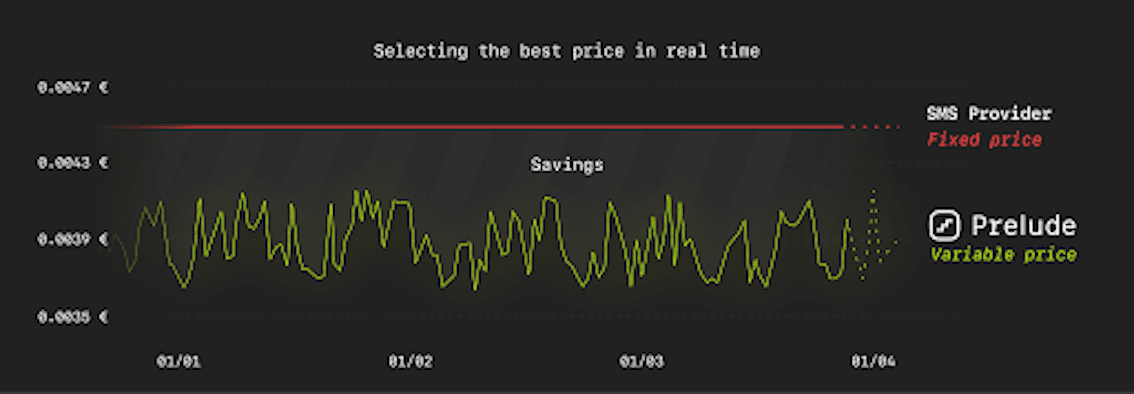
Les coûts des OTP grimpent rapidement en raison du prix élevé des SMS, du trafic frauduleux, d'un routage inefficace et de tentatives de renvoi répétées causées par une mauvaise délivrabilité.
En combinant un routage intelligent, une prévention de la fraude intégrée et des chemins de livraison optimisés, Prelude réduit le volume de messages inutiles et veille à ce que chaque OTP soit acheminé le plus efficacement possible. Dans les cas où le SMS n'est pas le canal le plus efficace, des méthodes de livraison alternatives peuvent être utilisées pour optimiser davantage les coûts et les performances.
Plutôt que de traiter le coût comme une simple conséquence, Prelude en fait un élément maîtrisable du système, offrant des économies immédiates et évolutives.
De la complexité à la fiabilité
Avec Prelude, les équipes n'ont plus à jongler entre plusieurs fournisseurs, à concevoir et maintenir des systèmes de routage, à intégrer des outils de fraude ou à créer des tableaux de bord de surveillance.
À la place, la vérification devient une infrastructure fiable, évolutive et gérée de manière intégrée.
Nous prenons en charge tout le travail fastidieux pour vous permettre d'obtenir :
Une mise sur le marché plus rapide en lançant votre service immédiatement sans concevoir d'infrastructure
Une fiabilité accrue grâce à la redondance intégrée et au routage intelligent
Une surcharge opérationnelle réduite puisqu'il n'y a pas de pile fragmentée à gérer
Une meilleure visibilité grâce à des indicateurs en temps réel sur l'ensemble du système
Une protection renforcée avec une prévention de la fraude intégrée par défaut
Conclusion
La vérification OTP ne doit pas nécessairement être un système fragmenté.
La clé réside dans le choix de la bonne approche, celle qui transforme la vérification en infrastructure afin que les équipes puissent se concentrer sur le développement de leur cœur de produit, et non sur la maintenance des systèmes sous-jacents.
La véritable question est celle de la propriété : souhaitez-vous concevoir et exploiter votre propre système tout en gérant les compromis associés, ou préférez-vous vous appuyer sur une infrastructure qui élimine totalement cette charge ?
En fin de compte, l'enjeu n'est pas de savoir à quel point vous pouvez mettre en œuvre la vérification rapidement, mais à quel point vous pouvez l'exploiter et la faire évoluer efficacement dans le temps.
Au bout du compte, envoyer des OTP est simple. Faire fonctionner le système qui se cache derrière ne l'est pas.
Prelude a été spécialement conçu pour éliminer cette contrainte en transformant la vérification en une infrastructure fiable et évolutive, afin que votre équipe puisse se concentrer sur le développement de votre produit principal. Réservez une démonstration dès aujourd'hui pour voir la solution en action.
FAQ
Qu'est-ce qu'un système de vérification OTP ?
Un système de vérification OTP (One-Time Password ou mot de passe à usage unique) est une méthode d'authentification utilisée pour vérifier l'identité d'un utilisateur en lui envoyant un code temporaire par SMS, e-mail ou via une application. Les systèmes OTP sont largement utilisés pour l'authentification de connexion, l'authentification multifacteur (2FA) et la sécurisation des comptes dans les applications modernes.
Pourquoi la construction d'un système OTP est-elle complexe ?
La création d'un système OTP est complexe car elle nécessite bien plus que le simple envoi d'un code. Elle implique une architecture de système distribué, une infrastructure de livraison de SMS, une logique de tentative de renvoi et de secours, la détection de la fraude, la limitation du débit et l'intégration d'opérateurs mondiaux. À grande échelle, les systèmes OTP doivent également gérer la latence, les pannes et les pics de trafic de manière fiable.
Quand devriez-vous développer un système OTP en interne ?
Vous devriez envisager de concevoir un système OTP en interne si vous disposez de solides compétences en infrastructure et en ingénierie de la sécurité, d'exigences de conformité strictes ou si l'authentification est un élément central de votre produit. Les équipes opérant à très grande échelle peuvent également tirer profit d'un développement interne pour obtenir un meilleur contrôle des performances et de l'optimisation.
Quels sont les risques liés au développement d'un système OTP en interne ?
Les principaux risques liés au développement d'un système OTP interne comprennent la grande complexité de l'infrastructure, la charge de maintenance continue, les failles de sécurité et l'exposition à la fraude. Les systèmes OTP nécessitent une surveillance et des mises à jour constantes, et les pannes peuvent impacter directement l'expérience utilisateur, les taux de réussite de connexion et la confiance.
Qu'est-ce que la fraude au SMS OTP ou SMS pumping ?
Le SMS pumping est un type de fraude par lequel des attaquants déclenchent de gros volumes de messages OTP pour générer des revenus ou exploiter les coûts de messagerie. Cela peut entraîner des pertes financières imprévues et une hausse des coûts d'infrastructure. Les systèmes SMS OTP sont également vulnérables aux attaques par robots et à l'exploitation du recyclage des numéros.
Comment fonctionnent les API de vérification OTP ?
Les API de vérification OTP simplifient l'authentification en fournissant une infrastructure prête à l'emploi pour l'envoi et la validation des codes OTP. Elles incluent généralement la livraison mondiale de SMS, une détection de base de la fraude et la gestion des tentatives de renvoi. Ces API permettent aux entreprises de mettre en œuvre rapidement l'authentification OTP sans avoir à concevoir d'infrastructure à partir de zéro.
Quelles sont les limites des API de vérification OTP ?
Les API de vérification OTP peuvent introduire des limites telles que la dépendance vis-à-vis d'un seul fournisseur, un contrôle restreint sur l'optimisation du routage et de la livraison, un manque d'observabilité approfondie et une protection générique contre la fraude. À grande échelle, ces contraintes peuvent impacter les performances, la rentabilité et la fiabilité.
Pourquoi les systèmes OTP se fragmentent-ils à grande échelle ?
Les systèmes OTP se fragmentent souvent lorsque les entreprises grandissent car ces dernières ajoutent plusieurs fournisseurs de SMS pour la redondance, conçoivent une logique de routage interne, intègrent des outils de détection de fraude distincts et créent des tableaux de bord personnalisés pour le suivi. Cela conduit à une pile de vérification distribuée et complexe, plus difficile à maintenir.
Quelle est la meilleure approche d'authentification OTP pour les entreprises en pleine croissance ?
Pour les entreprises en pleine croissance, la meilleure approche dépend de la maturité de leur infrastructure et des exigences de leur produit. De nombreuses équipes commencent par utiliser des API de vérification pour gagner en rapidité, mais au fur et à mesure de leur croissance, elles ont souvent besoin d'un meilleur contrôle, d'observabilité et de la fiabilité d'un environnement multi-fournisseur. Une infrastructure de vérification unifiée permet de réduire la complexité tout en préservant les performances globales et la sécurité.
Créer ou acheter un logiciel est une décision à laquelle chaque équipe produit et ingénierie est confrontée, indépendamment de la taille ou du stade de développement de l'entreprise. Lorsqu'il s'agit d'authentification, et plus particulièrement de la vérification par OTP, ce choix devient encore plus critique.
Avec les outils d'IA qui accélèrent le développement, la barrière à la création de logiciels n'a jamais été aussi basse, les équipes assemblant des systèmes plus rapidement que jamais. Cependant, bien que l'IA facilite l'écriture de code, elle n'élimine pas la complexité liée à l'exploitation de systèmes en production, en particulier pour ceux qui exigent une haute fiabilité, une sécurité renforcée et des performances mondiales.
À première vue, concevoir un système OTP semble assez simple. Pourtant, le choix que vous ferez concernant votre processus d'authentification aura non seulement des implications majeures en matière de sécurité, mais affectera également l'expérience utilisateur, la bande passante de vos ingénieurs et le coût à long terme de la maintenance du système.
Vous pourriez envisager de développer vos propres flux OTP, mais les équipes sous-estiment souvent la complexité que cela implique. Après tout, qu'y a-t-il de si complexe à envoyer un code à 6 chiffres ? En pratique, ce qui paraît simple se transforme rapidement en un problème de systèmes distribués, impliquant l'optimisation de la livraison des messages, la logique de tentative de renvoi, la prévention de la fraude et des contraintes d'infrastructure mondiale.
Les enjeux sont également exceptionnellement élevés, car les systèmes d'authentification gèrent de gros volumes de données personnelles et sensibles, ce qui en fait des cibles privilégiées pour les abus et les attaques. Cela peut entraîner des failles de sécurité, une perte de confiance des utilisateurs et des dommages durables sur la réputation de l'entreprise. Selon un rapport de CrowdStrike, les attaques basées sur l'IA ont bondi de 89 % au cours de la seule année écoulée, avec des temps d'intrusion moyens d'à peine 29 minutes, permettant aux attaquants de passer d'un accès initial à un impact réel plus rapidement que jamais.
Ce niveau de risque est aussi la raison pour laquelle la décision d'acheter ou de développer en interne est plus cruciale que jamais.
En règle générale, si cela ne fait pas partie de votre cœur de produit, il est préférable de reconsidérer l'option de le développer vous-même. En effet, pour la plupart des équipes, le véritable défi n'est pas d'implémenter l'OTP, mais de l'exploiter de manière fiable et à grande échelle.
Ce qu'un système de vérification OTP comprend réellement
À première vue, les flux SMS OTP semblent simples : un utilisateur demande l'accès à un système, reçoit un code OTP sur son appareil, le saisit et le voilà connecté. Le concept en lui-même est simple, mais son implémentation est bien plus complexe que ce que les équipes anticipent.
En réalité, cette interaction simple repose sur un système qui doit générer, acheminer de manière sécurisée et valider ces codes, souvent à travers différentes régions et réseaux.
La vérification OTP ne se limite pas à l'envoi d'un message. Ce qui se passe en coulisses, y compris la création, la livraison et la validation du code, est bien plus complexe. Le véritable défi est de réaliser cela de manière sécurisée et à grande échelle.
Composants clés d'un système de vérification OTP
Génération de l'OTP
Un système OTP commence par la génération de code, mais même cette étape est plus nuancée qu'il n'y paraît.
L'objectif ultime de tout système SMS OTP est de garantir que seul le bon utilisateur reçoive le code et que ce code :
Ne fonctionne qu'une seule fois
Expire dans un délai très court
Soit délivré correctement et rapidement, même lors des pics de trafic
Résiste aux attaques
Le système doit ensuite gérer l'intégralité de son cycle de vie, de sa génération à son expiration, en passant par sa période de validité.
Sans une gestion rigoureuse du cycle de vie, les systèmes peuvent devenir vulnérables aux attaques par rejeu ou offrir une mauvaise expérience utilisateur.
Stockage sécurisé
Une fois généré, le code doit être stocké de manière sécurisée pour éviter toute exposition, généralement par hachage ou chiffrement.
C'est d'autant plus critique que les systèmes d'authentification sont des cibles de choix pour les attaquants. Il est donc essentiel d'appliquer des règles de validation strictes lors de la vérification, car la moindre faiblesse dans la validation ou le stockage des codes peut être exploitée.
Routage SMS et optimisation de la livraison
La livraison introduit un autre niveau de complexité. Les performances varient considérablement selon les régions, les opérateurs et les choix de routage.
Garantir qu'un message atteigne un utilisateur rapidement et de manière fiable nécessite souvent une logique de routage dynamique, une connaissance des contraintes régionales et la capacité de s'adapter au comportement fluctuant des opérateurs.
Ce qui fonctionne bien dans un pays ou une région peut échouer de manière invisible dans un autre.
Logique de tentative de renvoi et de secours
Même avec un routage optimisé, une livraison réussie n'est jamais garantie. Les messages peuvent être retardés ou ne jamais arriver à destination, ce qui rend la logique de tentative de renvoi et de secours indispensable.
Un système bien conçu doit être capable de déterminer quand renvoyer un code sans submerger l'utilisateur, et comment gérer les cas intermédiaires, à savoir un OTP retardé qui arrive après l'envoi d'un nouveau code. Le système doit gérer efficacement les retards et les renvois, notamment en limitant le nombre de tentatives et en invalidant systématiquement les anciens OTP si un nouveau est renvoyé, afin de préserver la sécurité du processus d'authentification.
De plus, un système OTP robuste ne doit pas dépendre d'un seul chemin de livraison. Il doit disposer de mécanismes de secours automatisés capables de basculer vers un autre fournisseur ou un canal alternatif. Cela signifie que si une route principale est dégradée ou indisponible, le système doit rediriger les messages de manière fluide via un autre fournisseur ou basculer vers un autre canal.
Dans le cas contraire, les échecs de livraison deviennent des points de défaillance uniques, ce qui affecte directement les taux de réussite de connexion, la confiance des utilisateurs et, par conséquent, les taux de conversion.
Limitation du débit et prévention des abus
Parallèlement, les systèmes SMS OTP doivent continuellement se défendre contre un large éventail d'attaques. L'une des menaces courantes est le SMS pumping (ou pompage de SMS), où des attaquants génèrent de gros volumes de requêtes OTP vers des numéros surtaxés ou des régions spécifiques, faisant grimper les coûts de messagerie. En parallèle, on trouve les attaques par force brute où les attaquants testent à répétition différentes combinaisons de codes pour obtenir un accès non autorisé. Ce ne sont là que quelques-unes des nombreuses façons d'exploiter les points de terminaison OTP.
Comme ces attaques imitent souvent le trafic légitime, elles peuvent passer inaperçues jusqu'à ce que les coûts explosent, transformant ces systèmes en un véritable gouffre financier.
Contrer de tels risques nécessite des approches avancées, telles que la reconnaissance de formes, la détection d'anomalies et l'analyse comportementale pour distinguer l'activité légitime de l'activité malveillante.
À mesure que les méthodes d'attaque évoluent, ces protections nécessitent des ajustements continus, faisant de la lutte contre la fraude et les abus un effort constant de veille et d'adaptation.
Suivi et analyses
Il est important d'avoir une visibilité globale pour s'assurer que les messages sont livrés, déterminer s'il y a des retards et identifier où se produisent les échecs.
Un système OTP robuste doit vous permettre de suivre des indicateurs clés tels que les taux de livraison, la latence et les types d'échecs. Des tableaux de bord centralisés, associés à des alertes en temps réel, permettent aux équipes de détecter et de résoudre les problèmes avant qu'ils n'impactent les utilisateurs à grande échelle. Sans ce niveau de visibilité, les pannes passent inaperçues jusqu'à ce qu'elles affectent la confiance des utilisateurs ou la conversion.
Disposer d'une observabilité continue et en temps réel est le meilleur moyen d'optimiser les performances d'un système OTP.
Vérification rapide : ce qu'exige réellement un système OTP fiable
✔ Pouvons-nous générer, stocker et faire expirer les OTP de manière sécurisée et correcte ?
✔ Gérons-nous le cycle de vie des OTP (validation, invalidation, cas particuliers) ?
✔ Les messages sont-ils routés et optimisés pour une livraison internationale ?
✔ Disposons-nous d'une logique de tentative de renvoi et de secours en cas d'échec de livraison ?
✔ Avons-nous mis en place une limitation du débit et une prévention des abus ?
✔ Avons-nous une visibilité sur la livraison, la latence et les échecs ?
Quand il est judicieux de développer un système SMS OTP en interne
Après avoir examiné en détail ce à quoi ressemble réellement un système OTP, de nombreuses équipes peuvent décider que cela n'en vaut pas la peine. Cependant, il existe des scénarios spécifiques où le développement de votre propre système OTP peut être un choix justifié.
Vérification rapide : devez-vous développer votre solution OTP en interne ?
Disposons-nous d'une équipe d'infrastructure et de sécurité mature ?
Avons-nous besoin d'un contrôle total sur les données et la conformité ?
Opérons-nous à une échelle où l'optimisation est cruciale ?
L'OTP est-il au cœur de notre expérience produit ou de notre conversion ?
Sommes-nous prêts à maintenir et à faire évoluer ce système à long terme ?
Si vous avez répondu oui à la majorité de ces questions, vous êtes sur la bonne voie pour développer votre propre système. Voyons plus en détail ce que cela implique.
Vous disposez d'une équipe d'infrastructure et de sécurité mature
Comme nous l'avons vu, les systèmes OTP ne sont pas des fonctionnalités isolées. La vérification OTP peut sembler simple en surface, mais en pratique, elle repose sur une infrastructure qui doit être hautement disponible, distribuée mondialement et résiliente aux pannes.
Construire et exploiter ce type d'infrastructure mature nécessite des équipes expérimentées en systèmes distribués, en ingénierie de la fiabilité, en sécurité et en systèmes backend à grande échelle, ainsi que des équipes dédiées capables de surveiller la santé du système, de répondre aux incidents et d'optimiser continuellement les performances. Même de légères perturbations dans la livraison ou la latence peuvent impacter directement l'expérience utilisateur, faisant de la fiabilité une exigence fondamentale et non une option secondaire.
De plus, les systèmes OTP sont des cibles fréquentes de fraude et d'abus. Si vous choisissez de les développer en interne, cela signifie assumer l'entière responsabilité de la sécurité de tout le flux. Cela nécessite non seulement de mettre en place des protections, mais aussi de les faire évoluer en permanence à mesure que les techniques d'attaque changent.
Enfin, le travail sur les systèmes OTP ne s'arrête pas une fois le système construit. Il nécessite une maintenance, une surveillance et des itérations continues. Les organisations qui exploitent déjà des systèmes similaires, comme des plateformes de messagerie ou des services d'authentification, sont les mieux armées pour gérer cette complexité.
Vous avez besoin d'un contrôle total sur les données et la conformité
Le développement en interne est logique lorsque vous avez besoin d'un contrôle total sur les données et la conformité. C'est particulièrement vrai pour les organisations des secteurs financier, de la santé ou public, qui opèrent souvent sous des réglementations strictes concernant le stockage et l'utilisation des données.
Dans ces cas, s'appuyer sur des fournisseurs tiers peut introduire des risques ou des contraintes, surtout si ces fournisseurs ne peuvent garantir la manière et le lieu de traitement des données.
D'un côté, conserver la pleine propriété du flux d'authentification permet à ces organisations de respecter plus facilement leurs normes de sécurité internes, de réussir leurs audits de conformité et de s'aligner sur les cadres réglementaires.
D'un autre côté, ce niveau de contrôle s'accompagne d'une responsabilité accrue. Les équipes doivent s'assurer que leur implémentation respecte toutes les normes de sécurité et réglementations en vigueur, et que les systèmes sont continuellement mis à jour au fil de l'évolution des exigences. Cela demande un investissement continu, tant dans l'infrastructure que dans les processus.
Vous opérez à très grande échelle
L'échelle est un autre facteur important à prendre en compte lors du choix de développer votre propre système. Lorsqu'elles opèrent à grande échelle, en envoyant de gros volumes de requêtes OTP par jour, les organisations peuvent choisir de développer leur système en interne pour obtenir un meilleur contrôle sur l'acheminement des messages, en sélectionnant dynamiquement les fournisseurs en fonction des coûts, des performances ou de la fiabilité régionale.
Dans ce cas, les organisations peuvent tirer parti de négociations directes avec les opérateurs, de l'optimisation des stratégies de routage et de l'ajustement des performances d'une manière difficile à réaliser via des API standards.
Cependant, ces optimisations introduisent un nouveau niveau de complexité. Le routage dynamique nécessite une logique personnalisée et un ajustement constant. La gestion de plusieurs fournisseurs entraîne une surcharge administrative, des négociations de contrats et un suivi continu des prestataires. Ce qui commence par un effort de réduction des coûts peut rapidement se transformer en une charge opérationnelle, les équipes devant maintenir les systèmes de routage, surveiller les performances et résoudre les problèmes de livraison dans différentes régions.
De plus, les systèmes à grande échelle nécessitent une infrastructure plus sophistiquée, exigeant des systèmes de file d'attente robustes, des mécanismes de tentative de renvoi efficaces et la capacité de gérer des pics soudains de trafic sans dégradation des performances. Sans oublier que les produits opérant à l'échelle mondiale doivent tenir compte des différences régionales concernant les opérateurs, les réglementations et la fiabilité des réseaux, ce qui ajoute un niveau de complexité supplémentaire.
Opérer à ce niveau introduit de nouveaux défis car plus vous grandissez, plus vous intégrez d'éléments mobiles : fournisseurs multiples, logique de routage, surveillance des performances et gestion des coûts. Finalement, vous vous retrouvez avec un système complexe qui nécessite sa propre ingénierie et des ressources dédiées pour être maintenu à long terme, d'où l'importance de déterminer si les avantages de l'optimisation l'emportent sur les coûts à long terme de la possession et de la maintenance du système.
Pour les plus petites entreprises, le défi est légèrement différent. Il ne s'agit pas seulement de l'échelle actuelle, mais de l'anticiper. Ces entreprises doivent souvent concevoir des systèmes capables de grandir avec elles, mais sans disposer des mêmes ressources ou de la même expertise que les grandes structures pour concevoir à grande échelle. Par conséquent, les équipes sont contraintes de faire des compromis, soit en investissant tôt dans une infrastructure plus complexe que nécessaire à l'instant T, soit en commençant simplement au risque de rencontrer des limites lors de leur croissance.
L'OTP est un élément central de l'expérience de votre produit
Pour certains, l'OTP est le cœur même du produit plutôt qu'une fonctionnalité secondaire. Pour des applications telles que les places de marché ou les plateformes fintech, où l'authentification est fréquente et liée à des actions clés de l'utilisateur, l'OTP joue un rôle central, impactant directement l'expérience utilisateur et influençant ainsi les taux de conversion.
Dans ces cas, les équipes ont souvent besoin d'un niveau de contrôle plus élevé, allant de l'optimisation de la vitesse de livraison dans des régions spécifiques à la personnalisation des flux de vérification en fonction du comportement des utilisateurs et des signaux de risque, en passant par de petites améliorations comme l'augmentation des taux de réussite de livraison, qui ont toutes un impact direct sur l'engagement des utilisateurs et le chiffre d'affaires.
Par conséquent, le développement en interne est logique lorsque les équipes ont besoin de flexibilité pour optimiser et intégrer en profondeur la vérification dans leurs flux d'utilisateurs principaux.
En fin de compte, concevoir en interne se justifie si vous êtes prêt à traiter l'OTP comme une infrastructure plutôt que comme une fonctionnalité ponctuelle. Cela implique de s'engager pleinement dans une maintenance, un suivi et des itérations continues. Les équipes doivent être sur le pont, prêtes à répondre au moindre incident, à optimiser les performances et à investir dans la fiabilité à long terme.
Pour les organisations qui recherchent un contrôle total et de la flexibilité, le développement interne est généralement l'option privilégiée. Pour les autres, le défi ne réside pas seulement dans la mise en œuvre de l'OTP, mais aussi dans la viabilité et l'évolution du système au fil du temps.
Ce qui commence comme un simple système OTP se transforme souvent en un ensemble de composants interconnectés : plusieurs fournisseurs de SMS pour la couverture et la redondance, une logique de routage personnalisée pour optimiser la livraison, des outils distincts pour la prévention de la fraude et des tableaux de bord internes pour suivre les performances. Avec le temps, les équipes se retrouvent à gérer non pas un simple système, mais une pile fragmentée composée de multiples éléments mobiles.
Comprendre la nature d'un système fragmenté et la surcharge opérationnelle qui l'accompagne est essentiel pour évaluer le coût réel de la construction de votre propre infrastructure OTP.
La réalité de la construction de votre propre système OTP
Même lorsque la décision de développer en interne est justifiée, la réalité opérationnelle est plus complexe qu'il n'y paraît. Ce qui ressemble à une simple fonctionnalité d'authentification se transforme rapidement en un système fragmenté qui doit fonctionner de manière fiable dans le temps et sous pression.
Le fait est que les équipes sous-estiment souvent grandement la complexité d'un système OTP sous la surface, faisant du processus de conception et d'implémentation un défi plus important que prévu.
Voyons ce qu'il faut réellement pour construire votre propre système OTP à travers quelques questions que vous et votre équipe devriez vous poser :
Sommes-nous prêts à gérer la complexité des systèmes distribués ?
Pouvons-nous gérer la livraison mondiale de SMS à travers les régions et les opérateurs ?
Disposons-nous de systèmes pour détecter et prévenir la fraude ?
Pouvons-nous détecter et résoudre de manière fiable les échecs de livraison silencieux ?
Avons-nous les ressources pour la maintenance continue et la gestion des incidents ?
Complexité de l'infrastructure
Un système OTP est un problème de système distribué et fragmenté. Chaque demande de vérification doit être traitée en temps réel sous des contraintes de latence strictes tout en interagissant avec de multiples dépendances externes telles que les passerelles SMS, les bases de données et les services de secours.
Cela signifie que le système doit être conçu pour gérer les tentatives de renvoi, les expirations et les pannes partielles sans dupliquer les messages ni interrompre le parcours de l'utilisateur. Les systèmes OTP doivent également être capables de fonctionner de manière fiable dans des conditions imprévisibles, comme des pics de trafic soudains, sans dégradation de service.
La gestion des pannes est l'un des aspects les plus critiques de cette architecture. Les fournisseurs de SMS externes peuvent connaître des latences, des limitations de débit ou des pannes, et les services internes peuvent également faillir sous la charge. Le système doit être conçu pour gérer efficacement ces scénarios via des tentatives de renvoi, des délais d'attente et une logique de secours.
Un autre défi consiste à assurer la cohérence entre les processus asynchrones. Un OTP peut être généré, mis en file d'attente, partiellement livré, renvoyé ou retardé, arrivant parfois même dans le désordre par rapport à des codes plus récents. Le système doit garantir que seul le code valide le plus récent est accepté, tandis que les codes plus anciens sont correctement invalidés dans tous les états.
L'observabilité devient également essentielle à ce niveau. Le débogage des problèmes nécessite souvent de tracer une seule requête OTP à travers plusieurs services et fournisseurs externes, ce qui peut s'avérer difficile sans une journalisation et une surveillance unifiées.
Par conséquent, ces systèmes exigent une planification architecturale minutieuse, une compréhension approfondie des modes de défaillance et une supervision opérationnelle continue pour garantir des performances constantes à grande échelle.
Livraison internationale de SMS
La livraison de SMS à l'échelle mondiale est loin d'être uniforme. Elle dépend d'un écosystème fragmenté d'opérateurs, d'agrégateurs et de réglementations régionales, chacun ayant ses propres contraintes et caractéristiques de performance. Chaque pays a ses propres exigences en matière d'opérateurs, ses contraintes réglementaires et ses comportements de livraison qui ont un impact direct sur les taux de réussite de livraison.
Par exemple, le comportement des opérateurs varie considérablement d'une région à l'autre. La vitesse de livraison, la fiabilité et le débit peuvent différer selon le réseau local, les chemins de routage et même l'heure de la journée. Cela signifie que pour obtenir une livraison constante, il faut souvent sélectionner dynamiquement les fournisseurs ou les routes en fonction des performances régionales.
Par conséquent, les équipes doivent maintenir une logique de routage complexe qui détermine comment les messages sont livrés en fonction d'une combinaison de facteurs tels que la géographie, le coût et la performance. Dans de nombreux cas, cela implique d'établir des relations solides avec les opérateurs et de comprendre les spécificités régionales.
De plus, ces conditions ne sont pas statiques. Les performances des opérateurs fluctuent, les réglementations évoluent et l'efficacité du routage peut changer avec le temps. Assurer une livraison OTP fiable à travers les régions nécessite une optimisation, une surveillance et une adaptation continues aux contraintes locales.
Fraude et abus
Les systèmes OTP sont fréquemment la cible d'attaques, dont beaucoup imitent le trafic réel et les comportements d'utilisation légitimes. Parmi les exemples courants, citons le SMS pumping, où les attaquants génèrent de gros volumes de messages pour faire grimper les coûts, les attaques par robots qui saturent les points de terminaison de vérification, et les attaques par recyclage de numéros, où des numéros de téléphone précédemment utilisés sont exploités pour obtenir un accès non autorisé.
Détecter ces attaques n'est pas simple, ce qui fait de la fraude un défi permanent nécessitant des défenses multicouches, une surveillance continue et une adaptation à mesure que les techniques d'attaque évoluent.
Fiabilité : le problème des pannes silencieuses
On attend des systèmes OTP qu'ils soient hautement fiables, et pourtant, garantir une livraison constante à grande échelle s'avère difficile en pratique.
Comme nous l'avons vu, les taux de réussite de livraison varient en fonction de la région, du comportement de l'opérateur et de l'état du réseau. Il y a aussi le problème des messages envoyés avec succès mais qui arrivent en retard, dans le désordre ou pas du tout, créant d'importantes incohérences dans l'expérience utilisateur.
Cela signifie que les systèmes OTP ne doivent pas comporter de point de défaillance unique. Pour atténuer ce risque, les systèmes nécessitent souvent de la redondance, c'est-à-dire l'utilisation de plusieurs fournisseurs ou chemins de livraison pour s'assurer que les messages sont bien livrés si l'un d'eux échoue ou s'avère moins performant. Cependant, cela oblige les équipes à concevoir une logique non seulement pour détecter ces échecs, mais aussi pour changer de fournisseur en temps réel et s'assurer que les mécanismes de secours fonctionnent de manière fluide, sans risque de duplication des messages ni d'impact sur l'expérience utilisateur.
Ces défaillances sont le plus souvent silencieuses, les messages étant retardés ou abandonnés sans signaux d'erreur clairs. Sans une visibilité unifiée sur l'ensemble des fournisseurs et des régions, les équipes ont souvent du mal à diagnostiquer rapidement les problèmes, ce qui entraîne une dégradation de l'expérience utilisateur et une baisse des taux de conversion sans causes racines clairement identifiées.
Les pannes d'OTP les plus préjudiciables ne sont pas celles qui bloquent tout, mais celles que vous ne remarquez pas.
La maintenance ne s'arrête jamais
Avec des fournisseurs qui modifient leurs API, des comportements d'opérateurs qui varient selon les régions, des techniques de fraude qui évoluent et des exigences d'infrastructure qui augmentent avec le temps, les systèmes OTP doivent être surveillés et mis à jour en permanence pour s'adapter à ces changements et maintenir leurs performances et leur fiabilité.
De plus, face aux incidents qui surviennent constamment, la gestion des anomalies devient une responsabilité récurrente. Cela signifie que les équipes doivent être parfaitement préparées à répondre aux pannes de livraison, à enquêter sur les anomalies et à appliquer des correctifs dans des délais très serrés.
Au fil du temps, ce qui n'était qu'une simple fonctionnalité d'authentification se transforme rapidement en un système qui exige une attention dédiée et des ressources d'ingénierie à long terme.
Le coût réel de la construction d'une infrastructure OTP
Bien que l'approche du développement en interne puisse apporter de nombreux avantages, notamment un contrôle et une propriété totale de la solution, ainsi que des économies potentielles par rapport aux solutions tierces, les contreparties peuvent être significatives.
Les équipes doivent désormais consacrer beaucoup de temps et d'efforts non seulement à concevoir la solution, mais aussi à la maintenir à long terme, ce qui peut détourner leur attention de leur cœur de métier.
De plus, le fossé entre la mise en œuvre de l'OTP et son exploitation fiable à grande échelle est immense, et la nature complexe de ces systèmes n'affecte pas seulement l'ingénierie, mais génère également des coûts directs à long terme.
L'une des idées reçues les plus courantes concernant la création de systèmes OTP en interne est que le coût principal est technique, centré sur le prix des SMS et de l'infrastructure. Bien que ces considérations financières soient réelles et importantes, les coûts totaux dépassent largement la partie visible de l'iceberg.
Alors que les coûts directs sont relativement faciles à estimer, les coûts opérationnels cachés et récurrents sont souvent ceux qui rendent le développement interne nettement plus onéreux au fil du temps.
Coûts directs
À la base, les systèmes OTP entraînent des coûts directs et mesurables.
Le plus évident est le coût des SMS. Chaque OTP envoyé engendre un coût par message, qui varie selon la destination, l'opérateur et le canal de routage. À mesure que le volume d'OTP augmente, ces coûts peuvent rapidement devenir substantiels, en particulier dans les régions où les frais de messagerie sont élevés.
Il y a également les coûts liés au fonctionnement du système lui-même. Cela comprend les ressources de calcul, les bases de données pour stocker les OTP et les données de session, les systèmes de file d'attente pour gérer le trafic, et les outils de surveillance pour suivre les performances du système.
Cependant, ces frais ne représentent qu'une partie de l'investissement requis pour exploiter ces systèmes.
Coûts cachés
Temps d'ingénierie
Un système OTP nécessite une maintenance, une optimisation et un dépannage continus bien au-delà de sa mise en œuvre initiale. Cela inclut la définition de la logique de routage, l'amélioration des taux de livraison, la mise à jour des intégrations avec les fournisseurs et la résolution des problèmes de performance.
En raison de sa complexité, une infrastructure OTP devient un engagement d'ingénierie récurrent plutôt qu'un effort ponctuel.
Coût d'opportunité
Tout temps passé à concevoir et à maintenir des systèmes OTP est du temps qui n'est pas consacré au développement de votre cœur de produit.
Comme mentionné précédemment, les équipes doivent désormais consacrer un temps considérable à la maintenance du système et à la résolution d'incidents à tout moment. Pour les équipes pour lesquelles l'authentification n'est pas une fonctionnalité centrale et différenciante, le développement en interne prive les ressources d'ingénierie d'initiatives à plus fort impact, telles que l'innovation produit, les fonctionnalités de croissance ou l'amélioration de l'expérience utilisateur.
Ce compromis est souvent sous-estimé, alors que son impact est significatif, en particulier dans les organisations agiles où la vitesse de mise sur le marché est cruciale.
Résolution des incidents
Les systèmes OTP affectent directement l'accès des utilisateurs, ce qui signifie que toute défaillance peut avoir un impact immédiat (et négatif). Lorsque des problèmes surviennent, comme des pannes de livraison ou de fournisseur, les équipes doivent réagir rapidement pour minimiser l'interruption de service.
La réponse aux incidents nécessite généralement des efforts transversaux, incluant le débogage sur plusieurs systèmes et fournisseurs externes.
Par conséquent, ces situations sont urgentes, imprévisibles et nécessitent d'importantes ressources, ce qui alourdit encore la charge opérationnelle au fil du temps.
Achats et gestion des fournisseurs
Au-delà de la mise en œuvre technique, les équipes doivent également prendre en compte la responsabilité de la gestion des prestataires externes.
Cela comprend la recherche de fournisseurs de SMS, la négociation de contrats, le suivi des changements de tarifs et le maintien des relations dans différentes régions. Pour les équipes qui utilisent plusieurs fournisseurs afin de garantir couverture et redondance, cette charge de travail augmente considérablement.
Ces efforts d'achats et de gestion des prestataires sont rarement anticipés au départ, pourtant ils introduisent une complexité et des coûts continus qui évoluent proportionnellement au système.
Le coût réel d'un système OTP va bien au-delà du simple envoi de ce message. Il englobe tous les coûts liés à l'exploitation, à la maintenance et à la mise à jour du système dans le temps.
Développer vs Acheter : Tableau comparatif des coûts
Catégorie de coût | Développer en interne | Acheter (Fournisseur OTP) |
Coûts des SMS / d'usage | Tarification directe de l'opérateur ou de l'agrégateur (optimisable à grande échelle, mais exige des efforts) | Tarification à l'usage, généralement associée à l'optimisation de la livraison |
Infrastructure | Hébergement, bases de données, files d'attente, systèmes de surveillance | Inclus dans les tarifs du fournisseur |
Ingénierie initiale | Coût initial élevé pour concevoir, construire et intégrer le système | Faible — l'intégration de l'API prend généralement de quelques jours à quelques semaines |
Ingénierie continue | Maintenance, optimisation et mises à jour continues | Minimal — géré par le fournisseur |
Coût d'opportunité | Élevé — le temps des ingénieurs est détourné du cœur de produit | Faible — les équipes se concentrent sur le développement du produit |
Prévention de la fraude et des abus | Nécessite de concevoir et de maintenir des systèmes de détection | Souvent intégré ou partiellement pris en charge |
Ingénierie de la fiabilité | Responsabilité interne (basculement, tentatives de renvoi, surveillance) | Géré par le fournisseur (SLA, redondance) |
Gestion multi-fournisseur | Nécessaire pour la redondance et l'optimisation | Non requis (ou géré de manière transparente) |
Achats et négociation | Élevé — recherche de prestataires, contrats, négociations tarifaires | Aucun — relation avec un fournisseur unique |
Gestion des fournisseurs | Coordination continue avec de multiples fournisseurs | Minimale |
Conformité mondiale | Responsabilité interne (réglementations, IDs d'expéditeur, enregistrement) | Généralement géré ou guidé par le fournisseur |
Observabilité et analyses | Nécessite de créer des tableaux de bord, des alertes et des rapports | Souvent inclus d'office |
Gestion des incidents | Entièrement gérée en interne | Partagée ou gérée par le fournisseur |
Délai de mise sur le marché | Lent — plusieurs semaines à plusieurs mois | Rapide — quelques jours à quelques semaines |
Coûts d'évolutivité (Scalability) | Nécessite un investissement continu dans l'infrastructure et l'architecture | S'adapte automatiquement à l'usage |
Comment fonctionnent les API de vérification (et en quoi elles aident)
Compte tenu de la nature complexe des systèmes OTP, de nombreuses entreprises optent pour des API de vérification afin de simplifier l'implémentation et de se délester de la charge opérationnelle.
Les API de vérification permettent aux entreprises de valider les numéros de téléphone et/ou les adresses e-mail. Elles prennent en charge la gestion complète du cycle de vie de la vérification, de l'initialisation de la vérification à l'envoi des messages OTP et aux tentatives de renvoi, jusqu'à la vérification de la validité du code OTP et au retour du résultat.
En ce sens, plutôt que de concevoir et de maintenir l'intégralité du système, les équipes peuvent simplement s'intégrer à une API qui gère l'ensemble du travail difficile, y compris la génération, la livraison et la vérification des codes, sous forme de service managé.
De cette façon, les équipes n'ont pas à gérer d'infrastructure en effectuant des appels d'API, ce qui leur permet de réduire le temps et les efforts qui seraient autrement nécessaires pour lancer et exploiter des flux OTP.
Voici quelques-unes des façons dont les API peuvent aider à alléger cette charge :
Une implémentation plus rapide
La rapidité est sans doute l'un des plus grands avantages des API de vérification.
Avec les API de vérification, les équipes n'ont plus besoin de passer un temps considérable à concevoir un système OTP à partir de zéro. Elles peuvent s'intégrer à un fournisseur en quelques jours seulement. La plupart des API proposent des points de terminaison simples pour envoyer et vérifier les codes, ainsi que des SDK et une documentation claire qui simplifient le processus d'intégration et permettent de démarrer rapidement.
Cela permet aux équipes de se concentrer sur leurs fonctions clés et d'offrir une meilleure expérience utilisateur plutôt que de se soucier de l'infrastructure backend, accélérant ainsi le délai de mise sur le marché.
Routage SMS mondial
De nombreuses API de vérification prennent en charge la complexité de la livraison mondiale de SMS.
Les fournisseurs d'OTP entretiennent généralement des relations solides avec de multiples opérateurs et agrégateurs à travers les régions afin d'acheminer les messages efficacement selon leur destination, ce qui évite aux équipes de devoir naviguer dans le réseau complexe des réglementations télécoms internationales.
Cela permet de s'affranchir de la nature fragmentée de l'écosystème SMS, offrant une livraison plus constante et fiable sans nécessiter d'expertise interne.
Détection de la fraude intégrée
Les API de vérification avancées analysent les comportements et détectent les anomalies dans les processus de vérification, intégrant des mécanismes natifs pour se protéger contre la fraude et les abus.
Par exemple, l'API peut automatiquement signaler ou bloquer des numéros de téléphone suspects, des tentatives d'échec répétées ou des modèles de requêtes inhabituels.
En intégrant ces protections directement dans la plateforme, les fournisseurs d'OTP réduisent le risque d'abus sans que les équipes internes n'aient à concevoir leurs propres outils de détection de fraude.
Dans des cas plus avancés, ces systèmes peuvent distinguer les utilisateurs légitimes des comportements frauduleux en utilisant une combinaison de signaux tels que les modèles de requêtes, les caractéristiques des appareils et l'historique d'activité.
Étant donné la vitesse à laquelle les coûts liés à la fraude peuvent s'accumuler, disposer de mécanismes anti-fraude intégrés réduit considérablement les risques en permettant d'identifier et, souvent, de stopper les menaces potentielles avant même qu'elles ne surviennent.
Fiabilité et redondance
La fiabilité est généralement une caractéristique essentielle des systèmes conçus par les fournisseurs d'OTP.
Pour optimiser les taux de livraison, de nombreuses API utilisent plusieurs fournisseurs ou une stratégie de routage multiple, gérant automatiquement le basculement si un chemin de livraison s'avère moins performant. Cela permet de s'assurer que les messages sont toujours livrés avec succès, même si certains fournisseurs ou certaines routes rencontrent des difficultés.
Certaines API intègrent également une fonction de secours multicanal : si un canal échoue, comme le SMS, l'OTP peut toujours être envoyé par e-mail ou via WhatsApp.
Grâce à cela, les équipes bénéficient d'une plus grande fiabilité sans avoir à concevoir ou maintenir leur propre logique de secours.
Le problème de la pile de vérification fragmentée : les limites des API de vérification
Bien que les API de vérification réduisent la complexité, elles comportent tout de même leurs propres limites, en particulier lorsque les produits évoluent et que les exigences deviennent plus complexes.
Les API peuvent résoudre le problème initial, mais elles ne répondent pas pleinement aux besoins de contrôle, de visibilité et d'optimisation. Par conséquent, les équipes commencent à rencontrer des problèmes qui nécessitent des solutions de contournement supplémentaires ou des outils internes, ce qui complique d'autant plus les choses.
Dépendance vis-à-vis d'un fournisseur unique
La plupart des API de vérification fonctionnent comme une abstraction à fournisseur unique, ce qui signifie que les équipes dépendent des choix de routage, de la tarification et des performances régionales d'un seul prestataire. Cela limite la possibilité d'optimiser les chemins de livraison ou de basculer dynamiquement en fonction du coût.
Ce manque de contrôle devient d'autant plus flagrant lorsque le trafic augmente ou s'étend à l'international.
Visibilité limitée sur les performances de livraison
Les équipes disposent souvent d'une vue limitée sur l'état de livraison, avec peu de visibilité sur ce qui se passe après l'envoi du message.
Il est donc difficile d'identifier les problèmes liés aux retards, au filtrage des opérateurs ou à la dégradation des performances régionales. Sans ces informations détaillées, les équipes avancent à l'aveugle et s'appuient sur des données incomplètes pour tenter de résoudre efficacement les problèmes rencontrés par les utilisateurs.
Protection générique contre la fraude
Bien que de nombreuses API intègrent des fonctionnalités de détection de la fraude, ces systèmes sont généralement conçus pour des cas d'utilisation généraux ou courants.
En d'autres termes, ils peuvent ne pas détecter pleinement des attaques spécifiques à un produit ou à une région, ou des attaques plus sophistiquées, laissant ainsi des failles de sécurité. À mesure que les tactiques de fraude évoluent, en particulier à l'ère de l'IA, les équipes ont besoin de solutions plus avancées que ce que proposent les API standards.
Faible optimisation multirégionale
Bien que les API offrent une couverture mondiale, les performances de livraison ne sont pas réellement uniformes d'une région à l'autre.
Sans la possibilité d'ajuster précisément le routage ou de s'appuyer sur plusieurs fournisseurs, les équipes peuvent avoir du mal à obtenir des taux de livraison, une latence ou une rentabilité optimale sur certains marchés. Cela peut impacter les taux de réussite de livraison, la latence et les coûts, qui varient selon la géographie, le comportement de l'opérateur et les canaux de routage.
Il en résulte des performances irrégulières, où la vérification fonctionne parfaitement dans certaines régions mais échoue dans d'autres.
La pile de vérification fragmentée
Pour pallier ces lacunes, les équipes commencent à superposer des composants supplémentaires à leur intégration API initiale.
Ce qui commence par une configuration simple évolue progressivement vers une pile fragmentée comprenant :
plusieurs fournisseurs de SMS pour assurer couverture et redondance
une logique de routage interne pour optimiser la livraison et les coûts
des outils de prévention de la fraude distincts pour combler les failles de protection
des tableaux de bord personnalisés pour suivre les performances et les KPI
Ce qui visait initialement à économiser du coût, du temps et des ressources en s'appuyant sur un fournisseur externe finit par recréer bon nombre des défis liés au développement en interne.
Avec le temps, les équipes se retrouvent confrontées à l'exploitation d'un système tout aussi complexe à gérer que leur propre infrastructure interne, mais beaucoup plus fragmenté.
La simplicité initiale est finalement remplacée par une pile croissante d'outils interconnectés, résolvant chacun un problème spécifique mais ajoutant, au final, une nouvelle couche de complexité.
Ce dont les équipes ont réellement besoin (mais qu'elles obtiennent rarement)
À mesure que les exigences des entreprises évoluent et grandissent, leurs besoins concernant les systèmes OTP se précisent. En fin de compte, les équipes recherchent la fiabilité, le contrôle, la visibilité et la protection contre la fraude.
Bien que ces besoins soient légitimes, les satisfaire tous en même temps est un tout autre défi.
Ce dont les équipes ont réellement besoin
Pour exploiter les systèmes OTP de manière fiable et à grande échelle, les équipes ont besoin de :
Un support multi-fournisseur pour éviter les points de défaillance uniques
Un routage intelligent pour optimiser la livraison en fonction des coûts, de la région et des performances
Une protection anti-fraude intégrée qui s'adapte continuellement aux nouvelles vagues d'attaques
Une observabilité unifiée offrant une visibilité sur les taux de livraison et les échecs
Une couverture mondiale sans la contrainte de négocier et de gérer de multiples prestataires
Pourquoi est-ce si difficile à réaliser ? La réalité des compromis
La réalité est que ces fonctionnalités coexistent rarement au sein d'une seule et même solution. Les équipes doivent donc les assembler elles-mêmes : combiner les fournisseurs, concevoir la logique de routage, intégrer des outils anti-fraude et créer leurs propres tableaux de bord pour surveiller les incidents en temps réel.
Par conséquent, les équipes se retrouvent à gérer un système distribué de fournisseurs, d'outils et de logique interne.
À ce stade, elles sont contraintes de faire des choix difficiles et des compromis :
Privilégier la simplicité au détriment du contrôle
Privilégier le coût au détriment de la complexité
Privilégier la fiabilité au détriment d'une surcharge opérationnelle
La plupart des équipes finissent par trouver un juste milieu inconfortable : gérer un système partiellement optimisé mais de plus en plus fragmenté. Ce qui semblait être une décision simple (choisir un fournisseur de vérification) se transforme finalement en une tâche bien plus colossale.
Le défi n'est donc pas seulement d'implémenter la vérification OTP. Il s'agit de trouver un moyen de répondre à ces exigences sans introduire de fragmentation, de surcharge opérationnelle et de complexité à long terme.
Comparaison : Développer vs Acheter
Développer ou acheter, les deux approches partagent le même objectif final : identifier les utilisateurs de manière rapide et fiable. Cependant, elles diffèrent considérablement dans la manière dont ce résultat est obtenu et maintenu dans le temps.
Critère | Développer en interne | Acheter (API de vérification) |
Délai de lancement | Lent — nécessite de concevoir et de construire toute l'infrastructure du système | Rapide — intégration basée sur l'API en quelques jours ou semaines |
Complexité initiale | Élevée — génération d'OTP, routage, livraison, tentatives de renvoi et détection de fraude sont développés en interne | Faible — géré par le fournisseur |
Maintenance continue | Effort d'ingénierie continu requis | Maintenance minimale |
Contrôle sur le système | Contrôle total sur le routage, la logique et les données | Limité à l'abstraction proposée par le fournisseur |
Livraison internationale de SMS | Nécessite de gérer les opérateurs, la logique de routage et les contraintes régionales | Géré par le fournisseur |
Ingénierie de la fiabilité | Entièrement gérée en interne (basculements, redondance, réponse aux incidents) | Géré via les SLA et l'infrastructure du fournisseur |
Prévention de la fraude et des abus | Doit être conçu et continuellement mis à jour | Protections de base intégrées |
Observabilité | Nécessite de créer des tableaux de bord et des systèmes de surveillance | Généralement inclus d'office |
Évolutivité (Scalability) | Nécessite un investissement continu dans l'infrastructure | S'adapte automatiquement à l'usage |
Structure des coûts | Coûts d'infrastructure + ingénierie fixes et variables élevés | Tarification basée sur l'usage |
Dépendance fournisseur | Aucune, mais remplacée par la charge d'exploitation interne | Dépendance vis-à-vis d'un fournisseur unique |
Flexibilité | Très élevée — entièrement personnalisable | Modérée — limitée par les capacités de l'API |
Surcharge opérationnelle | Élevée — plusieurs systèmes et composants à gérer | Faible — centralisé via le fournisseur |
Questions à se poser avant de décider
Plutôt que de penser cela comme une décision binaire « développer vs acheter », il est utile d'évaluer votre niveau de préparation selon plusieurs dimensions clés.
Répondre à ces questions peut vous aider à déterminer si votre équipe doit développer sa solution en interne ou faire appel à un fournisseur de vérification.
Quiz de préparation : OTP Développer vs Acheter
Pour chaque question, choisissez l'option qui reflète le mieux votre situation actuelle.
1. À quel point l'OTP est-il critique pour l'expérience de votre produit principal ?
A. Il est au cœur des parcours utilisateurs et impacte directement la conversion ou le chiffre d'affaires
B. Il est important, mais principalement fonctionnel (ex. connexion, accès au compte)
C. C'est une fonctionnalité secondaire avec un faible impact sur la différenciation du produit
2. Comment décririez-vous vos capacités d'infrastructure actuelles ?
A. Nous exploitons déjà des systèmes distribués hautement disponibles et à grande échelle
B. Nous disposons de solides systèmes backend, mais d'une expérience limitée en infrastructures de livraison mondiales
C. Nous ne gérons pas d'infrastructure de ce niveau de complexité actuellement
3. Quelle est l'importance d'un contrôle total sur le routage, la livraison et la logique ?
A. Nous avons besoin d'un contrôle total et d'une personnalisation sur l'ensemble de la pile
B. Nous avons besoin d'un peu de flexibilité mais pouvons accepter des abstractions
C. Nous préférons ne pas gérer les décisions liées à l'infrastructure
4. Quelle est l'importance de la régularité de la livraison mondiale dans toutes les régions ?
A. Critique — nous opérons à l'international et avons besoin de performances optimisées par région
B. Important, mais des variations occasionnelles sont acceptables
C. Ce n'est pas une préoccupation majeure pour notre cas d'utilisation
5. Avez-vous la capacité d'assumer une complexité opérationnelle continue ?
A. Oui — nous pouvons assurer une surveillance, une maintenance et une optimisation continues
B. Partiellement — mais nous préférerions minimiser la charge opérationnelle
C. Non — nous avons besoin d'une solution clé en main
6. À quel point êtes-vous à l'aise avec la gestion de multiples fournisseurs et systèmes ?
A. Nous gérons déjà plusieurs prestataires et pouvons tout à fait en ajouter d'autres
B. Nous préférons limiter au maximum la complexité liée aux fournisseurs
C. Nous voulons une solution unique et intégrée
Comment interpréter vos réponses
Majorité de A → Vous tirerez probablement profit de la construction en interne ou d'une personnalisation poussée de votre infrastructure
Majorité de B → Vous vous situez dans une zone hybride, où les API vous aident mais peuvent ne pas répondre pleinement à l'ensemble de vos besoins
Majorité de C → Une API de vérification ou une solution managée est sans doute la solution la plus adaptée
Quelle que soit votre situation actuelle, une chose devient évidente avec le temps : la vérification ne reste pas simple très longtemps, ce qui aboutit à un système fragmenté qui doit être activement supervisé et entretenu.
De la fragmentation à la fiabilité : la vérification de bout en bout sur une seule plateforme
À ce stade, une chose est sûre : la vérification OTP n'est pas une simple fonctionnalité, c'est un système qui exige une coordination entre plusieurs fournisseurs, une logique de routage, une protection contre la fraude et une observabilité fine.
Le véritable défi n'est donc pas d'envoyer des OTP, mais de faire fonctionner le système qui se trouve derrière.
Résoudre le problème de la fragmentation
La plupart des systèmes de vérification modernes adoptent une approche fondamentalement différente en évitant d'obliger les équipes à assembler et gérer de multiples composants fragmentés.
Au lieu de cela, ils proposent la vérification comme une couche unifiée, où le routage, la redondance, la protection contre la fraude et l'observabilité sont intégrés au sein d'un seul et même système.
L'objectif est non seulement de simplifier la mise en œuvre, mais aussi d'éliminer la charge opérationnelle inhérente à ces architectures.
La vérification de bout en bout, conçue pour les équipes sur une seule plateforme
À mesure que les équipes grandissent, des pannes auparavant silencieuses et des inefficacités cachées commencent à faire surface.
Les équipes se retrouvent à jongler entre plusieurs fournisseurs, à gérer la logique de routage, à mettre en œuvre la prévention de la fraude et à concevoir des tableaux de bord personnalisés pour la surveillance.
Ce qui devrait être simple se transforme en un système qui réclame une attention constante.
Prelude a été conçu précisément pour éliminer cette complexité.
Prelude remplace cette approche fragmentée par un système unique, qui prend en charge le routage, la fiabilité, la protection contre la fraude et l'observabilité.
Plutôt que d'assembler et de gérer tous ces composants séparément, les équipes peuvent désormais s'appuyer sur un système où tout fonctionne harmonieusement et de manière intégrée dès le départ.
Une infrastructure multi-fournisseur, sans la surcharge de travail
Prelude vous donne accès à de multiples fournisseurs de SMS dans le monde entier en s'associant à de nombreux acteurs pour garantir le taux de livraison le plus élevé possible au coût le plus bas, sans que vous ayez à les rechercher, les intégrer ou les gérer individuellement.
Cela signifie :
Pas de recherche de fournisseurs ni de gestion des achats
Pas de logique de routage personnalisée à concevoir ou à maintenir
Une redondance intégrée entre les fournisseurs
Ce qui prend habituellement des mois à construire est disponible immédiatement dès la mise en service.
Routage en temps réel et fiabilité
Prelude surveille en permanence les performances de livraison pour vous et achemine dynamiquement le trafic pour garantir des taux de réussite élevés.
Le routage est géré automatiquement grâce à notre moteur de routage qui compare toutes les voies disponibles et sélectionne la meilleure pour chaque utilisateur individuel.
Si un fournisseur s'avère moins performant ou subit une panne, le trafic est automatiquement redirigé sans aucun impact sur l'expérience utilisateur.
La mesure suprême : au-delà des taux de livraison
Bien que le suivi des taux de livraison des SMS soit une priorité, ce n'est pas le seul indicateur sur lequel vous devez vous concentrer.
La plupart des systèmes OTP se concentrent sur la première étape du processus d'authentification, mais négligent l'étape suivante, qui est tout aussi importante, voire plus.
Le véritable objectif doit être de mesurer la conversion. En d'autres termes, combien d'utilisateurs ayant reçu un OTP ont réellement effectué l'action souhaitée suite à la réception de ce SMS ?
La solution Verify API de Prelude donne la priorité au temps et à la conversion en dirigeant dynamiquement les utilisateurs vers le canal le moins cher et le plus susceptible de convertir.
Protection anti-fraude intégrée
Alors que de nombreuses solutions proposent des fonctionnalités anti-fraude en option, la détection de la fraude est intégrée directement dans le flux de vérification de Prelude.
Notre solution détecte les comportements suspects en temps réel en s'appuyant sur des dizaines de signaux liés à chaque vérification et utilise les données de notre vaste base de données pour prédire si une requête est susceptible d'être frauduleuse.
Le système de Prelude apprend continuellement des nouveaux schémas de fraude afin de s'adapter aux nouveaux vecteurs d'attaque, tout en filtrant de manière granulaire les attaquants des utilisateurs réels sans avoir à bloquer tout un pays ou toute une plage réseau.
Aucune équipe ni intégration supplémentaire n'est requise.
Une visibilité unifiée sur l'ensemble de votre système
Prelude offre une visibilité totale, incluant des analyses et des alertes en temps réel sur votre système de vérification, le tout réuni en un seul endroit. Cela permet aux équipes de suivre les performances par région et par fournisseur, ainsi que de surveiller les taux de livraison afin de détecter rapidement les anomalies et d'optimiser les performances sans avoir à concevoir elles-mêmes un tableau de bord personnalisé.
Optimisation des coûts intégrée à l'authentification
Les coûts des OTP grimpent rapidement en raison du prix élevé des SMS, du trafic frauduleux, d'un routage inefficace et de tentatives de renvoi répétées causées par une mauvaise délivrabilité.
En combinant un routage intelligent, une prévention de la fraude intégrée et des chemins de livraison optimisés, Prelude réduit le volume de messages inutiles et veille à ce que chaque OTP soit acheminé le plus efficacement possible. Dans les cas où le SMS n'est pas le canal le plus efficace, des méthodes de livraison alternatives peuvent être utilisées pour optimiser davantage les coûts et les performances.
Plutôt que de traiter le coût comme une simple conséquence, Prelude en fait un élément maîtrisable du système, offrant des économies immédiates et évolutives.
De la complexité à la fiabilité
Avec Prelude, les équipes n'ont plus à jongler entre plusieurs fournisseurs, à concevoir et maintenir des systèmes de routage, à intégrer des outils de fraude ou à créer des tableaux de bord de surveillance.
À la place, la vérification devient une infrastructure fiable, évolutive et gérée de manière intégrée.
Nous prenons en charge tout le travail fastidieux pour vous permettre d'obtenir :
Une mise sur le marché plus rapide en lançant votre service immédiatement sans concevoir d'infrastructure
Une fiabilité accrue grâce à la redondance intégrée et au routage intelligent
Une surcharge opérationnelle réduite puisqu'il n'y a pas de pile fragmentée à gérer
Une meilleure visibilité grâce à des indicateurs en temps réel sur l'ensemble du système
Une protection renforcée avec une prévention de la fraude intégrée par défaut
Conclusion
La vérification OTP ne doit pas nécessairement être un système fragmenté.
La clé réside dans le choix de la bonne approche, celle qui transforme la vérification en infrastructure afin que les équipes puissent se concentrer sur le développement de leur cœur de produit, et non sur la maintenance des systèmes sous-jacents.
La véritable question est celle de la propriété : souhaitez-vous concevoir et exploiter votre propre système tout en gérant les compromis associés, ou préférez-vous vous appuyer sur une infrastructure qui élimine totalement cette charge ?
En fin de compte, l'enjeu n'est pas de savoir à quel point vous pouvez mettre en œuvre la vérification rapidement, mais à quel point vous pouvez l'exploiter et la faire évoluer efficacement dans le temps.
Au bout du compte, envoyer des OTP est simple. Faire fonctionner le système qui se cache derrière ne l'est pas.
Prelude a été spécialement conçu pour éliminer cette contrainte en transformant la vérification en une infrastructure fiable et évolutive, afin que votre équipe puisse se concentrer sur le développement de votre produit principal. Réservez une démonstration dès aujourd'hui pour voir la solution en action.
FAQ
Qu'est-ce qu'un système de vérification OTP ?
Un système de vérification OTP (One-Time Password ou mot de passe à usage unique) est une méthode d'authentification utilisée pour vérifier l'identité d'un utilisateur en lui envoyant un code temporaire par SMS, e-mail ou via une application. Les systèmes OTP sont largement utilisés pour l'authentification de connexion, l'authentification multifacteur (2FA) et la sécurisation des comptes dans les applications modernes.
Pourquoi la construction d'un système OTP est-elle complexe ?
La création d'un système OTP est complexe car elle nécessite bien plus que le simple envoi d'un code. Elle implique une architecture de système distribué, une infrastructure de livraison de SMS, une logique de tentative de renvoi et de secours, la détection de la fraude, la limitation du débit et l'intégration d'opérateurs mondiaux. À grande échelle, les systèmes OTP doivent également gérer la latence, les pannes et les pics de trafic de manière fiable.
Quand devriez-vous développer un système OTP en interne ?
Vous devriez envisager de concevoir un système OTP en interne si vous disposez de solides compétences en infrastructure et en ingénierie de la sécurité, d'exigences de conformité strictes ou si l'authentification est un élément central de votre produit. Les équipes opérant à très grande échelle peuvent également tirer profit d'un développement interne pour obtenir un meilleur contrôle des performances et de l'optimisation.
Quels sont les risques liés au développement d'un système OTP en interne ?
Les principaux risques liés au développement d'un système OTP interne comprennent la grande complexité de l'infrastructure, la charge de maintenance continue, les failles de sécurité et l'exposition à la fraude. Les systèmes OTP nécessitent une surveillance et des mises à jour constantes, et les pannes peuvent impacter directement l'expérience utilisateur, les taux de réussite de connexion et la confiance.
Qu'est-ce que la fraude au SMS OTP ou SMS pumping ?
Le SMS pumping est un type de fraude par lequel des attaquants déclenchent de gros volumes de messages OTP pour générer des revenus ou exploiter les coûts de messagerie. Cela peut entraîner des pertes financières imprévues et une hausse des coûts d'infrastructure. Les systèmes SMS OTP sont également vulnérables aux attaques par robots et à l'exploitation du recyclage des numéros.
Comment fonctionnent les API de vérification OTP ?
Les API de vérification OTP simplifient l'authentification en fournissant une infrastructure prête à l'emploi pour l'envoi et la validation des codes OTP. Elles incluent généralement la livraison mondiale de SMS, une détection de base de la fraude et la gestion des tentatives de renvoi. Ces API permettent aux entreprises de mettre en œuvre rapidement l'authentification OTP sans avoir à concevoir d'infrastructure à partir de zéro.
Quelles sont les limites des API de vérification OTP ?
Les API de vérification OTP peuvent introduire des limites telles que la dépendance vis-à-vis d'un seul fournisseur, un contrôle restreint sur l'optimisation du routage et de la livraison, un manque d'observabilité approfondie et une protection générique contre la fraude. À grande échelle, ces contraintes peuvent impacter les performances, la rentabilité et la fiabilité.
Pourquoi les systèmes OTP se fragmentent-ils à grande échelle ?
Les systèmes OTP se fragmentent souvent lorsque les entreprises grandissent car ces dernières ajoutent plusieurs fournisseurs de SMS pour la redondance, conçoivent une logique de routage interne, intègrent des outils de détection de fraude distincts et créent des tableaux de bord personnalisés pour le suivi. Cela conduit à une pile de vérification distribuée et complexe, plus difficile à maintenir.
Quelle est la meilleure approche d'authentification OTP pour les entreprises en pleine croissance ?
Pour les entreprises en pleine croissance, la meilleure approche dépend de la maturité de leur infrastructure et des exigences de leur produit. De nombreuses équipes commencent par utiliser des API de vérification pour gagner en rapidité, mais au fur et à mesure de leur croissance, elles ont souvent besoin d'un meilleur contrôle, d'observabilité et de la fiabilité d'un environnement multi-fournisseur. Une infrastructure de vérification unifiée permet de réduire la complexité tout en préservant les performances globales et la sécurité.
Commencez à optimiser votre flux d'Auth
Envoyez des SMS de vérification partout dans le monde au meilleur tarif, avec la meilleure délivrabilité et sans aucun spam.