Best Twilio Alternatives in 2026: Top Competitors Compared
From better pricing to faster setup, these 10 Twilio alternatives offer stronger OTP and SMS API solutions for developers and product teams in 2026.

Nam Hing Chau
Content & SEO Manager
Summary
The best Twilio alternatives in 2026 depend on why you're switching: Plivo and Telnyx for pricing and cost efficiency, Sinch and Infobip for enterprise carrier infrastructure, Vonage Verify for multi-channel workflows, Telesign for fraud intelligence, Kaleyra for APAC coverage, and Prelude for OTP-specific verification. The full comparison below maps each provider to the specific Twilio pain point it solves best.
How we evaluated these providers: Each provider was assessed against the most common reasons teams leave Twilio: pricing opacity, fraud prevention gaps, OTP infrastructure overhead, and support responsiveness. This is not a general SMS API comparison. For that, see our best SMS API guide. For OTP provider comparisons outside the Twilio context, see our best OTP providers guide. For transactional SMS specifically, see our transactional SMS providers guide. For authentication and identity platform alternatives, beyond OTP delivery, see our Auth0 Alternatives in 2026 guide.
Twilio helped define the messaging API category. Its reliability, scale, and developer-first origins helped power some of the most iconic apps of the last decade.
But in 2026, many fast-moving product teams are running into the same friction points: unpredictable pricing, slower integrations, and a support experience that often feels more suited to enterprise clients than agile SaaS startups.
This guide covers ten providers that are worth evaluating as alternatives. We include their genuine strengths, their real limitations, and the use cases they're best suited for. Whether you’re looking for a simpler SMS API, a more affordable option, or a platform built for your exact workflow, you’ll find the right alternative here.
Why Look for a Twilio Alternative?
Twilio still delivers at scale, but for many startups and product-led teams, it’s no longer the smoothest or clearest option.
For example, for teams whose primary use case is OTP and phone verification, Prelude was built specifically to solve these problems. It replaces Twilio's general purpose stack with pricing, fraud detection, and analytics designed around verification from the ground up. Understanding exactly where that stack falls short starts with where Twilio's complexity actually shows up.
As usage grows, so does the complexity. Here’s what many teams are running into with Twilio in 2026:
Onboarding and documentation friction
Getting started with Twilio isn’t as seamless as it should be. The documentation is extensive, but not always easy to navigate in practice, leading to frustrating back-and-forths that slow down integration with teams often spending time jumping between guides, piecing together flows, and handling edge cases before reaching a working setup. That friction stretches time-to-launch from hours into days or even weeks.
Limited built-in fraud detection for OTP flows
Twilio provides the infrastructure to send messages globally, and fraud protection exists, but it isn't automatically comprehensive across every use case.
Twilio's Fraud Guard is on by default for Verify customers and blocks suspected SMS pumping before the message sends. But coverage has real edges: Fraud Guard only protects the SMS channel, not Voice, and for Programmable Messaging traffic outside of Verify, the equivalent protection has to be manually enabled in the Console rather than being on from day one.
For teams running OTP or phone verification, that creates a gap wherever their setup falls outside Fraud Guard's default coverage:
Voice-based verification isn't covered by Fraud Guard
Programmable Messaging traffic needs its own protection turned on manually
Older integrations may predate current default settings
In practice, that means some teams are responsible for designing additional anti-abuse logic on top of what's built in, and can still see fraud costs land on an invoice before anyone notices the pattern. For high-growth products, this becomes expensive quickly. A single SMS pumping attack can generate thousands in unexpected costs before it's caught, even with default protections in place.
Support that doesn’t match product velocity
Unless you're on an enterprise contract, responses can be slow, templated, or disconnected from your actual issue. When you're trying to move fast, that lag has a cost.
Response times on standard plans are measured in days, not hours. Tickets get routed through templated flows that rarely match the specificity of your actual issue. For a team trying to ship fast, a 48-hour support lag on a delivery issue can have a real impact.
A growing gap between what agile teams need and what Twilio prioritizes
Twilio was built for scale and it shows. The platform's complexity, pricing tiers, and support structure increasingly prioritize large enterprise customers.
Agile startups and SaaS teams are consistently underserved. These teams need faster implementation, simpler abstractions and less infrastructure to manage.
That gap is where newer providers are gaining traction.
Too much infrastructure, not enough product
Twilio provides powerful building blocks but turning them into working features (like authentication or messaging flows) requires significant engineering effort from your end.
Teams often spend weeks wiring things together, managing edge cases, and building internal tooling just to get to a working baseline. Messaging, voice, and authentication are all managed separately, and none of it is optimized for the use case you actually care about.
The result: slower time to launch, fragmented developer experience, and a platform that scales in complexity faster than it scales in value.
Teams building verification flows often spend significant time on infrastructure that isn't their core product.
Twilio Pricing Deep Dive: What Does Twilio Actually Cost?
Pricing complexity becomes unavoidable when the invoice arrives. That's usually the moment teams realize that the cost of "sending an SMS" isn't a single number but a combination of charges that are difficult to map back to actual usage.
Instead of a single, predictable cost per message, billing is split across multiple layers of usage, infrastructure, and regional fees, even though they were triggered by a single user action. This makes it difficult to connect what your product does with what you're actually charged.
Twilio's billing splits a single API call into multiple line items: message segments, carrier pass-through fees, country-specific surcharges, number rental, and Verify API charges on top of raw SMS costs. Two identical verification flows can produce different invoices depending on message length (which determines segment count), destination country, and carrier routing.
That makes the question "How much does Twilio cost?" surprisingly difficult to answer with a single number.
How Twilio Pricing Works
For a basic SMS workflow in the US, Twilio charges for each SMS segment rather than necessarily treating every message as one billable unit. Longer messages can therefore cost more than expected, while Unicode characters can reduce the number of characters that fit into a single segment.
On top of the base messaging charge, carrier fees can also apply. Phone number rental adds a recurring cost, while applicable US 10DLC messaging can involve registration/onboarding and carrier fees.
For example, a single OTP flow might involve:
An SMS charge for each message segment
Carrier pass-through fees
A monthly phone number charge, where applicable
A2P 10DLC registration and carrier fees for applicable US 10DLC messaging
Country-specific pricing when sending internationally
A separate Verify charge if you're using Twilio Verify
So while a team might think of the workflow as "one OTP SMS," Twilio's billing can involve several independent cost components.
Twilio Cost: What Will You Actually Pay?
The total Twilio cost depends on more than the advertised price of an SMS or verification. For a US SMS messaging workflow, the basic calculation can look like:
Twilio cost = SMS charges + applicable carrier fees + phone number costs + applicable taxes and other fees
For a Verify workflow, add the applicable Verify charge per successful verification.
The exact calculation depends on the Twilio products you're using and where your messages are being sent. Twilio itself notes that messaging costs vary based on monthly volume, sender, channel, and applicable fees.
Twilio Cost by Pricing Component
Cost component | What affects the cost |
|---|---|
SMS | Destination, sender type, message segments, and volume |
Carrier fees | Destination, carrier, sender type, and message type |
Phone numbers | Number type and monthly rental |
A2P 10DLC | Registration/onboarding and applicable carrier fees for US 10DLC traffic |
Verify | Successful verifications plus applicable channel charges |
International SMS | Destination country, sender type, carrier, and volume |
Taxes and other charges | Customer location and applicable invoice-level adjustments |
This is why there isn't one universal answer to "How much does Twilio cost?" The answer changes based on your traffic, destinations, message length, sender type, and the Twilio products you're using.
How Much Does Twilio Cost for SMS Verification?
Twilio's current Verify pricing illustrates why the headline SMS rate isn't the whole story.
For US SMS, Twilio lists Verify at $0.05 per successful verification plus $0.0083 per SMS. That means a successful verification using one US SMS starts at $0.0583, before any applicable carrier fees or other charges. For a normal one-segment OTP, that calculation holds exactly; longer messages can generate additional SMS charges.
Twilio's own pricing confirms that the $0.0083 SMS fee is charged per attempt, regardless of whether the message is delivered, while the $0.05 platform fee is charged once, only when a verification succeeds. That means a user who requests several codes before entering the correct one can generate multiple billable SMS attempts on top of the single $0.05 success fee, so the effective cost of one completed verification can end up higher than the advertised $0.0583.
That makes cost per successful verification a more useful metric than simply looking at the SMS rate.
Actual pricing varies by destination, channel, sender type, volume, and applicable fees, so the $0.0583 figure should be treated as an illustrative US SMS starting point rather than a universal Twilio verification cost.
Example: OTP Message Cost Breakdown
Imagine sending a simple login verification code.
What you expect: 1 message, 1 cost.
What can actually happen:
The message is split into segments based on length and encoding
Each segment is billed separately
Carrier pass-through fees can be added depending on the destination, carrier, sender type, and message type
Additional compliance, registration, carrier, or country-specific charges may apply
A Verify charge applies if you're using Twilio Verify
Retries can create additional billable message attempts
The result is that the effective cost of an OTP isn't necessarily the headline SMS rate. Two otherwise identical verification flows can generate different costs depending on message length, destination, carrier, routing, and user behavior.
A Quick Reference: What Twilio Actually Charges
Twilio pricing component | How you're charged |
|---|---|
SMS | Per SMS segment, with pricing varying by destination and sender type |
Carrier fees | Vary by destination, carrier, sender type, and message type |
Phone numbers | Monthly rental fee, depending on number type |
A2P 10DLC | Registration/onboarding and carrier fees may apply to applicable US 10DLC traffic |
Verify API | $0.05 per successful verification, plus applicable channel fees; SMS attempts are billed per attempt regardless of delivery |
Twilio's current pricing documentation shows that messaging costs vary by volume, sender, channel, destination, and applicable carrier fees, while Verify has its own per-successful-verification charge. The important point is that the headline SMS rate isn't necessarily the effective cost per verification.
Prelude avoids this layering entirely. Pricing is based on the underlying carrier cost with no separate verification fee stacked on top, so the number on the rate card is close to the number on the invoice.
Why Twilio Pricing Gets Hard to Forecast
The complexity becomes more noticeable as volume grows.
At 100 messages per month, manually reconciling several billing components might be manageable. At millions of authentication messages, small differences in segmentation, carrier fees, country mix, retries, and verification success rates can have a meaningful impact on your total spend.
Carrier pricing can also change over time. Twilio has published carrier fee changes affecting US messaging in 2026, which illustrates why a pricing model based on a single static SMS rate can become outdated.
This also makes simple comparisons between providers difficult. A provider advertising a lower SMS rate isn't necessarily cheaper if it adds other fees elsewhere. Conversely, a higher headline rate can sometimes produce a lower total cost when pricing is more predictable.
For teams evaluating a Twilio alternative, the useful metric isn't simply cost per SMS. It's the effective cost per successful verification or delivered message.
Twilio's Dashboard vs. Your Actual Invoice
Twilio's Console provides visibility into usage, but usage estimates and the final invoice aren't necessarily identical. Carrier fees and other charges can affect the final amount, while taxes, credits, recurring charges, and other billing adjustments can also appear on an invoice.
Twilio also provides Usage Records that can be used to retrieve usage information by category and period, which can help teams build their own reporting and cost analysis.
This creates another layer of operational work: engineering teams monitor usage while finance teams reconcile the invoice, and someone ultimately has to connect those numbers back to product-level metrics.
The underlying data exists, but it isn't always presented in the same way your team thinks about its product.
What Twilio Analytics Tell You
Twilio provides analytics for messaging and verification workflows, including verification performance and conversion-related metrics. Verify, for example, provides visibility into verification performance across regions and channels.
The challenge is that these insights are distributed across different parts of the Twilio platform. Your messaging costs, verification performance, and fraud signals don't necessarily appear as one simple view showing:
How much did we spend → how many users did it reach → how many verifications succeeded → what did each successful verification cost?
That's the level of visibility teams typically need when messaging becomes a meaningful operating expense.
The Real Cost of Twilio
The biggest issue with Twilio pricing isn't that every individual fee is unreasonable. It's that the total cost of a messaging workflow can be difficult to predict from the headline price alone.
As usage grows, teams need to account for:
Message segmentation
Carrier fees
Phone number costs
Compliance and registration fees
International pricing
Verification charges
Retries and unsuccessful attempts
Taxes and other invoice-level adjustments
That's why evaluating a Twilio alternative should go beyond comparing advertised SMS rates.
The better question is: What will this authentication or messaging workflow actually cost us at scale?
For teams that want predictable pricing and a clearer connection between messaging spend and product outcomes, that's where newer alternatives can be compelling.
What to Check Before Committing to a Twilio Alternative
Evaluating a Twilio alternative isn't the same as evaluating an OTP provider from scratch. The question usually isn’t "is this platform good?". It’s asking "does this actually fix the specific problems Twilio is causing?" Here are the questions worth answering before committing:
Can you see your real cost before you sign up? Twilio's pricing complexity is one of the most common switching triggers. Before moving to an alternative, verify you can calculate your effective cost-per-verified-user, not just per message sent, using public rate cards. If you need a sales call to get a number, you're likely moving from one opaque pricing model to another.
Is fraud detection pre-send or post-hoc? Twilio's Fraud Guard has improved but teams that experienced SMS pumping exposure before it was enabled know the cost of detecting fraud after the fact. Ask specifically: is fraud protection on by default, or does it require separate setup? And does it cover every channel you use, some providers' default protection only covers SMS, not Voice or other channels.
How much of your existing infrastructure needs to change? The depth of a migration depends on how much custom logic sits on top of Twilio's APIs, including webhook handlers, error code mappings, retry logic and analytics pipelines. Providers with a dedicated verify API (rather than raw SMS) typically require less rebuilding than swapping like-for-like. Audit your integration before choosing a provider based on API similarity alone.
What happens to your existing numbers? If you're on 10DLC long codes in the US, porting takes 2-4 weeks and requires re-registering your brand and campaigns with the new provider. Short codes can take 6–8 weeks. Alphanumeric sender IDs may not be portable. Some providers maintain pre-registered sender IDs that bypass registration entirely for standard flows.
What does support actually look like at your plan tier? One of the biggest frustrations for growing teams is the gap between platform complexity and support responsiveness. Before committing to a provider, evaluate: support responsiveness during onboarding, escalation paths for delivery issues, access to technical teams, and whether support is ticket-driven or relationship-driven. A provider offering direct engineering access or shared Slack support operates very differently from one relying entirely on asynchronous ticket queues.
Top 10 Twilio Alternatives in 2026
The landscape has changed. While Twilio remains a dominant player, newer providers have emerged with clearer pricing, faster onboarding, and support that feels built for product teams, not just procurement departments.
In this section, we’ve ranked 10 modern messaging API providers that stand out in 2026. Each one brings something different to the table, whether it's affordability, fraud protection, global coverage, or developer-first design.
1. Prelude - Best for OTP and Authentication-Focused Teams
Prelude is the purpose-built Twilio alternative for teams focused on user verification.
Where Twilio is a general-purpose communications platform with a Verify add-on, Prelude's entire stack from pricing and API design to dashboard, routing, and fraud detection is oriented around authentication flows.
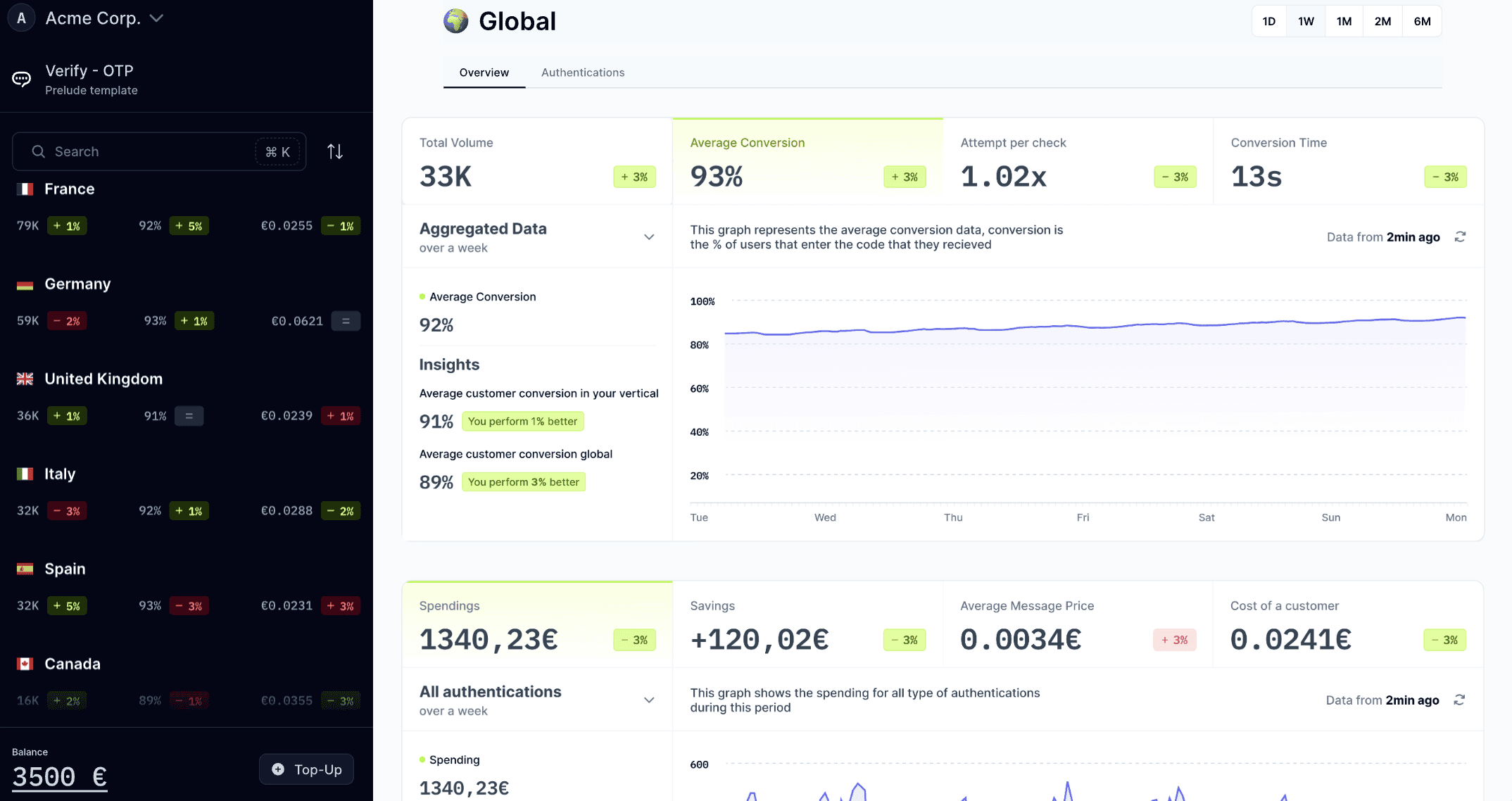
How it compares to Twilio:
Pricing: Prelude removes many of the layered pricing mechanics that make Twilio difficult to forecast at scale. Instead of charging separate verification fees on top of carrier delivery costs, pricing is structured around the underlying telecom cost itself, making spend easier to model as authentication volume grows.
Fraud protection: Fraud prevention is integrated directly into verification workflows rather than treated as a separate operational layer via the Watch API, which scores every request in real time before routing. For teams managing signup abuse or SMS pumping exposure, this reduces the amount of custom monitoring and mitigation infrastructure required internally.
OTP and verification: Prelude is optimized around verification workflows specifically. Multi-channel fallback, verification analytics, and conversion visibility are built directly into the platform. The experience feels more workflow-oriented than infrastructure-oriented compared to Twilio’s more modular approach.
Migration effort: Most teams migrate a single OTP flow within one sprint. Prelude provides direct migration support and assists with number porting.
Support: Direct Slack access to the engineering team during onboarding and production usage. Compared to Twilio’s tiered support structure, implementation and troubleshooting are generally more hands-on and responsive for smaller product teams.
Best for teams leaving Twilio because of: Pricing complexity, fraud exposure on OTP flows, or engineering overhead building verification infrastructure.
Ready to make the switch? See exactly how Prelude compares to Twilio on pricing, fraud protection, and onboarding on our Prelude Twilio alternative page.
2. Plivo - Best for Cost-Efficient SMS & Voice APIs
Plivo is a developer-focused messaging platform that offers clear pricing, good documentation, and reliable global coverage. Its API is easy to work with and supports both SMS and voice, making it a flexible option for product teams that want control without complexity.
Unlike some providers, Plivo doesn’t bury key features behind sales calls or enterprise tiers. Most of what you need is self-serve and well-documented. It’s not the flashiest option, but it’s stable, fast, and gets the job done. Plivo is the most structurally direct Twilio alternative for teams whose primary frustration is pricing complexity.
How it compares to Twilio:
Pricing: Plivo’s pricing model is significantly easier to understand than Twilio’s layered billing structure. Costs are generally tied directly to channel usage, without the additional verification fees, fragmented invoice categories, or pricing complexity that often makes Twilio difficult to forecast at scale.
Fraud protection: Fraud Shield included by default, configurable per flow type (signup vs. sign-in vs. password reset). No add-on required unlike Twilio's Fraud Guard configuration overhead.
OTP / verification: Dedicated Verify API handles the full flow. The implementation experience is lightweight and developer-friendly, though less analytics-oriented than platforms designed specifically around verification infrastructure.
Support: 24/7 via Slack and phone with same-day response guarantee vs. Twilio's multi-day ticket queue below enterprise tier.
Best for teams leaving Twilio because of: Unpredictable billing, the $0.05/verification fee, or the 10DLC registration overhead.
3. Bird (MessageBird) - Best for Multichannel Coverage
Bird offers a robust multichannel communication platform with strong international coverage. You can send messages via SMS, email, WhatsApp, voice, and even more niche channels like Viber or Zalo, with particularly strong delivery in EMEA and APAC markets where WhatsApp is a better primary channel than SMS. For teams on Twilio that are adding WhatsApp or running communications beyond OTP, Bird consolidates more into one platform.
How it compares to Twilio:
Pricing: Generally quote-based and less self-serve than Twilio. However, for larger international communication volumes, especially across WhatsApp-heavy regions, Bird can become more cost-efficient operationally.
Fraud protection: Less developed than Twilio's Fraud Guard for OTP-specific flows. The platform is better suited to general messaging than verification-focused fraud prevention.
OTP / verification: Bird supports OTP delivery and multi-channel fallback workflows well, particularly in regions where WhatsApp performs better than SMS. Its strength is communication orchestration rather than deep verification optimization.
Support: Structured onboarding with account management. Less immediate than Prelude or Plivo for technical integration issues.
Best for teams leaving Twilio because of: Limited WhatsApp or multichannel coverage, or teams consolidating OTP and customer communications onto one platform in EMEA/APAC.
4. Sinch - Best for Enterprise Compliance and Carrier-Level Infrastructure
Sinch operates 600+ direct carrier connections globally and is the natural landing spot for enterprises leaving Twilio where carrier-level SLAs, compliance tooling, and deep infrastructure are non-negotiable. Its Verification API includes flashcall and seamless authentication alongside standard SMS and voice- frictionless verification methods Twilio doesn't offer.
How it compares to Twilio:
Pricing: Sinch primarily operates through enterprise pricing and custom contracts rather than self-serve onboarding. At large scale, pricing can become highly competitive, though smaller teams may find the procurement process slower than Twilio’s.
Fraud protection: Built into the verification layer with automated detection. ISO 27001-certified infrastructure adds compliance depth Twilio doesn't match at the certification level.
OTP / verification: Dedicated Verification API with flashcall, seamless/data auth, and automatic OTP interception on Android.
Best for teams leaving Twilio because of: Carrier SLA requirements, compliance gaps, or the need for frictionless verification methods beyond code-based OTP.
5. Vonage - Best for Intelligent Multi-Channel Verification Workflows
Vonage’s API platform has evolved significantly beyond its earlier Nexmo positioning and now offers a more complete communications workflow platform across messaging, voice, and verification.
It balances enterprise infrastructure with relatively flexible workflow tooling.
How it compares to Twilio:
Pricing: Vonage’s pricing structure is generally easier to forecast than Twilio’s verification-heavy pricing model, particularly for international messaging and voice usage. Pay-as-you-go with custom enterprise plans available.
Fraud protection: Fraud Defender with semi-autonomous monitoring and Network Unblock API for self-service recovery. Identity Insights API adds SIM swap detection and Subscriber Match for pre-send risk signals.
OTP / verification: Vonage offers flexible verification workflows across SMS, voice, and messaging apps with configurable fallback logic. Compared to Twilio, the workflow customization feels more consolidated and easier to manage operationally.
Support — Vonage provides accessible support and onboarding across a broader range of pricing tiers than Twilio’s enterprise-focused support structure.
Best for teams leaving Twilio because of: Per-verification pricing, limited silent authentication, or wanting more intelligent multi-channel fallback logic.
If you're considering options besides Vonage instead, check out our list of Vonage alternatives.
6. Infobip - Best for Enterprise Multichannel Scale
Infobip Authenticate covers SMS, WhatsApp, RCS, Viber, email, and voice from a single API with always-on failover and automated fraud detection (Infobip Signals). It's the most feature-complete enterprise communications platform on this list and is suited to organizations that need a single vendor for OTP alongside all other customer communication channels.
How it compares to Twilio:
Pricing: Infobip operates primarily through enterprise contracts and custom pricing. At high international volume, it can become more operationally efficient than Twilio, especially for organizations consolidating multiple communication vendors into one platform.
Fraud protection: Infobip Signals detects and blocks SMS pumping automatically, charging only for legitimate messages. More automated than Twilio's Fraud Guard configuration.
OTP / verification: Infobip offers dedicated authentication and verification products alongside broader messaging infrastructure. Compared to Twilio, the platform feels more consolidated operationally for enterprises managing many communication channels simultaneously.
Support : Dedicated account management. Enterprise SLA depth exceeds Twilio for high-volume commitments.
Best for teams leaving Twilio because of: Need for a single enterprise vendor across all communication channels, or global compliance requirements at carrier level.
7. Bandwidth - Best for US-Based Voice & Number Control
Bandwidth offers voice and messaging APIs built on its own IP-based telecom network in the US, which allows for lower latency and direct control over call and message routing. It's especially strong in number management, SIP trunking, and voice applications.
While its SMS coverage is more US-centric, its infrastructure-level access makes it a good choice for platforms that need to customize or tightly control telephony.
How it compares to Twilio:
Pricing: Bandwidth’s direct carrier ownership can reduce operational costs for voice-heavy US use cases, particularly at scale.
Fraud protection: Not a primary focus. Better suited to voice infrastructure than OTP fraud prevention.
OTP / verification: Not a verification platform. SMS is available but secondary to voice. Not appropriate for teams whose switching reason is OTP-related.
Support: Enterprise-focused with direct US carrier relationships.
Best for teams leaving Twilio because of: US voice quality, telephony control, SIP trunking costs, or number provisioning at scale.
8. Telesign - Best for Identity Intelligence & Fraud Prevention
Telesign specializes in messaging with a focus on identity verification and fraud prevention. More than a delivery tool, it’s a security layer for apps needing to verify users, prevent abuse, and protect transactions.
It’s trusted by large platforms that need more than just message delivery, especially where user trust and authentication are core to the product.
How it compares to Twilio:
Pricing: Pricing is usage-based with fraud and identity tooling layered into the broader verification offering. For teams already spending heavily on separate anti-abuse infrastructure, the operational consolidation can offset higher platform costs.
Fraud protection: The deepest fraud intelligence layer on this list. The platform focuses heavily on identity intelligence, phone reputation scoring, and verification risk analysis, reducing the amount of internal fraud tooling teams need to build themselves.
OTP / verification: Single Verify API across SMS, voice, silent verification, push, email, WhatsApp, Viber, and RCS; comparable channel breadth to Twilio.
Support: Enterprise-grade. Less immediate than Prelude or Plivo for technical integration questions.
Best for teams leaving Twilio because of: Fraud exposure, specifically IRSF, fake signups, or promotion abuse that Twilio's Fraud Guard hasn't adequately addressed.
9. Kaleyra - Best for APAC & Emerging Markets
Kaleyra is particularly strong in the Asia-Pacific region and emerging markets. It offers voice and messaging APIs, with bundled packages and regional pricing tailored to countries like India, Indonesia, and Vietnam.
It’s a reliable option for businesses looking to scale in these geographies, with APIs that cover essentials and a commercial model designed for cost control.
How it compares to Twilio:
Pricing: Significantly cheaper than Twilio for India, Indonesia, Vietnam, and similar markets. Bundled plans available for regional traffic. Not competitive outside its core APAC footprint.
Fraud protection: Basic. Not comparable to Twilio's Fraud Guard or dedicated fraud platforms. APAC-specific compliance expertise is the stronger differentiator.
OTP / verification: Functional SMS and voice OTP. No dedicated conversion analytics or advanced routing intelligence.
Support: Regional support team with local market expertise.
Best for teams leaving Twilio because of: APAC delivery costs or regional pricing that makes Twilio's global rate card uneconomical for India or Southeast Asia traffic.
10. Telnyx - Best for Programmable Infrastructure
Telnyx is a programmable communications platform built for engineering teams that want total control over messaging, voice, and wireless connectivity. It operates its own global IP network and offers granular tools for routing, reporting, and customization.
For engineering-heavy teams that found Twilio's abstractions too constraining or whose complexity actually warrants carrier-level infrastructure access, Telnyx is the most customizable platform on this list.
How it compares to Twilio:
Pricing: Transparent modular pricing with public rate cards and strong cost visibility for infrastructure-heavy teams.
Fraud protection: Not a primary focus. Requires custom instrumentation; more work than Twilio's Fraud Guard, not less.
OTP / verification: Raw infrastructure, not a dedicated verify platform. Teams need to build code generation, validation logic, and fraud handling themselves.
Support: Developer-focused with technical documentation depth, though less guided than enterprise account-managed platforms.
Best for teams leaving Twilio because of: Infrastructure constraints, custom routing requirements, or needing direct carrier access that Twilio's abstraction layer prevents.
Which Alternative Fits Your Reason for Leaving Twilio?
The right alternative depends on what's actually driving the evaluation. Here's how the list maps to the most common reasons teams switch:
If you're leaving Twilio because of… | Consider | Why |
|---|---|---|
Pricing complexity and carrier markup | Prelude | No carrier markup, transparent cost-per-verified-user |
Fraud exposure on OTP flows | Prelude or Telesign | Both providers block by default pre-send; differentiate on default signal depth and per-channel coverage |
Engineering overhead building verify flows | Prelude or Plivo | Single verify API vs. Twilio's separate Verify + SMS stack |
Cost at scale for general-purpose SMS | Plivo or Telnyx | No verification fee, lower per-message rates |
Enterprise compliance and carrier SLAs | Sinch or Infobip | Direct carrier network, deeper compliance tooling |
International or multichannel coverage | Bird or Infobip | WhatsApp-first routing in EMEA/APAC markets |
US voice quality and telephony control | Bandwidth or Telnyx | Own-network routing, lower US latency |
APAC regional pricing | Kaleyra | Local carrier pricing in India and Southeast Asia |
Fraud scoring and identity intelligence | Prelude or Telesign | Prelude: default ML-based fraud detection on every plan, deeper scoring via Watch; Telesign: 15+ years of proprietary mobile identity data. |
Silent authentication and frictionless OTP | Vonage | Silent Auth GA, customizable multi-channel fallback |
Prelude vs. Twilio: Feature Comparison
For teams evaluating Prelude as a direct Twilio replacement for verification use cases:
Feature | Twilio | Prelude |
|---|---|---|
Pricing model | Pay-as-you-go + carrier markup + $0.05/verification fee | No markup on carrier costs; no per-verification fee |
OTP / Verify | Separate Verify add-on on top of messaging infrastructure | Core product; entire stack built for verification |
Fraud detection | Fraud Guard: on by default for Verify, blocks pre-send | Default ML-based fraud detection on every plan, blocks pre-send; deeper scoring available via Watch as a separate product |
Verification analytics | Conversion, retry, and cost-per-conversion data available, split across separate dashboards (Verify, Messaging Insights, Fraud Guard) | Unified dashboard: conversion rate, cost-per-verified-user by country and channel |
Support | Tiered, ticket-based below enterprise | Shared Slack channel with engineering team on all plans |
Channels | SMS, MMS, WhatsApp, voice, email, TOTP, SNA, push, passkeys (pilot) | SMS, voice, WhatsApp, Telegram, Viber, RCS, SNA |
Compliance | SOC 2 Type II | SOC 2 Type II + ISO/IEC 27001 |
Onboarding speed | Days to weeks | Hours |
Conclusion
Twilio helped define the messaging API space, and it’s still a powerful platform. But in 2026, it’s no longer the easiest or most transparent choice for fast-moving teams. Between unpredictable pricing, slower integrations, and support better suited to enterprise contracts, many startups are finding themselves out of sync with the Twilio model.
That’s why more teams are moving toward platforms that simplify not just messaging, but the entire experience around it, from onboarding to billing to performance visibility.
If your team is spending more time understanding costs than building product, it may be time to consider a better Twilio alternative.
The good news is there’s no shortage of strong alternatives. Whether you’re looking for better pricing, faster onboarding, stronger fraud protection, or simply support that answers your questions when you need it, modern providers are stepping up with solutions built for today’s product teams.
FAQs
What is the best Twilio alternative for OTP and user verification?
For teams whose primary use case is phone verification and authentication, Prelude is the most purpose-built option. It handles fraud detection, multi-channel routing, and conversion analytics in a single API rather than requiring separate tools. For teams with broader CPaaS needs beyond verification, Sinch or Infobip offer more comprehensive platform coverage. If your evaluation is really about authentication and session management rather than OTP delivery, see our Auth0 Alternatives guide instead.
What’s the cheapest Twilio alternative?
It depends on your volume and geography. Prelude's no-markup pricing tends to be most competitive for OTP-specific workloads, especially at scale, because you're paying carrier rates directly. For India and Southeast Asia, Kaleyra's regional pricing can undercut global providers. Plivo is typically competitive for general-purpose US and European SMS.
Which Twilio alternative is easiest to integrate?
Prelude and Plivo are both rated highly for fast, developer-friendly onboarding.
They both offer clear documentation, lightweight SDKs, and no-friction setup. If your team values speed over endless configuration, these platforms are hard to beat.
Is Twilio still worth using in 2026?
For teams with complex, multi-product communication needs (voice, video, chat, SMS, email from one platform), Twilio's breadth still makes it a reasonable choice, particularly at enterprise scale. For teams whose primary or sole use case is user verification and authentication, the combination of pricing opacity, separate fraud tooling, and support tier structure means that purpose-built alternatives now offer better value for most startup and growth-stage teams.
Can you migrate from Twilio to another provider without downtime?
Most providers offer test environments and gradual traffic migration.
Prelude provides direct migration support to minimize disruption. Most teams migrate within a single sprint. The team actively assists with number porting and integration so you're not left to figure it out from documentation alone. Read more here
How we evaluated these providers: Each provider was assessed against the most common reasons teams leave Twilio: pricing opacity, fraud prevention gaps, OTP infrastructure overhead, and support responsiveness. This is not a general SMS API comparison. For that, see our best SMS API guide. For OTP provider comparisons outside the Twilio context, see our best OTP providers guide. For transactional SMS specifically, see our transactional SMS providers guide. For authentication and identity platform alternatives, beyond OTP delivery, see our Auth0 Alternatives in 2026 guide.
Twilio helped define the messaging API category. Its reliability, scale, and developer-first origins helped power some of the most iconic apps of the last decade.
But in 2026, many fast-moving product teams are running into the same friction points: unpredictable pricing, slower integrations, and a support experience that often feels more suited to enterprise clients than agile SaaS startups.
This guide covers ten providers that are worth evaluating as alternatives. We include their genuine strengths, their real limitations, and the use cases they're best suited for. Whether you’re looking for a simpler SMS API, a more affordable option, or a platform built for your exact workflow, you’ll find the right alternative here.
Why Look for a Twilio Alternative?
Twilio still delivers at scale, but for many startups and product-led teams, it’s no longer the smoothest or clearest option.
For example, for teams whose primary use case is OTP and phone verification, Prelude was built specifically to solve these problems. It replaces Twilio's general purpose stack with pricing, fraud detection, and analytics designed around verification from the ground up. Understanding exactly where that stack falls short starts with where Twilio's complexity actually shows up.
As usage grows, so does the complexity. Here’s what many teams are running into with Twilio in 2026:
Onboarding and documentation friction
Getting started with Twilio isn’t as seamless as it should be. The documentation is extensive, but not always easy to navigate in practice, leading to frustrating back-and-forths that slow down integration with teams often spending time jumping between guides, piecing together flows, and handling edge cases before reaching a working setup. That friction stretches time-to-launch from hours into days or even weeks.
Limited built-in fraud detection for OTP flows
Twilio provides the infrastructure to send messages globally, and fraud protection exists, but it isn't automatically comprehensive across every use case.
Twilio's Fraud Guard is on by default for Verify customers and blocks suspected SMS pumping before the message sends. But coverage has real edges: Fraud Guard only protects the SMS channel, not Voice, and for Programmable Messaging traffic outside of Verify, the equivalent protection has to be manually enabled in the Console rather than being on from day one.
For teams running OTP or phone verification, that creates a gap wherever their setup falls outside Fraud Guard's default coverage:
Voice-based verification isn't covered by Fraud Guard
Programmable Messaging traffic needs its own protection turned on manually
Older integrations may predate current default settings
In practice, that means some teams are responsible for designing additional anti-abuse logic on top of what's built in, and can still see fraud costs land on an invoice before anyone notices the pattern. For high-growth products, this becomes expensive quickly. A single SMS pumping attack can generate thousands in unexpected costs before it's caught, even with default protections in place.
Support that doesn’t match product velocity
Unless you're on an enterprise contract, responses can be slow, templated, or disconnected from your actual issue. When you're trying to move fast, that lag has a cost.
Response times on standard plans are measured in days, not hours. Tickets get routed through templated flows that rarely match the specificity of your actual issue. For a team trying to ship fast, a 48-hour support lag on a delivery issue can have a real impact.
A growing gap between what agile teams need and what Twilio prioritizes
Twilio was built for scale and it shows. The platform's complexity, pricing tiers, and support structure increasingly prioritize large enterprise customers.
Agile startups and SaaS teams are consistently underserved. These teams need faster implementation, simpler abstractions and less infrastructure to manage.
That gap is where newer providers are gaining traction.
Too much infrastructure, not enough product
Twilio provides powerful building blocks but turning them into working features (like authentication or messaging flows) requires significant engineering effort from your end.
Teams often spend weeks wiring things together, managing edge cases, and building internal tooling just to get to a working baseline. Messaging, voice, and authentication are all managed separately, and none of it is optimized for the use case you actually care about.
The result: slower time to launch, fragmented developer experience, and a platform that scales in complexity faster than it scales in value.
Teams building verification flows often spend significant time on infrastructure that isn't their core product.
Twilio Pricing Deep Dive: What Does Twilio Actually Cost?
Pricing complexity becomes unavoidable when the invoice arrives. That's usually the moment teams realize that the cost of "sending an SMS" isn't a single number but a combination of charges that are difficult to map back to actual usage.
Instead of a single, predictable cost per message, billing is split across multiple layers of usage, infrastructure, and regional fees, even though they were triggered by a single user action. This makes it difficult to connect what your product does with what you're actually charged.
Twilio's billing splits a single API call into multiple line items: message segments, carrier pass-through fees, country-specific surcharges, number rental, and Verify API charges on top of raw SMS costs. Two identical verification flows can produce different invoices depending on message length (which determines segment count), destination country, and carrier routing.
That makes the question "How much does Twilio cost?" surprisingly difficult to answer with a single number.
How Twilio Pricing Works
For a basic SMS workflow in the US, Twilio charges for each SMS segment rather than necessarily treating every message as one billable unit. Longer messages can therefore cost more than expected, while Unicode characters can reduce the number of characters that fit into a single segment.
On top of the base messaging charge, carrier fees can also apply. Phone number rental adds a recurring cost, while applicable US 10DLC messaging can involve registration/onboarding and carrier fees.
For example, a single OTP flow might involve:
An SMS charge for each message segment
Carrier pass-through fees
A monthly phone number charge, where applicable
A2P 10DLC registration and carrier fees for applicable US 10DLC messaging
Country-specific pricing when sending internationally
A separate Verify charge if you're using Twilio Verify
So while a team might think of the workflow as "one OTP SMS," Twilio's billing can involve several independent cost components.
Twilio Cost: What Will You Actually Pay?
The total Twilio cost depends on more than the advertised price of an SMS or verification. For a US SMS messaging workflow, the basic calculation can look like:
Twilio cost = SMS charges + applicable carrier fees + phone number costs + applicable taxes and other fees
For a Verify workflow, add the applicable Verify charge per successful verification.
The exact calculation depends on the Twilio products you're using and where your messages are being sent. Twilio itself notes that messaging costs vary based on monthly volume, sender, channel, and applicable fees.
Twilio Cost by Pricing Component
Cost component | What affects the cost |
|---|---|
SMS | Destination, sender type, message segments, and volume |
Carrier fees | Destination, carrier, sender type, and message type |
Phone numbers | Number type and monthly rental |
A2P 10DLC | Registration/onboarding and applicable carrier fees for US 10DLC traffic |
Verify | Successful verifications plus applicable channel charges |
International SMS | Destination country, sender type, carrier, and volume |
Taxes and other charges | Customer location and applicable invoice-level adjustments |
This is why there isn't one universal answer to "How much does Twilio cost?" The answer changes based on your traffic, destinations, message length, sender type, and the Twilio products you're using.
How Much Does Twilio Cost for SMS Verification?
Twilio's current Verify pricing illustrates why the headline SMS rate isn't the whole story.
For US SMS, Twilio lists Verify at $0.05 per successful verification plus $0.0083 per SMS. That means a successful verification using one US SMS starts at $0.0583, before any applicable carrier fees or other charges. For a normal one-segment OTP, that calculation holds exactly; longer messages can generate additional SMS charges.
Twilio's own pricing confirms that the $0.0083 SMS fee is charged per attempt, regardless of whether the message is delivered, while the $0.05 platform fee is charged once, only when a verification succeeds. That means a user who requests several codes before entering the correct one can generate multiple billable SMS attempts on top of the single $0.05 success fee, so the effective cost of one completed verification can end up higher than the advertised $0.0583.
That makes cost per successful verification a more useful metric than simply looking at the SMS rate.
Actual pricing varies by destination, channel, sender type, volume, and applicable fees, so the $0.0583 figure should be treated as an illustrative US SMS starting point rather than a universal Twilio verification cost.
Example: OTP Message Cost Breakdown
Imagine sending a simple login verification code.
What you expect: 1 message, 1 cost.
What can actually happen:
The message is split into segments based on length and encoding
Each segment is billed separately
Carrier pass-through fees can be added depending on the destination, carrier, sender type, and message type
Additional compliance, registration, carrier, or country-specific charges may apply
A Verify charge applies if you're using Twilio Verify
Retries can create additional billable message attempts
The result is that the effective cost of an OTP isn't necessarily the headline SMS rate. Two otherwise identical verification flows can generate different costs depending on message length, destination, carrier, routing, and user behavior.
A Quick Reference: What Twilio Actually Charges
Twilio pricing component | How you're charged |
|---|---|
SMS | Per SMS segment, with pricing varying by destination and sender type |
Carrier fees | Vary by destination, carrier, sender type, and message type |
Phone numbers | Monthly rental fee, depending on number type |
A2P 10DLC | Registration/onboarding and carrier fees may apply to applicable US 10DLC traffic |
Verify API | $0.05 per successful verification, plus applicable channel fees; SMS attempts are billed per attempt regardless of delivery |
Twilio's current pricing documentation shows that messaging costs vary by volume, sender, channel, destination, and applicable carrier fees, while Verify has its own per-successful-verification charge. The important point is that the headline SMS rate isn't necessarily the effective cost per verification.
Prelude avoids this layering entirely. Pricing is based on the underlying carrier cost with no separate verification fee stacked on top, so the number on the rate card is close to the number on the invoice.
Why Twilio Pricing Gets Hard to Forecast
The complexity becomes more noticeable as volume grows.
At 100 messages per month, manually reconciling several billing components might be manageable. At millions of authentication messages, small differences in segmentation, carrier fees, country mix, retries, and verification success rates can have a meaningful impact on your total spend.
Carrier pricing can also change over time. Twilio has published carrier fee changes affecting US messaging in 2026, which illustrates why a pricing model based on a single static SMS rate can become outdated.
This also makes simple comparisons between providers difficult. A provider advertising a lower SMS rate isn't necessarily cheaper if it adds other fees elsewhere. Conversely, a higher headline rate can sometimes produce a lower total cost when pricing is more predictable.
For teams evaluating a Twilio alternative, the useful metric isn't simply cost per SMS. It's the effective cost per successful verification or delivered message.
Twilio's Dashboard vs. Your Actual Invoice
Twilio's Console provides visibility into usage, but usage estimates and the final invoice aren't necessarily identical. Carrier fees and other charges can affect the final amount, while taxes, credits, recurring charges, and other billing adjustments can also appear on an invoice.
Twilio also provides Usage Records that can be used to retrieve usage information by category and period, which can help teams build their own reporting and cost analysis.
This creates another layer of operational work: engineering teams monitor usage while finance teams reconcile the invoice, and someone ultimately has to connect those numbers back to product-level metrics.
The underlying data exists, but it isn't always presented in the same way your team thinks about its product.
What Twilio Analytics Tell You
Twilio provides analytics for messaging and verification workflows, including verification performance and conversion-related metrics. Verify, for example, provides visibility into verification performance across regions and channels.
The challenge is that these insights are distributed across different parts of the Twilio platform. Your messaging costs, verification performance, and fraud signals don't necessarily appear as one simple view showing:
How much did we spend → how many users did it reach → how many verifications succeeded → what did each successful verification cost?
That's the level of visibility teams typically need when messaging becomes a meaningful operating expense.
The Real Cost of Twilio
The biggest issue with Twilio pricing isn't that every individual fee is unreasonable. It's that the total cost of a messaging workflow can be difficult to predict from the headline price alone.
As usage grows, teams need to account for:
Message segmentation
Carrier fees
Phone number costs
Compliance and registration fees
International pricing
Verification charges
Retries and unsuccessful attempts
Taxes and other invoice-level adjustments
That's why evaluating a Twilio alternative should go beyond comparing advertised SMS rates.
The better question is: What will this authentication or messaging workflow actually cost us at scale?
For teams that want predictable pricing and a clearer connection between messaging spend and product outcomes, that's where newer alternatives can be compelling.
What to Check Before Committing to a Twilio Alternative
Evaluating a Twilio alternative isn't the same as evaluating an OTP provider from scratch. The question usually isn’t "is this platform good?". It’s asking "does this actually fix the specific problems Twilio is causing?" Here are the questions worth answering before committing:
Can you see your real cost before you sign up? Twilio's pricing complexity is one of the most common switching triggers. Before moving to an alternative, verify you can calculate your effective cost-per-verified-user, not just per message sent, using public rate cards. If you need a sales call to get a number, you're likely moving from one opaque pricing model to another.
Is fraud detection pre-send or post-hoc? Twilio's Fraud Guard has improved but teams that experienced SMS pumping exposure before it was enabled know the cost of detecting fraud after the fact. Ask specifically: is fraud protection on by default, or does it require separate setup? And does it cover every channel you use, some providers' default protection only covers SMS, not Voice or other channels.
How much of your existing infrastructure needs to change? The depth of a migration depends on how much custom logic sits on top of Twilio's APIs, including webhook handlers, error code mappings, retry logic and analytics pipelines. Providers with a dedicated verify API (rather than raw SMS) typically require less rebuilding than swapping like-for-like. Audit your integration before choosing a provider based on API similarity alone.
What happens to your existing numbers? If you're on 10DLC long codes in the US, porting takes 2-4 weeks and requires re-registering your brand and campaigns with the new provider. Short codes can take 6–8 weeks. Alphanumeric sender IDs may not be portable. Some providers maintain pre-registered sender IDs that bypass registration entirely for standard flows.
What does support actually look like at your plan tier? One of the biggest frustrations for growing teams is the gap between platform complexity and support responsiveness. Before committing to a provider, evaluate: support responsiveness during onboarding, escalation paths for delivery issues, access to technical teams, and whether support is ticket-driven or relationship-driven. A provider offering direct engineering access or shared Slack support operates very differently from one relying entirely on asynchronous ticket queues.
Top 10 Twilio Alternatives in 2026
The landscape has changed. While Twilio remains a dominant player, newer providers have emerged with clearer pricing, faster onboarding, and support that feels built for product teams, not just procurement departments.
In this section, we’ve ranked 10 modern messaging API providers that stand out in 2026. Each one brings something different to the table, whether it's affordability, fraud protection, global coverage, or developer-first design.
1. Prelude - Best for OTP and Authentication-Focused Teams
Prelude is the purpose-built Twilio alternative for teams focused on user verification.
Where Twilio is a general-purpose communications platform with a Verify add-on, Prelude's entire stack from pricing and API design to dashboard, routing, and fraud detection is oriented around authentication flows.
How it compares to Twilio:
Pricing: Prelude removes many of the layered pricing mechanics that make Twilio difficult to forecast at scale. Instead of charging separate verification fees on top of carrier delivery costs, pricing is structured around the underlying telecom cost itself, making spend easier to model as authentication volume grows.
Fraud protection: Fraud prevention is integrated directly into verification workflows rather than treated as a separate operational layer via the Watch API, which scores every request in real time before routing. For teams managing signup abuse or SMS pumping exposure, this reduces the amount of custom monitoring and mitigation infrastructure required internally.
OTP and verification: Prelude is optimized around verification workflows specifically. Multi-channel fallback, verification analytics, and conversion visibility are built directly into the platform. The experience feels more workflow-oriented than infrastructure-oriented compared to Twilio’s more modular approach.
Migration effort: Most teams migrate a single OTP flow within one sprint. Prelude provides direct migration support and assists with number porting.
Support: Direct Slack access to the engineering team during onboarding and production usage. Compared to Twilio’s tiered support structure, implementation and troubleshooting are generally more hands-on and responsive for smaller product teams.
Best for teams leaving Twilio because of: Pricing complexity, fraud exposure on OTP flows, or engineering overhead building verification infrastructure.
Ready to make the switch? See exactly how Prelude compares to Twilio on pricing, fraud protection, and onboarding on our Prelude Twilio alternative page.
2. Plivo - Best for Cost-Efficient SMS & Voice APIs
Plivo is a developer-focused messaging platform that offers clear pricing, good documentation, and reliable global coverage. Its API is easy to work with and supports both SMS and voice, making it a flexible option for product teams that want control without complexity.
Unlike some providers, Plivo doesn’t bury key features behind sales calls or enterprise tiers. Most of what you need is self-serve and well-documented. It’s not the flashiest option, but it’s stable, fast, and gets the job done. Plivo is the most structurally direct Twilio alternative for teams whose primary frustration is pricing complexity.
How it compares to Twilio:
Pricing: Plivo’s pricing model is significantly easier to understand than Twilio’s layered billing structure. Costs are generally tied directly to channel usage, without the additional verification fees, fragmented invoice categories, or pricing complexity that often makes Twilio difficult to forecast at scale.
Fraud protection: Fraud Shield included by default, configurable per flow type (signup vs. sign-in vs. password reset). No add-on required unlike Twilio's Fraud Guard configuration overhead.
OTP / verification: Dedicated Verify API handles the full flow. The implementation experience is lightweight and developer-friendly, though less analytics-oriented than platforms designed specifically around verification infrastructure.
Support: 24/7 via Slack and phone with same-day response guarantee vs. Twilio's multi-day ticket queue below enterprise tier.
Best for teams leaving Twilio because of: Unpredictable billing, the $0.05/verification fee, or the 10DLC registration overhead.
3. Bird (MessageBird) - Best for Multichannel Coverage
Bird offers a robust multichannel communication platform with strong international coverage. You can send messages via SMS, email, WhatsApp, voice, and even more niche channels like Viber or Zalo, with particularly strong delivery in EMEA and APAC markets where WhatsApp is a better primary channel than SMS. For teams on Twilio that are adding WhatsApp or running communications beyond OTP, Bird consolidates more into one platform.
How it compares to Twilio:
Pricing: Generally quote-based and less self-serve than Twilio. However, for larger international communication volumes, especially across WhatsApp-heavy regions, Bird can become more cost-efficient operationally.
Fraud protection: Less developed than Twilio's Fraud Guard for OTP-specific flows. The platform is better suited to general messaging than verification-focused fraud prevention.
OTP / verification: Bird supports OTP delivery and multi-channel fallback workflows well, particularly in regions where WhatsApp performs better than SMS. Its strength is communication orchestration rather than deep verification optimization.
Support: Structured onboarding with account management. Less immediate than Prelude or Plivo for technical integration issues.
Best for teams leaving Twilio because of: Limited WhatsApp or multichannel coverage, or teams consolidating OTP and customer communications onto one platform in EMEA/APAC.
4. Sinch - Best for Enterprise Compliance and Carrier-Level Infrastructure
Sinch operates 600+ direct carrier connections globally and is the natural landing spot for enterprises leaving Twilio where carrier-level SLAs, compliance tooling, and deep infrastructure are non-negotiable. Its Verification API includes flashcall and seamless authentication alongside standard SMS and voice- frictionless verification methods Twilio doesn't offer.
How it compares to Twilio:
Pricing: Sinch primarily operates through enterprise pricing and custom contracts rather than self-serve onboarding. At large scale, pricing can become highly competitive, though smaller teams may find the procurement process slower than Twilio’s.
Fraud protection: Built into the verification layer with automated detection. ISO 27001-certified infrastructure adds compliance depth Twilio doesn't match at the certification level.
OTP / verification: Dedicated Verification API with flashcall, seamless/data auth, and automatic OTP interception on Android.
Best for teams leaving Twilio because of: Carrier SLA requirements, compliance gaps, or the need for frictionless verification methods beyond code-based OTP.
5. Vonage - Best for Intelligent Multi-Channel Verification Workflows
Vonage’s API platform has evolved significantly beyond its earlier Nexmo positioning and now offers a more complete communications workflow platform across messaging, voice, and verification.
It balances enterprise infrastructure with relatively flexible workflow tooling.
How it compares to Twilio:
Pricing: Vonage’s pricing structure is generally easier to forecast than Twilio’s verification-heavy pricing model, particularly for international messaging and voice usage. Pay-as-you-go with custom enterprise plans available.
Fraud protection: Fraud Defender with semi-autonomous monitoring and Network Unblock API for self-service recovery. Identity Insights API adds SIM swap detection and Subscriber Match for pre-send risk signals.
OTP / verification: Vonage offers flexible verification workflows across SMS, voice, and messaging apps with configurable fallback logic. Compared to Twilio, the workflow customization feels more consolidated and easier to manage operationally.
Support — Vonage provides accessible support and onboarding across a broader range of pricing tiers than Twilio’s enterprise-focused support structure.
Best for teams leaving Twilio because of: Per-verification pricing, limited silent authentication, or wanting more intelligent multi-channel fallback logic.
If you're considering options besides Vonage instead, check out our list of Vonage alternatives.
6. Infobip - Best for Enterprise Multichannel Scale
Infobip Authenticate covers SMS, WhatsApp, RCS, Viber, email, and voice from a single API with always-on failover and automated fraud detection (Infobip Signals). It's the most feature-complete enterprise communications platform on this list and is suited to organizations that need a single vendor for OTP alongside all other customer communication channels.
How it compares to Twilio:
Pricing: Infobip operates primarily through enterprise contracts and custom pricing. At high international volume, it can become more operationally efficient than Twilio, especially for organizations consolidating multiple communication vendors into one platform.
Fraud protection: Infobip Signals detects and blocks SMS pumping automatically, charging only for legitimate messages. More automated than Twilio's Fraud Guard configuration.
OTP / verification: Infobip offers dedicated authentication and verification products alongside broader messaging infrastructure. Compared to Twilio, the platform feels more consolidated operationally for enterprises managing many communication channels simultaneously.
Support : Dedicated account management. Enterprise SLA depth exceeds Twilio for high-volume commitments.
Best for teams leaving Twilio because of: Need for a single enterprise vendor across all communication channels, or global compliance requirements at carrier level.
7. Bandwidth - Best for US-Based Voice & Number Control
Bandwidth offers voice and messaging APIs built on its own IP-based telecom network in the US, which allows for lower latency and direct control over call and message routing. It's especially strong in number management, SIP trunking, and voice applications.
While its SMS coverage is more US-centric, its infrastructure-level access makes it a good choice for platforms that need to customize or tightly control telephony.
How it compares to Twilio:
Pricing: Bandwidth’s direct carrier ownership can reduce operational costs for voice-heavy US use cases, particularly at scale.
Fraud protection: Not a primary focus. Better suited to voice infrastructure than OTP fraud prevention.
OTP / verification: Not a verification platform. SMS is available but secondary to voice. Not appropriate for teams whose switching reason is OTP-related.
Support: Enterprise-focused with direct US carrier relationships.
Best for teams leaving Twilio because of: US voice quality, telephony control, SIP trunking costs, or number provisioning at scale.
8. Telesign - Best for Identity Intelligence & Fraud Prevention
Telesign specializes in messaging with a focus on identity verification and fraud prevention. More than a delivery tool, it’s a security layer for apps needing to verify users, prevent abuse, and protect transactions.
It’s trusted by large platforms that need more than just message delivery, especially where user trust and authentication are core to the product.
How it compares to Twilio:
Pricing: Pricing is usage-based with fraud and identity tooling layered into the broader verification offering. For teams already spending heavily on separate anti-abuse infrastructure, the operational consolidation can offset higher platform costs.
Fraud protection: The deepest fraud intelligence layer on this list. The platform focuses heavily on identity intelligence, phone reputation scoring, and verification risk analysis, reducing the amount of internal fraud tooling teams need to build themselves.
OTP / verification: Single Verify API across SMS, voice, silent verification, push, email, WhatsApp, Viber, and RCS; comparable channel breadth to Twilio.
Support: Enterprise-grade. Less immediate than Prelude or Plivo for technical integration questions.
Best for teams leaving Twilio because of: Fraud exposure, specifically IRSF, fake signups, or promotion abuse that Twilio's Fraud Guard hasn't adequately addressed.
9. Kaleyra - Best for APAC & Emerging Markets
Kaleyra is particularly strong in the Asia-Pacific region and emerging markets. It offers voice and messaging APIs, with bundled packages and regional pricing tailored to countries like India, Indonesia, and Vietnam.
It’s a reliable option for businesses looking to scale in these geographies, with APIs that cover essentials and a commercial model designed for cost control.
How it compares to Twilio:
Pricing: Significantly cheaper than Twilio for India, Indonesia, Vietnam, and similar markets. Bundled plans available for regional traffic. Not competitive outside its core APAC footprint.
Fraud protection: Basic. Not comparable to Twilio's Fraud Guard or dedicated fraud platforms. APAC-specific compliance expertise is the stronger differentiator.
OTP / verification: Functional SMS and voice OTP. No dedicated conversion analytics or advanced routing intelligence.
Support: Regional support team with local market expertise.
Best for teams leaving Twilio because of: APAC delivery costs or regional pricing that makes Twilio's global rate card uneconomical for India or Southeast Asia traffic.
10. Telnyx - Best for Programmable Infrastructure
Telnyx is a programmable communications platform built for engineering teams that want total control over messaging, voice, and wireless connectivity. It operates its own global IP network and offers granular tools for routing, reporting, and customization.
For engineering-heavy teams that found Twilio's abstractions too constraining or whose complexity actually warrants carrier-level infrastructure access, Telnyx is the most customizable platform on this list.
How it compares to Twilio:
Pricing: Transparent modular pricing with public rate cards and strong cost visibility for infrastructure-heavy teams.
Fraud protection: Not a primary focus. Requires custom instrumentation; more work than Twilio's Fraud Guard, not less.
OTP / verification: Raw infrastructure, not a dedicated verify platform. Teams need to build code generation, validation logic, and fraud handling themselves.
Support: Developer-focused with technical documentation depth, though less guided than enterprise account-managed platforms.
Best for teams leaving Twilio because of: Infrastructure constraints, custom routing requirements, or needing direct carrier access that Twilio's abstraction layer prevents.
Which Alternative Fits Your Reason for Leaving Twilio?
The right alternative depends on what's actually driving the evaluation. Here's how the list maps to the most common reasons teams switch:
If you're leaving Twilio because of… | Consider | Why |
|---|---|---|
Pricing complexity and carrier markup | Prelude | No carrier markup, transparent cost-per-verified-user |
Fraud exposure on OTP flows | Prelude or Telesign | Both providers block by default pre-send; differentiate on default signal depth and per-channel coverage |
Engineering overhead building verify flows | Prelude or Plivo | Single verify API vs. Twilio's separate Verify + SMS stack |
Cost at scale for general-purpose SMS | Plivo or Telnyx | No verification fee, lower per-message rates |
Enterprise compliance and carrier SLAs | Sinch or Infobip | Direct carrier network, deeper compliance tooling |
International or multichannel coverage | Bird or Infobip | WhatsApp-first routing in EMEA/APAC markets |
US voice quality and telephony control | Bandwidth or Telnyx | Own-network routing, lower US latency |
APAC regional pricing | Kaleyra | Local carrier pricing in India and Southeast Asia |
Fraud scoring and identity intelligence | Prelude or Telesign | Prelude: default ML-based fraud detection on every plan, deeper scoring via Watch; Telesign: 15+ years of proprietary mobile identity data. |
Silent authentication and frictionless OTP | Vonage | Silent Auth GA, customizable multi-channel fallback |
Prelude vs. Twilio: Feature Comparison
For teams evaluating Prelude as a direct Twilio replacement for verification use cases:
Feature | Twilio | Prelude |
|---|---|---|
Pricing model | Pay-as-you-go + carrier markup + $0.05/verification fee | No markup on carrier costs; no per-verification fee |
OTP / Verify | Separate Verify add-on on top of messaging infrastructure | Core product; entire stack built for verification |
Fraud detection | Fraud Guard: on by default for Verify, blocks pre-send | Default ML-based fraud detection on every plan, blocks pre-send; deeper scoring available via Watch as a separate product |
Verification analytics | Conversion, retry, and cost-per-conversion data available, split across separate dashboards (Verify, Messaging Insights, Fraud Guard) | Unified dashboard: conversion rate, cost-per-verified-user by country and channel |
Support | Tiered, ticket-based below enterprise | Shared Slack channel with engineering team on all plans |
Channels | SMS, MMS, WhatsApp, voice, email, TOTP, SNA, push, passkeys (pilot) | SMS, voice, WhatsApp, Telegram, Viber, RCS, SNA |
Compliance | SOC 2 Type II | SOC 2 Type II + ISO/IEC 27001 |
Onboarding speed | Days to weeks | Hours |
Conclusion
Twilio helped define the messaging API space, and it’s still a powerful platform. But in 2026, it’s no longer the easiest or most transparent choice for fast-moving teams. Between unpredictable pricing, slower integrations, and support better suited to enterprise contracts, many startups are finding themselves out of sync with the Twilio model.
That’s why more teams are moving toward platforms that simplify not just messaging, but the entire experience around it, from onboarding to billing to performance visibility.
If your team is spending more time understanding costs than building product, it may be time to consider a better Twilio alternative.
The good news is there’s no shortage of strong alternatives. Whether you’re looking for better pricing, faster onboarding, stronger fraud protection, or simply support that answers your questions when you need it, modern providers are stepping up with solutions built for today’s product teams.
FAQs
What is the best Twilio alternative for OTP and user verification?
For teams whose primary use case is phone verification and authentication, Prelude is the most purpose-built option. It handles fraud detection, multi-channel routing, and conversion analytics in a single API rather than requiring separate tools. For teams with broader CPaaS needs beyond verification, Sinch or Infobip offer more comprehensive platform coverage. If your evaluation is really about authentication and session management rather than OTP delivery, see our Auth0 Alternatives guide instead.
What’s the cheapest Twilio alternative?
It depends on your volume and geography. Prelude's no-markup pricing tends to be most competitive for OTP-specific workloads, especially at scale, because you're paying carrier rates directly. For India and Southeast Asia, Kaleyra's regional pricing can undercut global providers. Plivo is typically competitive for general-purpose US and European SMS.
Which Twilio alternative is easiest to integrate?
Prelude and Plivo are both rated highly for fast, developer-friendly onboarding.
They both offer clear documentation, lightweight SDKs, and no-friction setup. If your team values speed over endless configuration, these platforms are hard to beat.
Is Twilio still worth using in 2026?
For teams with complex, multi-product communication needs (voice, video, chat, SMS, email from one platform), Twilio's breadth still makes it a reasonable choice, particularly at enterprise scale. For teams whose primary or sole use case is user verification and authentication, the combination of pricing opacity, separate fraud tooling, and support tier structure means that purpose-built alternatives now offer better value for most startup and growth-stage teams.
Can you migrate from Twilio to another provider without downtime?
Most providers offer test environments and gradual traffic migration.
Prelude provides direct migration support to minimize disruption. Most teams migrate within a single sprint. The team actively assists with number porting and integration so you're not left to figure it out from documentation alone. Read more here
Start optimizing your auth flow
Send verification text-messages anywhere in the world with the best price, the best deliverability and no spam.