Auth0 Alternatives in 2026: A Buyer's Framework
What to actually check before switching off Auth0, beyond price.

Rowan Haddad
Content & SEO Manager
Summary
Auth0 alternatives get compared by price and login methods constantly. This guide uses six evaluation dimensions instead, authentication, authorization, identity context, enterprise readiness, developer experience, and total cost of ownership, and spends the most time on the one most comparisons skip: whether a platform still knows if a session should be trusted after login, or whether that question stops mattering the moment authentication succeeds.
If you're looking for an Auth0 alternative, you're probably not looking for authentication alone.
You're evaluating how much of your identity stack you want one platform to own, how much you want to build yourself, and whether your authentication system can keep up with enterprise customers, fraud, and AI agents acting on behalf of your users.
Auth0 remains one of the most mature identity platforms available, and for many teams it's still the right choice.
But the market has shifted meaningfully over the last few years. New platforms have emerged with different priorities: developer experience, enterprise SSO, open source control, or authentication that's tightly coupled with fraud and session trust rather than relying on separate systems downstream.
What follows is a framework for evaluating the tradeoffs different platforms make, so you can choose the one that best fits your architecture.
How we Evaluated These Platforms
Rather than ranking products by feature count, we evaluated them across six dimensions:
Authentication capabilities
Authorization
Identity context
Enterprise readiness
Developer experience
Total cost of ownership
Specific pricing, tier limits, and feature launches referenced below reflect what was publicly documented as of mid-2026. This space moves fast, every vendor here ships new capabilities and adjusts pricing regularly. The six dimensions above are built to hold up regardless: they're how to compare any of these platforms a year from now, too. The specific numbers and features below are a snapshot, not a guarantee, confirm anything that matters directly with the vendor before deciding.
Start With the Question Behind the Question
Teams usually start searching for an Auth0 alternative for one of five reasons:
Pricing becomes difficult to predict as users or enterprise customers grow. Auth0's free tier covers 25,000 MAU, genuinely generous, but each enterprise SSO connection eats into a hard cap, three on the B2B Essentials plan, five on Professional, before a sixth customer forces a jump to custom, contact-sales Enterprise pricing.
Authentication turns out to be one piece of a broader problem that includes fraud detection, device trust, and AI agent identity.
They want more control over infrastructure and where user data lives.
They want a simpler developer experience than a dashboard-heavy identity platform.
They're replacing a homegrown authentication system and want to avoid creating another one.
The important point is that these are different problems. A team that's outgrown Auth0's SSO connection limits shouldn't necessarily land on the same alternative as a team trying to reduce fraud losses or support AI agents.
Understanding why you're looking elsewhere usually determines which alternative actually fits.
A Framework for Evaluating Authentication Platforms
Nearly every mature authentication platform now supports passkeys, OAuth, SAML, social login, and MFA. The real differences sit elsewhere.
Evaluation area | Questions to ask |
Authentication | Does it support every login method you need? |
Authorization | Can it express your permission model? |
Identity context | Does it understand devices, sessions, and risk, not just successful logins? |
Enterprise readiness | Does it support SAML, SCIM, organizations, and enterprise administration? |
Developer experience | How difficult is implementation, customization, and migration? |
Total cost of ownership | Beyond licensing, what engineering and operational costs are you taking on? |
Identity context is becoming the real differentiator
Five years ago, authentication platforms mostly competed on login methods. Today, nearly every established provider supports passkeys, passwordless authentication, social login, MFA, OAuth, and enterprise SSO.
The harder question is what happens after the user signs in. Can the platform recognize a trusted device? Detect a suspicious session? Distinguish a human from an AI agent acting on the user's behalf? Decide whether a sensitive action deserves step-up authentication?
That's what we mean by identity context. It's becoming one of the biggest differences between authentication platforms, not because authentication itself has become less important, but because modern applications increasingly need context alongside authentication before making high-value security decisions.
Prelude answers that identity-context question directly for teams whose evaluation is really about what happens after login. The Auth product recognizes trusted devices, catches suspicious sessions, tells a human from an AI agent acting on a user's behalf, and decides when a sensitive action needs step-up authentication, the layer most identity platforms only handle partially, if at all.
Leading Auth0 Alternatives
Clerk
Best for: Fast developer experience for startups and product teams.
Clerk is a hosted authentication platform that focuses on reducing implementation time with polished UI components, framework-native SDKs, and a developer experience that's difficult to beat for greenfield applications.
Its pricing has also become significantly more generous with the introduction of Monthly Retained Users (MRU), making the effective free tier substantially larger than the previous MAU-based model.
Clerk supports step-up authentication through its Reverification feature, so that's not a gap. Where it's thinner is depth of signal underneath that step-up trigger: bot and credential-stuffing protection are dashboard-level toggles rather than a continuous risk score, so there isn't much for a step-up decision to react to beyond "new device" or "MFA enabled." If your biggest priority is shipping authentication quickly and your fraud exposure is low, Clerk is one of the strongest options available.
WorkOS
Best for: Enterprise SSO and B2B infrastructure.
WorkOS is an enterprise identity platform that earned its reputation by making enterprise identity dramatically easier to implement, particularly SAML, SCIM, and directory synchronization. AuthKit, its consumer-facing layer, is free up to 1 million MAU, with SSO connections priced per connection rather than bundled in.
WorkOS shipped Step-Up Auth in July 2026, closing a gap that existed as recently as mid-2026. Its fraud product, Radar, is built into AuthKit's own sign-in flow rather than bolted on separately, though its response is still binary, block or challenge, not something that adjusts a session's ongoing access. For teams selling into enterprise customers, WorkOS remains one of the strongest choices.
Amazon Cognito
Best for: Organizations already invested in AWS.
Amazon Cognito is AWS's managed user-authentication service, and it continues to offer compelling economics for companies already running on AWS, particularly when tightly integrated with Lambda, IAM, and API Gateway. Its free tier depends on which pricing tier and account vintage you're on, up to 50,000 MAU for accounts predating AWS's November 2024 restructuring, a smaller default allotment for new pools on the Essentials tier, worth checking directly.
The tradeoff is complexity. Adaptive authentication and compromised-credential detection sit behind the paid Plus tier, and real fraud protection means assembling additional AWS services: WAF for traffic-layer protection, Amazon Fraud Detector for ML-based scoring, and for SMS-specific fraud, a documented integration with Vonage's network-level authentication and Fraud Defender tools. That flexibility is valuable for some teams but increases operational complexity compared to more opinionated managed platforms.
Keycloak and FusionAuth
Best for: Organizations that prioritize ownership and infrastructure control.
Keycloak and FusionAuth are open-source, self-hostable identity platforms that appeal to engineering teams that want to avoid vendor lock-in, and retain full control over user data. Keycloak became a CNCF incubating project in 2023 but is still primarily developed and sponsored by Red Hat; FusionAuth is developer-first and self-hostable with a full feature set. Both are mature and standards-compliant on core authentication.
The tradeoff is operational ownership. Keycloak's abuse protection tops out at reCAPTCHA; teams are responsible not only for running the identity platform itself, but for integrating third-party systems when they need richer fraud detection, device reputation, or continuous session evaluation.
Stytch
Best for: Flexible authentication APIs and passwordless-first applications.
Stytch is a developer-first authentication API provider that has consistently emphasized developer-friendly authentication APIs and strong support for passwordless authentication. Its approach to device fingerprinting feeding directly into adaptive MFA gives developers more identity context than most authentication platforms, making it one of the few developer-first options with real fraud signal built in rather than bolted on.
Twilio completed its acquisition of Stytch on November 14, 2025. The product hasn't changed as a result, but organizations evaluating Stytch today should factor in that they're choosing a piece of a much larger communications platform's roadmap rather than a standalone developer tool.
Stack Auth and Better Auth
Best for: Modern startups and TypeScript-first applications.
Stack Auth is an open-source authentication library that has gained momentum by focusing on developer experience and reducing vendor lock-in, positioned as a full open-source Auth0/Clerk alternative.
Better Auth started the same way, a TypeScript-first framework that runs on your own backend rather than as a hosted service, and had already absorbed Auth.js/NextAuth.js before Vercel acquired it in July 2026. Vercel's own announcement says it's staying open source and framework-agnostic, and names its next focus explicitly: securing agentic workflows, under an Agent Auth Protocol it had already started before the acquisition. If agent identity is part of why you're evaluating alternatives in the first place, this is worth knowing: Better Auth is no longer a small independent project. It's now backed by Vercel's resources and working on exactly that problem.
Neither positions integrated fraud evaluation as a core part of the platform today. For many early-stage teams, that's perfectly reasonable, it isn't the problem they're solving yet. Better Auth specifically is worth revisiting again once its Vercel-backed agent-auth work ships, since that's a live, moving target rather than a settled gap.
Where Prelude Auth Fits
Every platform above optimizes for a different tradeoff. Clerk optimizes for developer velocity. WorkOS optimizes for enterprise identity. Cognito optimizes for AWS integration and cost. Keycloak and FusionAuth optimize for ownership. Stack Auth and Better Auth optimize for openness and developer control.
Best for: Teams that want authentication, fraud detection, and session trust to work as one system instead of three.
That's visible in the product itself, not just the pitch: the product switcher in the top nav lets you move between Auth, Verify, Watch, and the rest without leaving the dashboard or switching accounts, number intelligence, verification, and anti-fraud sit next to auth, rather than living in a separate product you have to stitch together yourself.
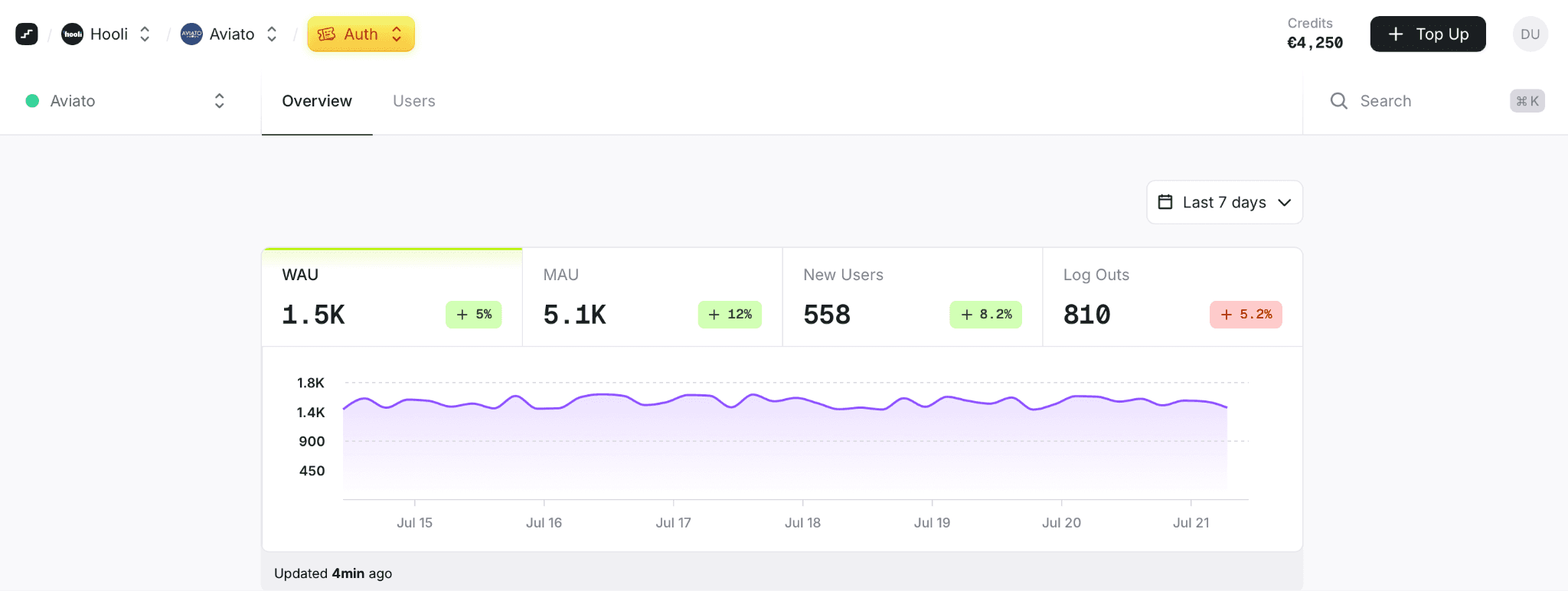
Prelude Auth is an authentication API, covering OTP, password, social, and SAML SSO login, session management, and step-up authentication for sensitive actions, built to share signal directly with Prelude's own phone verification and fraud-detection products rather than operate as a standalone auth layer.
That's the different assumption it starts from: instead of treating authentication, fraud evaluation, and session trust as separate systems that exchange information after login, Prelude treats them as different parts of the same identity decision.
The key idea is that verification shouldn't end once a user signs in. Instead, verification signals, such as device identity, network fingerprint, previous verification events, and fraud intelligence, carry forward into every authentication decision that follows. Authentication becomes cumulative rather than stateless.
That approach becomes increasingly valuable for applications serving enterprise users, high-value workflows, financial operations, or AI agents acting on behalf of users, where the question isn't simply "Who logged in?" but "How much confidence do we have in this session right now?"
In practice, that changes how authentication behaves.
Step-up challenges route through a webhook to your own backend, so you decide whether to challenge, block, or grant with full context, rather than following a fixed platform rule.
It also reduces unnecessary friction. A user who already proved their identity via OTP to log in isn't asked to re-verify to change their password minutes later, since the session tracks that state instead of treating auth and fraud as two disconnected systems.
Token security runs on RFC 9449 DPoP and PKCE at the protocol level, SAML SSO is available from day one, and it's SOC 2 Type II, ISO 27001, GDPR-ready, and EU-hosted, with authentication data hosted entirely in Europe and no exposure to the US CLOUD Act, relevant if Auth0 being part of a US group (Okta) matters for your compliance posture. Pricing uses the same per-MAU model as Auth0, without the sharp tier jumps that come from crossing a connection or user-count boundary.
It’s not the right answer for every team. If your biggest priority is shipping a polished sign-in experience for a new startup this afternoon, Clerk may be the faster choice. If your biggest challenge is adding enterprise SSO to an existing B2B product, WorkOS remains exceptionally strong. Prelude Auth becomes more compelling once authentication, fraud, and identity context start overlapping, and you no longer want those decisions made by three separate systems.
Which Platform is Right For You?
If your priority is... | Consider... |
AWS-native infrastructure | Amazon Cognito |
Enterprise identity | WorkOS |
Open-source control | Keycloak or FusionAuth |
Fastest developer experience | Clerk |
Flexible authentication APIs | Stytch |
Modern TypeScript applications | Better Auth |
Startup-friendly managed auth | Stack Auth |
Authentication combined with identity context and fraud evaluation | Prelude Auth |
The most useful question isn't which platform has the most features. It's which platform matches the security model your application will need six months from now.
As applications increasingly serve employees, customers, automated workflows, and AI agents, authentication is becoming one layer of a much broader identity problem. Platforms that separate authentication from identity context leave engineering teams to connect those systems themselves. Platforms that combine authentication with session trust and fraud evaluation reduce that integration burden while giving security teams more context for every access decision.
FAQs
What's the best Auth0 alternative for a startup?
Depends on what you need most. Clerk is the fastest to implement if you want polished UI components out of the box. Stack Auth and Better Auth are free and open source if you'd rather avoid a vendor relationship entirely while you're pre-fraud-exposure.
What's the best Auth0 alternative for B2B SaaS selling into enterprise accounts?
WorkOS, specifically for fast SAML and SCIM implementation. It also shipped Step-Up Auth in July 2026, closing a gap that used to be a reason to look elsewhere.
Is there a free, open-source Auth0 alternative?
Yes, several: Keycloak, FusionAuth, Stack Auth, and Better Auth all avoid per-user licensing. The tradeoff is operational ownership, you're running the infrastructure and, in most cases, building or buying fraud detection separately.
What's the cheapest Auth0 alternative at scale?
AWS Cognito, if you're already running on AWS. Its free tier and per-user costs undercut Auth0 meaningfully, though adaptive authentication and real fraud coverage require assembling additional AWS services on top.
Which Auth0 alternative includes fraud detection as part of authentication, not a separate product?
This is the smallest group. Stytch built device fingerprinting into adaptive MFA from the start, though it's now part of Twilio. Prelude Auth shares signal directly with its own verification and fraud-detection products rather than treating them as separate purchases.
Can I migrate off Auth0 without forcing every user to log in again?
It depends on the platform. Prelude Auth, for example, supports importing existing sessions and custom claims directly, so users don't get forced into a mass password reset during the switch. Not every alternative here handles migration the same way, some do require a credential reset as part of switching, so it's worth checking this specifically for whichever platform you're evaluating before committing.
See How Prelude Auth Fits Your Stack
If fraud exposure, agent traffic, or session trust are part of why you're evaluating alternatives, talk to the Auth team about your specific setup.
If you're looking for an Auth0 alternative, you're probably not looking for authentication alone.
You're evaluating how much of your identity stack you want one platform to own, how much you want to build yourself, and whether your authentication system can keep up with enterprise customers, fraud, and AI agents acting on behalf of your users.
Auth0 remains one of the most mature identity platforms available, and for many teams it's still the right choice.
But the market has shifted meaningfully over the last few years. New platforms have emerged with different priorities: developer experience, enterprise SSO, open source control, or authentication that's tightly coupled with fraud and session trust rather than relying on separate systems downstream.
What follows is a framework for evaluating the tradeoffs different platforms make, so you can choose the one that best fits your architecture.
How we Evaluated These Platforms
Rather than ranking products by feature count, we evaluated them across six dimensions:
Authentication capabilities
Authorization
Identity context
Enterprise readiness
Developer experience
Total cost of ownership
Specific pricing, tier limits, and feature launches referenced below reflect what was publicly documented as of mid-2026. This space moves fast, every vendor here ships new capabilities and adjusts pricing regularly. The six dimensions above are built to hold up regardless: they're how to compare any of these platforms a year from now, too. The specific numbers and features below are a snapshot, not a guarantee, confirm anything that matters directly with the vendor before deciding.
Start With the Question Behind the Question
Teams usually start searching for an Auth0 alternative for one of five reasons:
Pricing becomes difficult to predict as users or enterprise customers grow. Auth0's free tier covers 25,000 MAU, genuinely generous, but each enterprise SSO connection eats into a hard cap, three on the B2B Essentials plan, five on Professional, before a sixth customer forces a jump to custom, contact-sales Enterprise pricing.
Authentication turns out to be one piece of a broader problem that includes fraud detection, device trust, and AI agent identity.
They want more control over infrastructure and where user data lives.
They want a simpler developer experience than a dashboard-heavy identity platform.
They're replacing a homegrown authentication system and want to avoid creating another one.
The important point is that these are different problems. A team that's outgrown Auth0's SSO connection limits shouldn't necessarily land on the same alternative as a team trying to reduce fraud losses or support AI agents.
Understanding why you're looking elsewhere usually determines which alternative actually fits.
A Framework for Evaluating Authentication Platforms
Nearly every mature authentication platform now supports passkeys, OAuth, SAML, social login, and MFA. The real differences sit elsewhere.
Evaluation area | Questions to ask |
Authentication | Does it support every login method you need? |
Authorization | Can it express your permission model? |
Identity context | Does it understand devices, sessions, and risk, not just successful logins? |
Enterprise readiness | Does it support SAML, SCIM, organizations, and enterprise administration? |
Developer experience | How difficult is implementation, customization, and migration? |
Total cost of ownership | Beyond licensing, what engineering and operational costs are you taking on? |
Identity context is becoming the real differentiator
Five years ago, authentication platforms mostly competed on login methods. Today, nearly every established provider supports passkeys, passwordless authentication, social login, MFA, OAuth, and enterprise SSO.
The harder question is what happens after the user signs in. Can the platform recognize a trusted device? Detect a suspicious session? Distinguish a human from an AI agent acting on the user's behalf? Decide whether a sensitive action deserves step-up authentication?
That's what we mean by identity context. It's becoming one of the biggest differences between authentication platforms, not because authentication itself has become less important, but because modern applications increasingly need context alongside authentication before making high-value security decisions.
Prelude answers that identity-context question directly for teams whose evaluation is really about what happens after login. The Auth product recognizes trusted devices, catches suspicious sessions, tells a human from an AI agent acting on a user's behalf, and decides when a sensitive action needs step-up authentication, the layer most identity platforms only handle partially, if at all.
Leading Auth0 Alternatives
Clerk
Best for: Fast developer experience for startups and product teams.
Clerk is a hosted authentication platform that focuses on reducing implementation time with polished UI components, framework-native SDKs, and a developer experience that's difficult to beat for greenfield applications.
Its pricing has also become significantly more generous with the introduction of Monthly Retained Users (MRU), making the effective free tier substantially larger than the previous MAU-based model.
Clerk supports step-up authentication through its Reverification feature, so that's not a gap. Where it's thinner is depth of signal underneath that step-up trigger: bot and credential-stuffing protection are dashboard-level toggles rather than a continuous risk score, so there isn't much for a step-up decision to react to beyond "new device" or "MFA enabled." If your biggest priority is shipping authentication quickly and your fraud exposure is low, Clerk is one of the strongest options available.
WorkOS
Best for: Enterprise SSO and B2B infrastructure.
WorkOS is an enterprise identity platform that earned its reputation by making enterprise identity dramatically easier to implement, particularly SAML, SCIM, and directory synchronization. AuthKit, its consumer-facing layer, is free up to 1 million MAU, with SSO connections priced per connection rather than bundled in.
WorkOS shipped Step-Up Auth in July 2026, closing a gap that existed as recently as mid-2026. Its fraud product, Radar, is built into AuthKit's own sign-in flow rather than bolted on separately, though its response is still binary, block or challenge, not something that adjusts a session's ongoing access. For teams selling into enterprise customers, WorkOS remains one of the strongest choices.
Amazon Cognito
Best for: Organizations already invested in AWS.
Amazon Cognito is AWS's managed user-authentication service, and it continues to offer compelling economics for companies already running on AWS, particularly when tightly integrated with Lambda, IAM, and API Gateway. Its free tier depends on which pricing tier and account vintage you're on, up to 50,000 MAU for accounts predating AWS's November 2024 restructuring, a smaller default allotment for new pools on the Essentials tier, worth checking directly.
The tradeoff is complexity. Adaptive authentication and compromised-credential detection sit behind the paid Plus tier, and real fraud protection means assembling additional AWS services: WAF for traffic-layer protection, Amazon Fraud Detector for ML-based scoring, and for SMS-specific fraud, a documented integration with Vonage's network-level authentication and Fraud Defender tools. That flexibility is valuable for some teams but increases operational complexity compared to more opinionated managed platforms.
Keycloak and FusionAuth
Best for: Organizations that prioritize ownership and infrastructure control.
Keycloak and FusionAuth are open-source, self-hostable identity platforms that appeal to engineering teams that want to avoid vendor lock-in, and retain full control over user data. Keycloak became a CNCF incubating project in 2023 but is still primarily developed and sponsored by Red Hat; FusionAuth is developer-first and self-hostable with a full feature set. Both are mature and standards-compliant on core authentication.
The tradeoff is operational ownership. Keycloak's abuse protection tops out at reCAPTCHA; teams are responsible not only for running the identity platform itself, but for integrating third-party systems when they need richer fraud detection, device reputation, or continuous session evaluation.
Stytch
Best for: Flexible authentication APIs and passwordless-first applications.
Stytch is a developer-first authentication API provider that has consistently emphasized developer-friendly authentication APIs and strong support for passwordless authentication. Its approach to device fingerprinting feeding directly into adaptive MFA gives developers more identity context than most authentication platforms, making it one of the few developer-first options with real fraud signal built in rather than bolted on.
Twilio completed its acquisition of Stytch on November 14, 2025. The product hasn't changed as a result, but organizations evaluating Stytch today should factor in that they're choosing a piece of a much larger communications platform's roadmap rather than a standalone developer tool.
Stack Auth and Better Auth
Best for: Modern startups and TypeScript-first applications.
Stack Auth is an open-source authentication library that has gained momentum by focusing on developer experience and reducing vendor lock-in, positioned as a full open-source Auth0/Clerk alternative.
Better Auth started the same way, a TypeScript-first framework that runs on your own backend rather than as a hosted service, and had already absorbed Auth.js/NextAuth.js before Vercel acquired it in July 2026. Vercel's own announcement says it's staying open source and framework-agnostic, and names its next focus explicitly: securing agentic workflows, under an Agent Auth Protocol it had already started before the acquisition. If agent identity is part of why you're evaluating alternatives in the first place, this is worth knowing: Better Auth is no longer a small independent project. It's now backed by Vercel's resources and working on exactly that problem.
Neither positions integrated fraud evaluation as a core part of the platform today. For many early-stage teams, that's perfectly reasonable, it isn't the problem they're solving yet. Better Auth specifically is worth revisiting again once its Vercel-backed agent-auth work ships, since that's a live, moving target rather than a settled gap.
Where Prelude Auth Fits
Every platform above optimizes for a different tradeoff. Clerk optimizes for developer velocity. WorkOS optimizes for enterprise identity. Cognito optimizes for AWS integration and cost. Keycloak and FusionAuth optimize for ownership. Stack Auth and Better Auth optimize for openness and developer control.
Best for: Teams that want authentication, fraud detection, and session trust to work as one system instead of three.
That's visible in the product itself, not just the pitch: the product switcher in the top nav lets you move between Auth, Verify, Watch, and the rest without leaving the dashboard or switching accounts, number intelligence, verification, and anti-fraud sit next to auth, rather than living in a separate product you have to stitch together yourself.
Prelude Auth is an authentication API, covering OTP, password, social, and SAML SSO login, session management, and step-up authentication for sensitive actions, built to share signal directly with Prelude's own phone verification and fraud-detection products rather than operate as a standalone auth layer.
That's the different assumption it starts from: instead of treating authentication, fraud evaluation, and session trust as separate systems that exchange information after login, Prelude treats them as different parts of the same identity decision.
The key idea is that verification shouldn't end once a user signs in. Instead, verification signals, such as device identity, network fingerprint, previous verification events, and fraud intelligence, carry forward into every authentication decision that follows. Authentication becomes cumulative rather than stateless.
That approach becomes increasingly valuable for applications serving enterprise users, high-value workflows, financial operations, or AI agents acting on behalf of users, where the question isn't simply "Who logged in?" but "How much confidence do we have in this session right now?"
In practice, that changes how authentication behaves.
Step-up challenges route through a webhook to your own backend, so you decide whether to challenge, block, or grant with full context, rather than following a fixed platform rule.
It also reduces unnecessary friction. A user who already proved their identity via OTP to log in isn't asked to re-verify to change their password minutes later, since the session tracks that state instead of treating auth and fraud as two disconnected systems.
Token security runs on RFC 9449 DPoP and PKCE at the protocol level, SAML SSO is available from day one, and it's SOC 2 Type II, ISO 27001, GDPR-ready, and EU-hosted, with authentication data hosted entirely in Europe and no exposure to the US CLOUD Act, relevant if Auth0 being part of a US group (Okta) matters for your compliance posture. Pricing uses the same per-MAU model as Auth0, without the sharp tier jumps that come from crossing a connection or user-count boundary.
It’s not the right answer for every team. If your biggest priority is shipping a polished sign-in experience for a new startup this afternoon, Clerk may be the faster choice. If your biggest challenge is adding enterprise SSO to an existing B2B product, WorkOS remains exceptionally strong. Prelude Auth becomes more compelling once authentication, fraud, and identity context start overlapping, and you no longer want those decisions made by three separate systems.
Which Platform is Right For You?
If your priority is... | Consider... |
AWS-native infrastructure | Amazon Cognito |
Enterprise identity | WorkOS |
Open-source control | Keycloak or FusionAuth |
Fastest developer experience | Clerk |
Flexible authentication APIs | Stytch |
Modern TypeScript applications | Better Auth |
Startup-friendly managed auth | Stack Auth |
Authentication combined with identity context and fraud evaluation | Prelude Auth |
The most useful question isn't which platform has the most features. It's which platform matches the security model your application will need six months from now.
As applications increasingly serve employees, customers, automated workflows, and AI agents, authentication is becoming one layer of a much broader identity problem. Platforms that separate authentication from identity context leave engineering teams to connect those systems themselves. Platforms that combine authentication with session trust and fraud evaluation reduce that integration burden while giving security teams more context for every access decision.
FAQs
What's the best Auth0 alternative for a startup?
Depends on what you need most. Clerk is the fastest to implement if you want polished UI components out of the box. Stack Auth and Better Auth are free and open source if you'd rather avoid a vendor relationship entirely while you're pre-fraud-exposure.
What's the best Auth0 alternative for B2B SaaS selling into enterprise accounts?
WorkOS, specifically for fast SAML and SCIM implementation. It also shipped Step-Up Auth in July 2026, closing a gap that used to be a reason to look elsewhere.
Is there a free, open-source Auth0 alternative?
Yes, several: Keycloak, FusionAuth, Stack Auth, and Better Auth all avoid per-user licensing. The tradeoff is operational ownership, you're running the infrastructure and, in most cases, building or buying fraud detection separately.
What's the cheapest Auth0 alternative at scale?
AWS Cognito, if you're already running on AWS. Its free tier and per-user costs undercut Auth0 meaningfully, though adaptive authentication and real fraud coverage require assembling additional AWS services on top.
Which Auth0 alternative includes fraud detection as part of authentication, not a separate product?
This is the smallest group. Stytch built device fingerprinting into adaptive MFA from the start, though it's now part of Twilio. Prelude Auth shares signal directly with its own verification and fraud-detection products rather than treating them as separate purchases.
Can I migrate off Auth0 without forcing every user to log in again?
It depends on the platform. Prelude Auth, for example, supports importing existing sessions and custom claims directly, so users don't get forced into a mass password reset during the switch. Not every alternative here handles migration the same way, some do require a credential reset as part of switching, so it's worth checking this specifically for whichever platform you're evaluating before committing.
See How Prelude Auth Fits Your Stack
If fraud exposure, agent traffic, or session trust are part of why you're evaluating alternatives, talk to the Auth team about your specific setup.
Start optimizing your auth flow
Send verification text-messages anywhere in the world with the best price, the best deliverability and no spam.