
You Acquired 1,000 Users Last Month. How Many of Them Were Real?
In the AI era, good bots and bad bots are really difficult to tell apart. This is what Prelude presented at Web Summit on how to approve only legitimate users.

Rowan Haddad
Content & SEO Manager
Summary
AI agents and bad bots now look the same at signup. Prelude CEO Matias Berny explains how to tell good bots from bad ones, the 5 bot detection techniques that make attacks expensive, and how one social app blocked 400 million bad requests.
You acquired 1,000 users last month. How many of them were real?
That's the question Matias Berny, CEO of Prelude, opened with at Web Summit Lisbon 2026. If your answer is "all of them," he told the room, you're either very lucky or very good at fundraising. Most teams simply don't know.
The difference between good bots vs bad bots comes down to intent: a good bot does something you or your users want, like indexing your site or booking a ticket for a real customer. A bad bot abuses your platform, by scraping it, scalping inventory or opening accounts that no human will ever use. In 2026, the two often look identical at your signup form, so telling them apart takes layered checks, not a single filter.
This article breaks down the framework Berny shared, drawing on what Prelude sees across more than 1 billion authentications.
Good Bots vs Bad Bots: What's the Difference?
Bots now generate most of the traffic on the internet. According to the Thales 2026 Bad Bot Report, bots made up 53% of all internet traffic in 2025, and bad bots alone accounted for 40%. That leaves roughly 13% for good bots.
Good bots | Bad bots | |
What they do | Index pages, monitor uptime, act for a real user | Scrape, scalp, spam, create accounts at scale |
Who benefits | You or your users | The attacker |
Typical examples | Search engine crawlers, site monitoring bots, AI agents acting for a real user | Scalper bots, bot farms, SMS pumping scripts |
How to handle them | Allow, ideally once they identify themselves | Make every attempt expensive, then block |
How Prelude handles them | Lets requests that Prelude scores as legitimate continue to signup | Prelude Verify and Watch score each signup, then block or challenge suspicious requests before a code is sent |
The line used to be easy to draw. Good bots announced themselves, and bad bots tried to hide. AI agents have blurred it.
Why AI Made Good Bots and Bad Bots Harder to Tell Apart
In B2B software, AI agents mostly act through scoped API tokens that limit what they can do. Consumer apps are different. Many AI agents act there by driving a real browser, exactly like a person would, because there's still no shared identity standard for agents.
Visa, Mastercard and OpenAI have each launched their own agentic commerce protocols, with no consensus between them. Until one wins, a helpful agent and a scalper bot hit your signup form the same way.
Bad bots benefit from the same AI boom. Anyone can now describe a bot in a single prompt and get one that buys every ticket for a sold-out show. Berny lists DDoS attacks, fake users, scalping and scams as threats that are all growing with LLMs, and Thales reports that daily AI-driven bot attacks grew more than tenfold in 2025, from 2 million to 25 million.
What Bad Bots Cost a Consumer App
Bad bots rarely announce themselves. Most teams notice them only when the damage shows up in their metrics or their SMS bill.
Messaging costs: bots that request OTPs to fake numbers inflate your SMS spend, a pattern known as SMS pumping.
Distorted growth metrics: daily active users, retention, lifetime value and acquisition cost all become unreliable when you can't tell humans from bots.
Fake accounts downstream: bots open accounts for promo abuse, scams and fake account creation at scale.
Account takeovers: bots replay passwords leaked in past breaches against your login form, a pattern known as credential stuffing.
As Berny put it: if you don't know a human from a bot, how can you be sure that what you measure is real?
5 Bot Detection Techniques That Stop Bad Bots at Signup
Blocking every bad bot isn't possible, and no platform can honestly promise it. What you can do is make each attempt cost more than it's worth. Each technique below raises that cost and catches bots that slipped past the previous one.
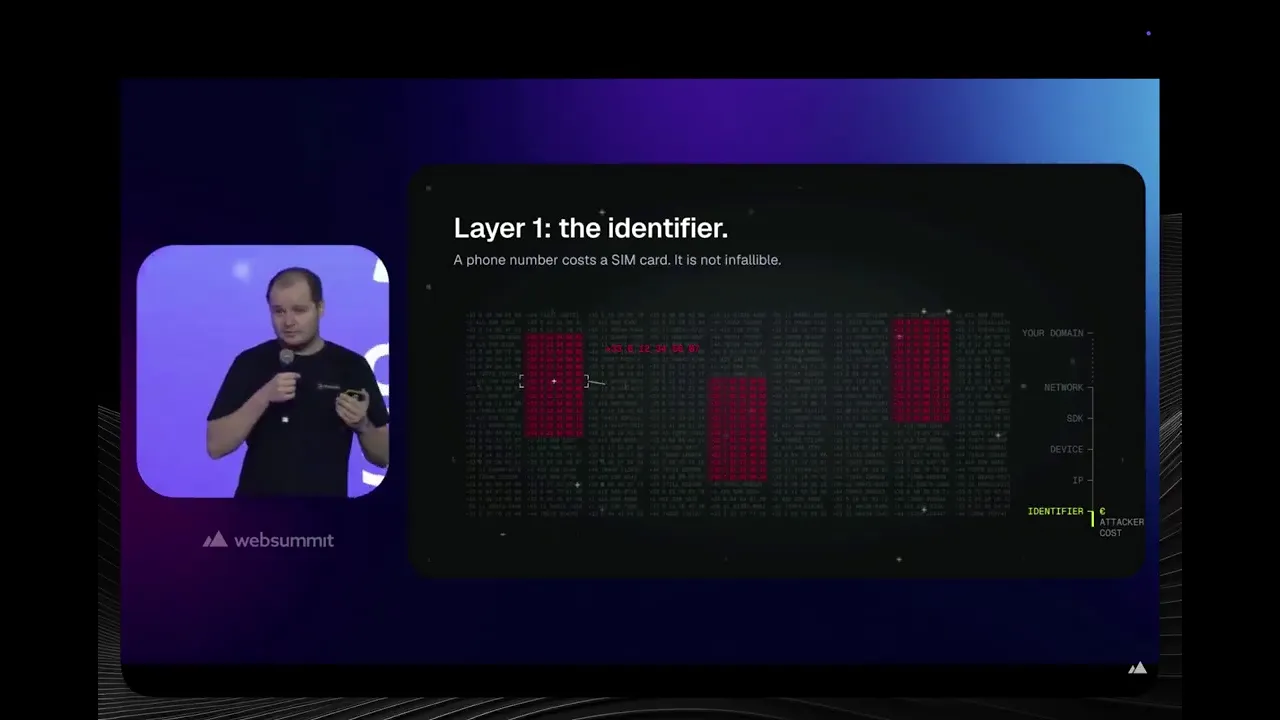
1. Pick an identifier that costs something
In a consumer app, users sign up with one of two identifiers: an email address (directly, or through Google or Apple sign-in) or a phone number.
An email costs nothing. Berny points out that an attacker can create 10,000 email addresses in about 10 minutes. A phone number requires a SIM card, which adds the first real cost to every bot account. It's not bulletproof, since virtual and disposable numbers exist, but it raises the bar.
Prelude's Verify API screens every phone verification for fraud and can block a suspicious request before any code is sent.
2. Check the IP address, but don't stop there
IP intelligence databases tell you a request's country and whether the IP belongs to a data center. That's useful, but it only filters out lazy bots.
Most serious scrapers and attackers now route traffic through residential proxies, so each request appears to come from a different home connection. To catch them, you need to go deeper.
3. Look at the device
Device signals let you limit how many accounts a single device can create. If one device is behind 10 signups, that's a clear signal.
Bots adapt here too. Berny describes emulators that can impersonate 14 devices at once: one machine wearing 14 different costumes. Device checks need support from the next layers.
Prelude's Frontend SDKs for Web, iOS, Android, React Native and Flutter collect device signals at signup and pass them to Prelude's anti-fraud system with each verification.
4. Confirm requests come from your own app
An app integrity SDK confirms that each action really comes from your website or app, not from a script calling your API directly.
This stops a lot of automation, but not bot farms: racks of real phones stacked on shelves, each running your genuine app. That's what the fifth technique is for.
With Prelude, teams can enforce SDK signatures per platform, so a verification is blocked unless it was started from a device that ran the Prelude SDK.
5. Inspect the network
Network signals expose lies the other layers can't. A request might claim to come from an Apple device while its connection behaves like Linux. It might claim to be in Lisbon while its latency says it's much farther away.
Berny notes that a platform that reaches this layer is already better protected than most websites. Prelude's Watch API scores signups using network-level signals, including IP and JA4 fingerprints, alongside device data.
The 5 techniques at a glance
Technique | What it checks | What gets past it | How Prelude covers it |
1. Identifier | Email vs phone number | Virtual and disposable numbers | Verify API fraud screening before a code is sent |
2. IP address | Country, data center IPs | Residential proxies | IP signals in Verify and Watch |
3. Device | Accounts per device | Emulators posing as many devices | Frontend SDK device signals |
4. App integrity | Requests come from your app | Bot farms of real phones | SDK signature enforcement |
5. Network | OS and location consistency | Very few attackers | Watch API network signals such as JA4 |
The Real Test: Is This Action Legitimate?
The five techniques answer one question: is this user real? For good bots vs bad bots, behavioral analysis asks a better one: is this action legitimate?
That shift matters because a legitimate bot can behave exactly like a bad bot, or like a human. A real person's AI agent booking one ticket is fine. A thousand agents booking every seat to resell them is not. Tracking behavior across the whole session, not just the signup, is how you tell them apart.
Protection is a Process, Not a Switch
You don't need to deploy every layer at once. Berny shared how Prelude rolled out bot protection for one of the world's top 10 social media apps, in three stages:
Start where fraud costs the most. The team first protected paid users.
Expand to every new user. Once paid users were secure, Prelude verified all users entering the platform, across hundreds of millions of requests.
Move the check before signup. Finally, requests were scored for likely illegitimate activity before the user even signed up.
The results: out of 600 million requests scanned, Prelude blocked 400 million, with a false positive rate under 0.1%. The app saved €10 million in SMS costs alone, plus the harder-to-measure value of keeping a platform built for human interaction actually human. The protection was then rolled out across the entire app.
Three Questions to Ask Your Team
Berny closed with three questions every growth and product team should be able to answer:
What share of activity on your platform comes from good bots, and what share from bad bots?
How do you measure it?
Which defense layers do you have in place today?
Your market size, daily active users, retention, lifetime value and acquisition cost all depend on those answers.
Watch the Full Talk
This article covers the core ideas but the talk is worth eight minutes of your time. Watch Matias Berny's full Web Summit 2026 session, You Onboarded 1,000 Users. How Many Were Real? below.
FAQs
What’s the difference between good bots and bad bots?
Good bots perform tasks that benefit a website or its users, such as search engine crawling or an AI agent acting for a real customer. Bad bots abuse a platform through scraping, scalping, spam, credential stuffing or mass account creation.
What are examples of good bots?
Cloudflare lists search engine crawlers, site monitoring bots and personal assistant bots among common good bots. An AI agent acting for a real, consenting user fits the same category, as long as what it does is legitimate.
Are AI agents good bots or bad bots?
It depends on the action, not the technology. An AI agent booking one ticket for its user is legitimate, while the same tooling used to buy every ticket for resale is abuse. That's why Prelude recommends judging whether each action is legitimate, not only whether the user is human.
How do you detect bad bots at signup?
Stack several checks rather than relying on one. Prelude recommends five layers: a phone number identifier, IP checks, device signals, app integrity verification and network analysis, followed by behavioral monitoring after signup.
How much internet traffic comes from bots?
According to the Thales 2026 Bad Bot Report, bots generated 53% of internet traffic in 2025, and bad bots made up 40% of all traffic.
Keep Bad Bots Out Without Blocking the Good Ones
Prelude helps teams check that the people they onboard actually exist. Prelude Verify screens every verification for fraud before a code is sent, and Prelude Watch scores signups by phone number or email using IP, device and network signals. See how Prelude Watch works or talk to the team.
Start optimizing your auth flow
Send verification text-messages anywhere in the world with the best price, the best deliverability and no spam.